Midpoint sums | Accumulation and Riemann sums | AP Calculus AB | Khan Academy
TL;DR
Learn how to estimate the area under a curve by dividing it into rectangles and defining their heights using different methods.
Transcript
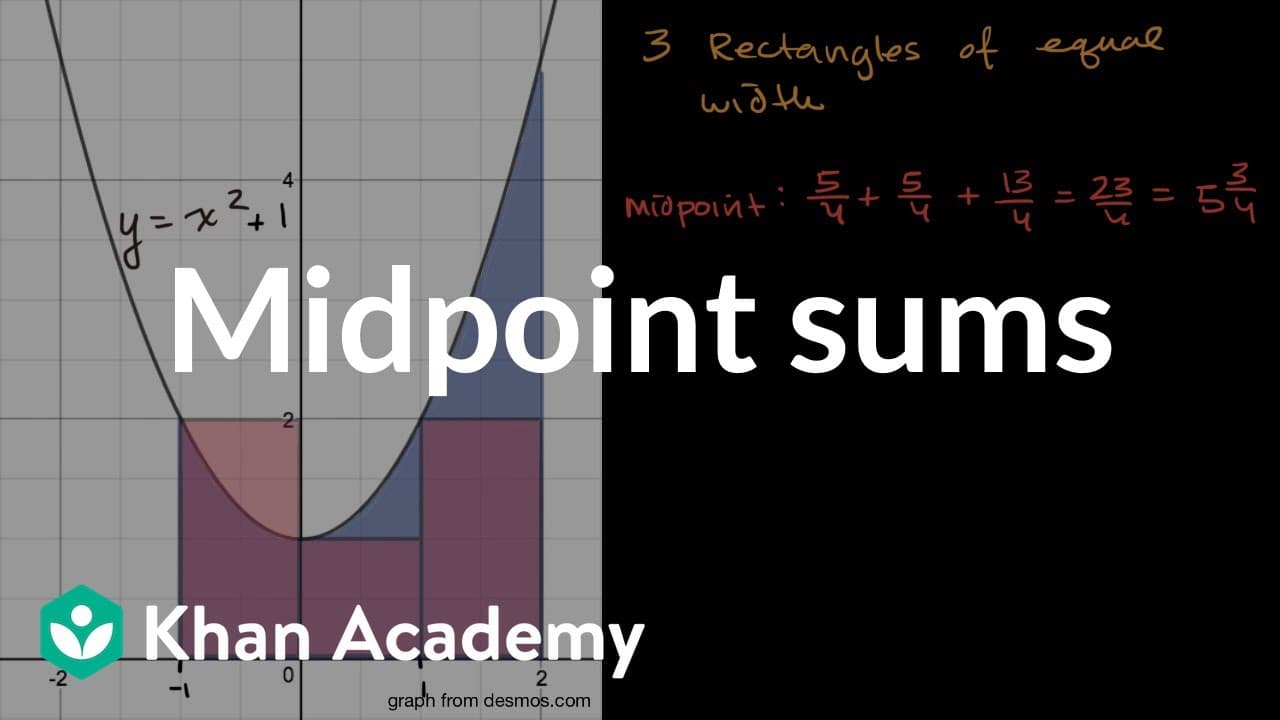
- [Instructor] What we wanna do in this video is get an understanding of how we can approximate the area under a curve. And for the sake of an example, we'll use the curve y is equal to x squared plus one. And let's think about the area under this curve, above the x-axis, from x equals negative one to x equals two. So that would be this area right ... Read More
Key Insights
- 🎮 The video demonstrates how to approximate the area under a curve using rectangles.
- 🗂️ Dividing the curve into equal sections helps create a more accurate estimation.
- 🎚️ Different methods of defining the heights of the rectangles result in varying levels of approximation.
- 🪜 Adding more rectangles with narrower bases improves the precision of the approximation.
- ❓ Midpoint approximation is one of the methods used to estimate the area under a curve.
- 🗯️ Left endpoint approximation tends to underestimate the area, while right endpoint approximation tends to overestimate it.
- 🪡 The choice of approximation method depends on the specific requirements and accuracy needed.
Install to Summarize YouTube Videos and Get Transcripts
Explore YouTube Video Summarizer or Get YouTube Transcript Extractor
Questions & Answers
Q: How can we approximate the area under a curve?
The video demonstrates the process of dividing the curve into rectangles and using their areas to estimate the overall area under the curve.
Q: What are the different ways to define the heights of the rectangles?
The heights of the rectangles can be determined using the midpoint, left endpoint, or right endpoint of each section. Each method provides a different approximation of the area.
Q: How does using the midpoint to define the heights of the rectangles affect the approximation?
Using the midpoint ensures that each rectangle encompasses both above and below the curve, providing a relatively accurate estimation of the area.
Q: What are the advantages and disadvantages of using left and right endpoints?
Defining the heights of the rectangles using left endpoints tends to underestimate the area, while using right endpoints tends to overestimate it. It depends on the context and desired level of approximation.
Summary & Key Takeaways
-
The video explains how to estimate the area under a curve by dividing it into equal sections and using rectangles as approximations.
-
Three rectangles with equal width are used to represent the area under the curve.
-
The heights of the rectangles can be defined using the midpoint, left endpoint, or right endpoint of each section.
Read in Other Languages (beta)
Share This Summary 📚
Summarize YouTube Videos and Get Video Transcripts with 1-Click
Try YouTube Summary with ChatGPT & Claude or YouTube Transcript Generator
Explore More Summaries from Khan Academy 📚



Summarize YouTube Videos and Get Video Transcripts with 1-Click
Try YouTube Summary with ChatGPT & Claude or YouTube Transcript Generator