Types of indifference curves | Microeconomics | Khan Academy
TL;DR
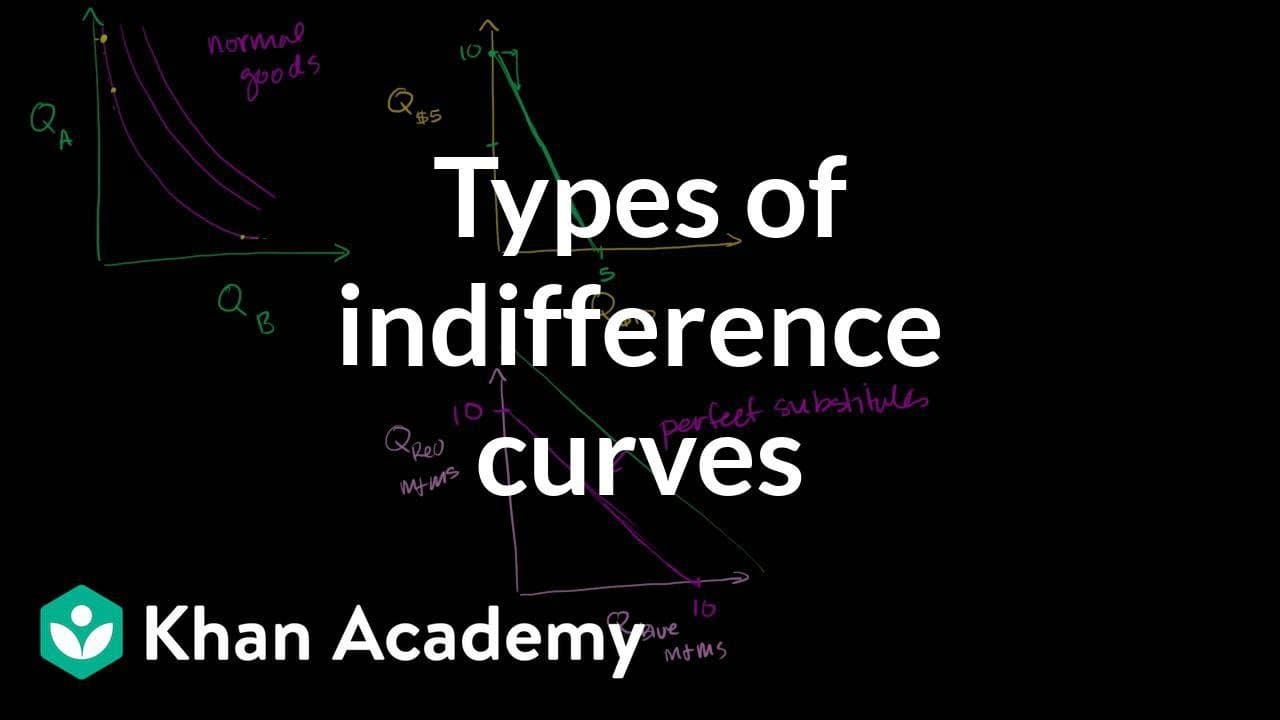
Indifference curves represent the combinations of goods that provide the same level of utility. Different types of goods result in different shapes of indifference curves.
Transcript
I've been drawing my indifference curves to look something like this. So that's the vertical axis. That's one good. So this is the quantity of good A. This is the quantity of good B. And I've been drawing the indifference curves like this. So it might look like that. That's one indifference curve. Then another indifference curve would look like tha... Read More
Key Insights
- 👋 Indifference curves depict the combinations of goods that provide equal levels of utility.
- 👋 Normal goods have inward bow-shaped indifference curves, representing varying trade-offs between the goods.
- 💯 Linear indifference curves indicate perfect substitutes, where goods can be easily substituted based on value.
- 👋 Perfect complements result in indifference curves where both goods must be paired, and increasing one without a corresponding increase in the other does not provide additional utility.
- 💯 Indifference curves for perfect substitutes have a slope of -1, while perfect complements have vertical or horizontal portions.
- ❓ Intersecting indifference curves would violate the principle of rational choice.
Install to Summarize YouTube Videos and Get Transcripts
Explore YouTube Video Summarizer or Get YouTube Transcript Extractor
Questions & Answers
Q: Why do indifference curves have an inward bow shape for normal goods?
Indifference curves for normal goods have an inward bow shape because when one good (e.g., good A) is abundant, individuals are willing to trade more of it for a smaller amount of the other good (B). As the abundance of good B increases, they become less willing to trade off more of good A, resulting in the curved shape.
Q: What does a linear indifference curve represent?
A linear indifference curve represents goods that are perfect substitutes. The slope of -1 indicates that individuals are willing to trade one unit of one good for one unit of the other, regardless of the quantities involved.
Q: How are perfect substitutes different from perfect complements?
Perfect substitutes are goods that can be easily substituted for each other based on their value, while perfect complements are goods that are used together and cannot be substituted. In the case of perfect substitutes, the indifference curve has a slope of -1, whereas perfect complements have indifference curves with a vertical or horizontal portion.
Q: Can indifference curves intersect?
No, indifference curves cannot intersect. If they did, it would imply that individuals are simultaneously willing to trade off different quantities of goods, which violates the assumption of rational choice.
Summary & Key Takeaways
-
Indifference curves illustrate the trade-offs between two normal goods, with an inward bow-shaped curve representing the varying willingness to trade goods A and B.
-
Some goods, like dollar bills, have linear indifference curves, as they can be easily substituted with each other based on their value.
-
Perfect substitutes, such as red and blue M&Ms, result in indifference curves with a slope of -1, indicating a one-for-one trade-off.
-
Perfect complements, like left and right shoes, result in indifference curves where one good must be paired with the other, and increasing one good without a corresponding increase in the other does not provide any additional utility.
Read in Other Languages (beta)
Share This Summary 📚
Summarize YouTube Videos and Get Video Transcripts with 1-Click
Try YouTube Summary with ChatGPT & Claude or YouTube Transcript Generator
Explore More Summaries from Khan Academy 📚



Summarize YouTube Videos and Get Video Transcripts with 1-Click
Try YouTube Summary with ChatGPT & Claude or YouTube Transcript Generator