Exponent rules part 1 | Exponents, radicals, and scientific notation | Pre-Algebra | Khan Academy
TL;DR
Learn how to multiply and simplify numbers with exponents by applying the rules of adding and subtracting exponents.
Transcript
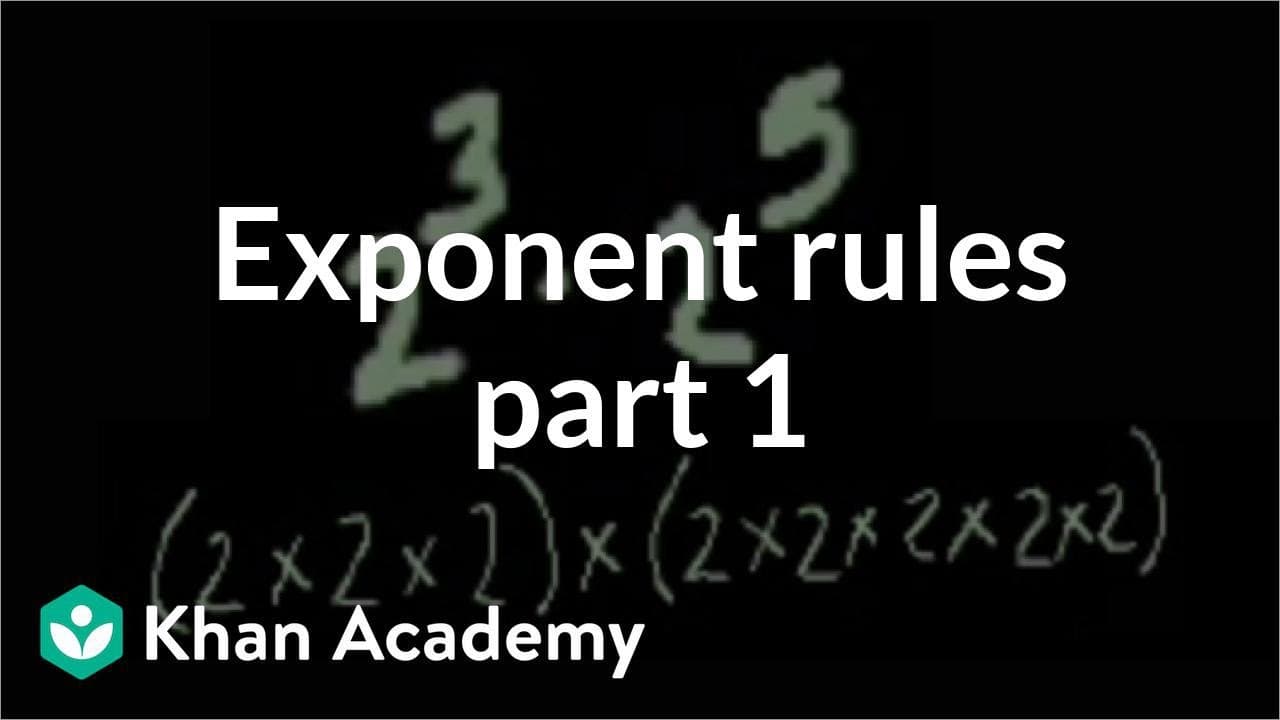
Welcome to the presentation on level one exponent rules. Let's get started with some problems. So if I were to ask you what 2 -- that's a little fatter than I wanted it to be, but let's keep it fat so it doesn't look strange -- 2 the third times -- and dot is another way of saying times -- if I were to ask you what 2 to the third times 2 to the fif... Read More
Key Insights
- 👻 Exponent rules simplify calculations by allowing us to add or subtract exponents of the same base.
- 🪜 Multiplication of exponents involves adding the exponents, while division requires subtracting the exponent in the denominator from the exponent in the numerator.
- 🍵 Exponent rules can be used to handle large numbers and make calculations more efficient.
- 📏 The same base is crucial in applying exponent rules; different bases cannot be simplified using these rules.
- 😑 Exponent rules can also be applied to negative exponents, resulting in simplified expressions.
- ⚾ The multiplication of exponents with different bases does not follow the same rules as those with the same base.
- 📔 Further understanding of rules involving exponents and their applications will be covered in the next module of the presentation.
Install to Summarize YouTube Videos and Get Transcripts
Explore YouTube Video Summarizer or Get YouTube Transcript Extractor
Questions & Answers
Q: How can exponent rules help simplify calculations with large numbers?
Exponent rules provide shortcuts for multiplying numbers with exponents by adding or subtracting exponents. This makes calculations with large numbers more manageable and less time-consuming.
Q: What happens when we multiply exponents with different bases?
Exponent rules are applicable only when the bases of the exponents being multiplied or divided are the same. When the bases are different, we cannot simplify the expression using these rules.
Q: Can the exponent rule of multiplying exponents be applied to negative exponents?
Yes, the rule of adding exponents can also be applied to negative exponents. For example, when multiplying 5 to the power of -100 with 5 to the power of 102, we can simplify it to 5 squared.
Q: Are there any exceptions to the exponent rules?
In cases where the exponents involve different bases, the rules of adding and subtracting exponents cannot be applied. The bases must be the same for the rules to be used.
Summary & Key Takeaways
-
Exponents can be multiplied by adding the exponents when the base is the same.
-
When dividing exponents with the same base, subtract the exponent in the denominator from the exponent in the numerator.
-
Multiplying a number raised to an exponent with another number raised to an exponent involves multiplying the exponents.
Read in Other Languages (beta)
Share This Summary 📚
Summarize YouTube Videos and Get Video Transcripts with 1-Click
Try YouTube Summary with ChatGPT & Claude or YouTube Transcript Generator
Explore More Summaries from Khan Academy 📚



Summarize YouTube Videos and Get Video Transcripts with 1-Click
Try YouTube Summary with ChatGPT & Claude or YouTube Transcript Generator