Oxymercuration Demercuration Reaction Mechanism
TL;DR
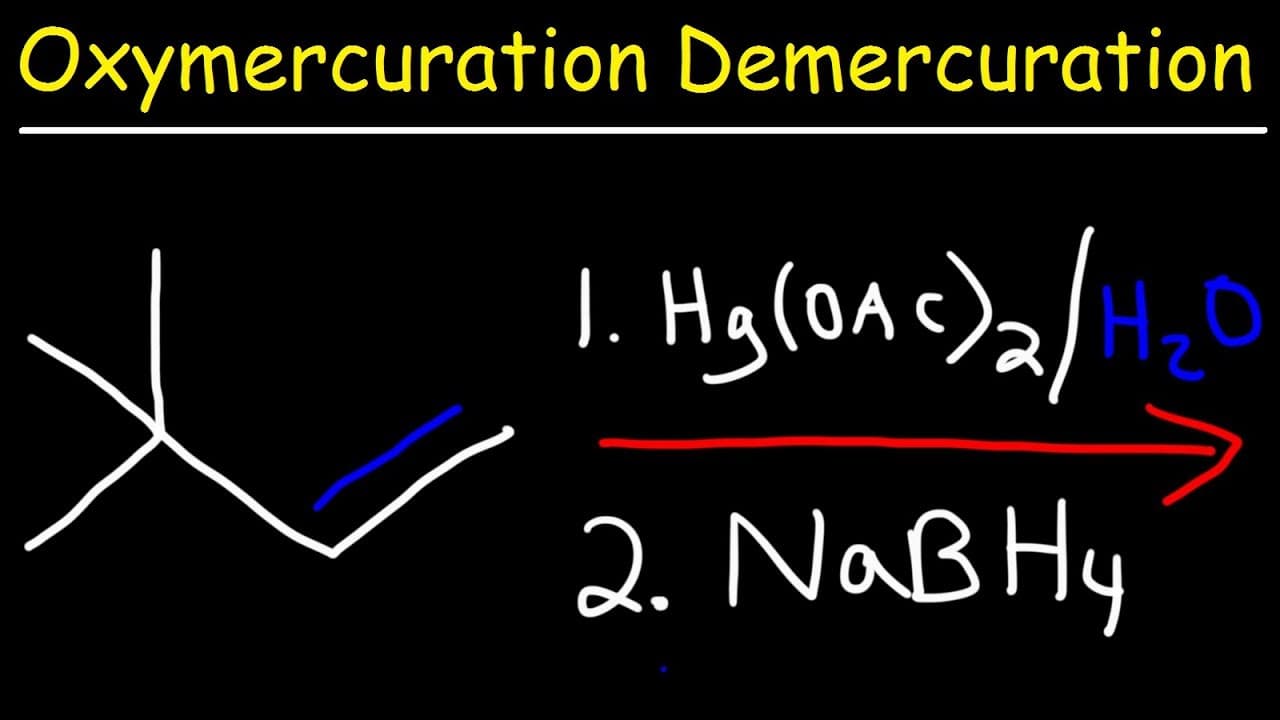
The oxymercuration demercuration reaction converts alkenes into alcohols with more karmicoff addition. The reaction is regioselective and produces a racemic mixture of stereochemical isomers.
Transcript
in this video we're going to go over the oxymercuration demercuration reaction of alkanes so let's start with one butane and so we're going to react it with mercury two acetate also known as mercuric acetate with water so this first step is called oxymercuration and in this step the oh group is going to go on the more substituted carbon of the doub... Read More
Key Insights
- ❓ Oxymercuration demercuration reaction converts alkenes into alcohols with more karmicoff addition.
- ❓ The reaction involves two steps: oxymercuration and demercuration.
- 🇦🇬 The oxymercuration step is an anti-addition reaction, while the demercuration step replaces the mercury with hydrogen.
- 👥 The reaction is regioselective, with the OH group adding to the more substituted carbon of the double bond.
- ❓ The reaction produces a racemic mixture of stereochemical isomers.
- 🈂️ The regioselectivity is determined by the partial positive charge on the carbon during the reaction.
- 😑 Demercuration occurs using sodium borohydride, which donates a hydride ion to replace the mercury.
Install to Summarize YouTube Videos and Get Transcripts
Explore YouTube Video Summarizer or Get YouTube Transcript Extractor
Questions & Answers
Q: What is the purpose of the oxymercuration demercuration reaction?
The oxymercuration demercuration reaction is used to convert alkenes into alcohols with more karmicoff addition. It is a regioselective reaction that adds an OH group to the more substituted carbon of the double bond.
Q: Why does the oxymercuration step produce a racemic mixture of stereochemical isomers?
The oxymercuration step forms an intermediate with a partially positive charged carbon, which undergoes attack by water. This results in the formation of a racemic mixture of stereoisomers because the attack can occur from either side of the alkene.
Q: How does the demercuration step remove the mercury and replace it with a hydrogen atom?
The demercuration step uses sodium borohydride as a reagent to demercurate the molecule. Sodium borohydride donates a hydride ion, which attacks the carbon bound to mercury, displacing the mercury and forming a C-H bond.
Q: Is the oxymercuration demercuration reaction regioselective?
Yes, the reaction is regioselective. The OH group adds specifically to the more substituted carbon of the alkene double bond, while the mercury atom adds to the less substituted carbon.
Summary & Key Takeaways
-
The oxymercuration step involves the addition of an OH group to the more substituted carbon of the double bond and the addition of a mercury atom to the less substituted carbon.
-
The demercuration step removes the mercury and replaces it with a hydrogen atom, resulting in the formation of an alcohol.
-
The reaction is regioselective and does not involve rearrangement of the carbon atoms.
Read in Other Languages (beta)
Share This Summary 📚
Summarize YouTube Videos and Get Video Transcripts with 1-Click
Try YouTube Summary with ChatGPT & Claude or YouTube Transcript Generator
Explore More Summaries from The Organic Chemistry Tutor 📚




Summarize YouTube Videos and Get Video Transcripts with 1-Click
Try YouTube Summary with ChatGPT & Claude or YouTube Transcript Generator