Arenediazonium Salts With Diazo Coupling and Sandmeyer Reactions
TL;DR
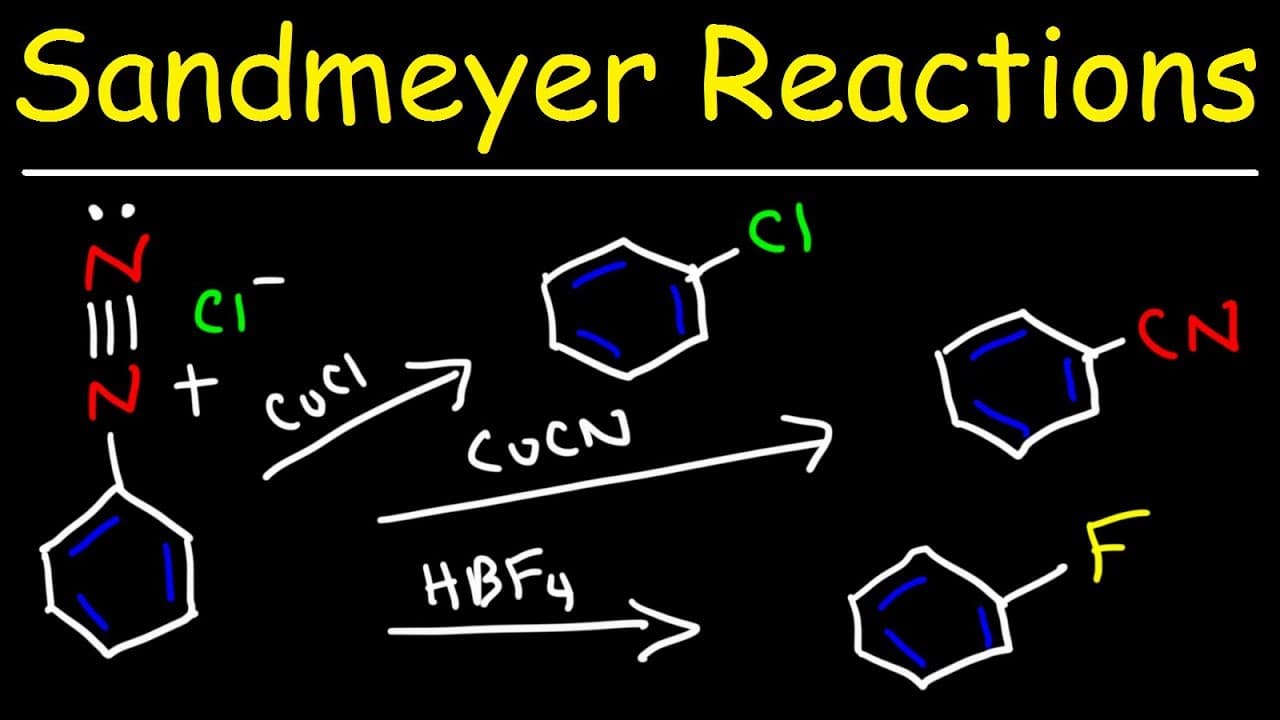
Aryl diazonium salts are made from benzene by aromatic nitration to nitrobenzene, reduction to aniline with a metal (iron, zinc, or tin) and HCl, then reaction with sodium nitrite and HCl at low temperature. Once formed, they undergo Sandmeyer reactions with copper(I) salts to install Cl, Br, CN, or I, and diazo coupling with phenol to form azo compounds. Read on for the exact reagents behind each product.
Transcript
in this video we're going to talk about airing diazonium salts the sandby reactions and diesel coupling so let's get into the material first let's talk about how we could synthesize an aryan diazonium salt so let's start with benzene now the first step is aromatic nitration so we need to install an no2 group to the ring so once we have nitrobenzene... Read More
Key Insights
- 🧂 Aromatic nitration followed by reduction and reaction with sodium nitrite is a common method for synthesizing aryl diazonium salts.
- 👥 Sandmeyer reactions allow for the substitution of the NO2 group in aryl diazonium salts with other atoms or groups, depending on the copper salt used.
- 💁 Diazo coupling reactions involve the reaction of aryl diazonium salts with nucleophilic compounds, forming azo compounds.
- 👥 Phenol, with its OH group, is a strong activating group in diazo coupling reactions, making the phenol ring highly reactive towards aryl diazonium salts.
- ❓ Different reagents and reaction conditions can be used to achieve specific substitutions in the Sandmeyer reactions and diazo coupling reactions.
- 💁 Understanding the mechanism of diazo coupling reactions helps explain the formation of azo compounds and the role of activating groups.
- 🧂 Other compounds, such as fluorobenzene and phenol, can be synthesized using aryl diazonium salts through appropriate reactions.
Install to Summarize YouTube Videos and Get Transcripts
Explore YouTube Video Summarizer or Get YouTube Transcript Extractor
Questions & Answers
Q: How do you synthesize an aryl diazonium salt from benzene?
Start with aromatic nitration to install an NO2 group and form nitrobenzene. Reduce the NO2 group to an NH2 group using a metal such as iron (zinc or tin also work) with hydrochloric acid, giving aniline. Finally, react the aniline with sodium nitrite and hydrochloric acid at low temperature; the nitrite and hydrogen combine into nitrous acid, and the result is the aryl diazonium salt with a nitrogen-nitrogen triple bond and a chloride counterion.
Q: What products can Sandmeyer reactions make from an aryl diazonium salt?
Reacting the aryl diazonium salt with a copper(I) salt replaces the N2 group with a new atom or group. Copper(I) chloride gives chlorobenzene, copper bromide gives bromobenzene, copper cyanide installs a CN group, and copper(I) iodide (or potassium iodide) installs iodine. The specific copper salt you choose determines the substitution.
Q: Why do Sandmeyer and related reactions of diazonium salts go forward so readily?
When the N2 group leaves, it departs as nitrogen gas, which is a very good leaving group. Nitrogen gas is extremely stable, with a triple bond between the two nitrogen atoms and a lone pair on each side. The formation of this stable gas drives the reaction forward.
Q: How can you convert an aryl diazonium salt into phenol or an aryl fluoride?
To make phenol, react the aryl diazonium salt with H3O+ and heat; alternatively, copper oxide with copper(II) nitrate and water also gives phenol. To make fluorobenzene, react it with HBF4, which replaces the N2 group with a fluorine atom.
Q: How do you remove a nitro group and turn nitrobenzene back into benzene?
First reduce the NO2 group to an NH2 group using a metal such as zinc, iron, or tin with hydrochloric acid, giving aniline. Then react the aniline with sodium nitrite and hydrochloric acid at low temperature to form the aryl diazonium salt. Finally, treat it with H3PO2 (hypophosphorous acid), which replaces the N2 group with a hydrogen atom and returns you to benzene.
Q: What happens in a diazo coupling reaction?
An aryl diazonium salt reacts with a nucleophilic compound such as phenol to form an azo compound. The nucleophilic carbon of phenol attacks the diazonium salt, breaking one of the nitrogen-nitrogen bonds. After a proton is removed, an azo linkage is formed connecting the two aromatic rings.
Q: Why is the OH group in phenol a strong activating group for diazo coupling?
The OH group donates electron density into the benzene ring, making the ring electron-rich and highly nucleophilic. This activated, electron-rich character lets the phenol ring attack the electrophilic diazonium salt, which is what makes phenol so reactive in diazo coupling reactions.
Q: Which reagent replaces the diazonium group with hydrogen versus other groups?
H3PO2 (hypophosphorous acid) replaces the N2 group with a hydrogen atom, effectively removing the substituent. This contrasts with copper(I) salts, which install Cl, Br, CN, or I, and with HBF4 for fluorine or H3O+ and heat for an OH group. Choosing the reagent lets you decide exactly what ends up on the ring.
Summary & Key Takeaways
-
Aromatic nitration is performed to install an NO2 group on a benzene ring, which is then reduced to an NH2 group using metal and hydrochloric acid. The resulting compound is reacted with sodium nitrite and hydrochloric acid to form an aryl diazonium salt.
-
Aryl diazonium salts can undergo Sandmeyer reactions in which the NO2 group is replaced by other atoms or groups using copper salts. Different copper salts can yield different substitution products, such as chlorine, bromine, cyanide, iodine, or fluorine.
-
Aryl diazonium salts can also undergo diazo coupling reactions, where they react with nucleophilic compounds (such as phenol) to form azo compounds. The reaction involves the attack of a nucleophilic carbon on the diazonium salt, followed by removal of a proton and formation of an azo linkage.
Read in Other Languages (beta)
Share This Summary 📚
Summarize YouTube Videos and Get Video Transcripts with 1-Click
Try YouTube Summary with ChatGPT & Claude or YouTube Transcript Generator
Explore More Summaries from The Organic Chemistry Tutor 📚





Summarize YouTube Videos and Get Video Transcripts with 1-Click
Try YouTube Summary with ChatGPT & Claude or YouTube Transcript Generator