Useful Math Words and Phrases in European Portuguese
TL;DR
Learn Portuguese math terms for daily use and communication.
Transcript
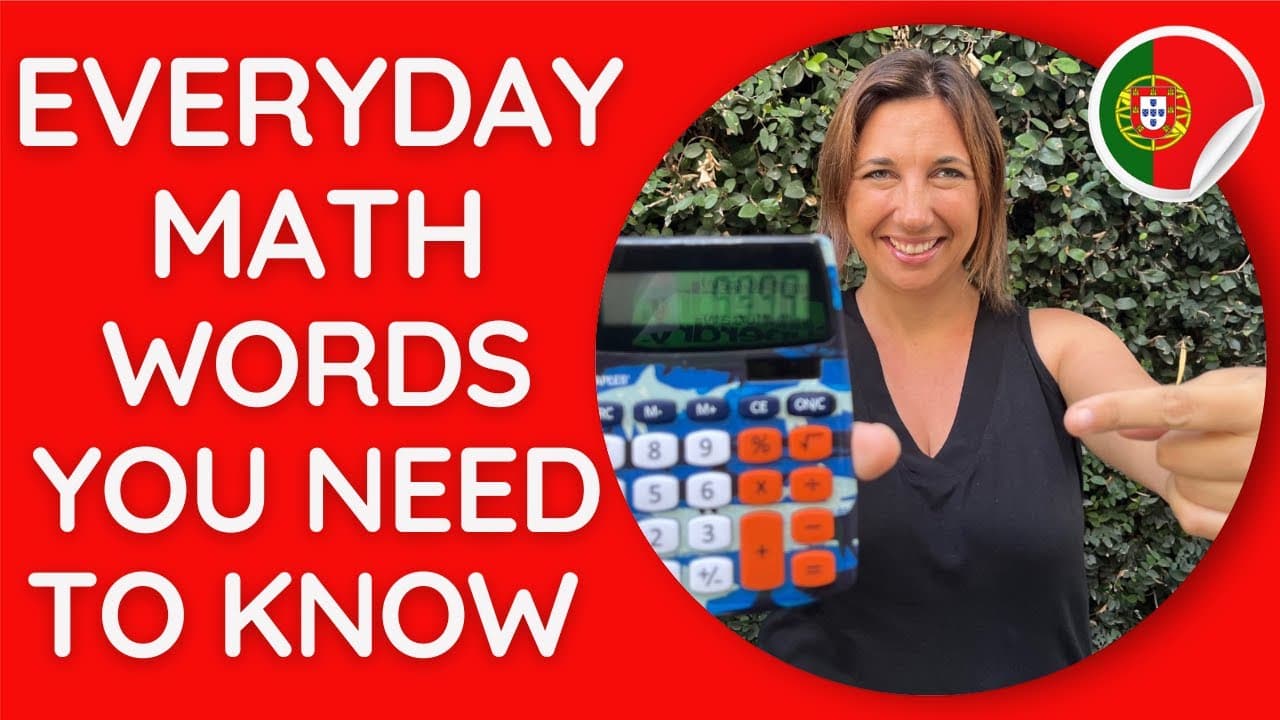
Olá, bem-vindos a mais um episódio! Today’s episode is going to be quite different. We are going to talk about Math. If you are thinking “what does Math have to do with Portuguese”, you will be surprised how often we use math vocabulary in our day to day lives. How would you say “I was here first”? or “I want half of that”? I am here to help you ma... Read More
Key Insights
- The video highlights the importance of math vocabulary in everyday Portuguese, showing how terms are integrated into daily conversations.
- Portuguese cardinal numbers have gender forms, with 'uma' and 'duas' used for feminine nouns, affecting numbers beyond twenty.
- In Portuguese, the diminutive 'nº' is used for numbers instead of the pound symbol, as seen in addresses.
- Phone numbers in Portugal are read digit by digit, with special formats for 800 numbers, indicating free hotlines.
- The Portuguese term for a billion is 'mil milhões', while 'bilião' means a trillion, differing from English usage.
- Ordinal numbers in Portuguese require gender agreement with nouns and are used before the noun, unlike most adjectives.
- Fractions in Portuguese are commonly used in recipes and time expressions, with gender-specific terms like 'meio' and 'meia'.
- Collective numerals such as 'dezena' and 'dúzia' express quantities, with 'dezenas' used similarly to 'dozens' in English.
Install to Summarize YouTube Videos and Get Transcripts
Explore YouTube Video Summarizer or Get YouTube Transcript Extractor
Questions & Answers
Q: What is the significance of gender in Portuguese cardinal numbers?
In Portuguese, cardinal numbers have gender-specific forms, with 'uma' and 'duas' used for feminine nouns. This distinction is important as it affects the agreement of numbers with nouns, influencing how numbers are expressed beyond twenty, such as 'vinte e uma'. Understanding this concept is crucial for accurate communication in Portuguese.
Q: How are phone numbers read differently in Portugal?
In Portugal, phone numbers are typically read digit by digit, unlike in some other countries where numbers may be grouped. This method ensures clarity in communication. However, for 800 numbers, which are free hotlines, the numbers are sometimes grouped in advertisements to make them easier to remember.
Q: What is the difference between 'bilião' in Portuguese and English?
In European Portuguese, the term 'bilião' refers to what is known as a trillion in English. Conversely, the English term 'billion' translates to 'mil milhões' in Portuguese. This significant difference can lead to confusion if not understood properly, especially in financial or scientific contexts.
Q: How do ordinal numbers function in Portuguese compared to English?
Ordinal numbers in Portuguese require agreement with the gender and number of the noun they modify, unlike in English. They are typically placed before the noun, contrary to most adjectives in Portuguese. For example, 'primeira dama' means 'first lady', with 'primeira' reflecting the feminine singular form of 'dama'.
Q: What role do fractions play in Portuguese language use?
Fractions in Portuguese, such as 'meio' (half) and 'um terço' (a third), are commonly used in everyday language, especially in contexts like cooking and time-telling. They require gender agreement and are often encountered in recipes and schedules, making them essential for practical communication.
Q: Why is the diminutive 'nº' used in Portuguese for numbers?
In Portuguese, the diminutive 'nº' is used instead of the pound symbol to denote numbers, particularly in addresses. This usage reflects a linguistic convention where 'nº' stands for 'número', providing a clear and concise way to indicate numerical references in written communication.
Q: How are collective numerals used in Portuguese?
Collective numerals in Portuguese, like 'dezena' (ten) and 'dúzia' (dozen), express specific quantities and are used similarly to English. The term 'dezenas' can imply a large quantity, akin to 'dozens' in English, providing a flexible way to describe amounts in various contexts, from items to time periods.
Q: What is a practical application of Portuguese math vocabulary?
Portuguese math vocabulary is applied in numerous everyday situations, such as reading phone numbers, writing addresses, and following recipes. Understanding terms like cardinal and ordinal numbers, fractions, and collective numerals enables effective communication and comprehension in both casual and formal interactions.
Summary & Key Takeaways
-
The video introduces essential Portuguese math vocabulary, emphasizing its relevance in everyday situations such as reading phone numbers and writing addresses.
-
It covers cardinal and ordinal numbers, explaining their gender forms and usage, along with differences between Portuguese and English numerical terms.
-
Practical examples are provided for using fractions and collective numerals in Portuguese, making the content applicable for learners in real-life contexts.
Read in Other Languages (beta)
Share This Summary 📚
Summarize YouTube Videos and Get Video Transcripts with 1-Click
Try YouTube Summary with ChatGPT & Claude or YouTube Transcript Generator
Explore More Summaries from Learn European Portuguese Online 📚




Summarize YouTube Videos and Get Video Transcripts with 1-Click
Try YouTube Summary with ChatGPT & Claude or YouTube Transcript Generator