Coulomb's Law - Net Electric Force & Point Charges
TL;DR
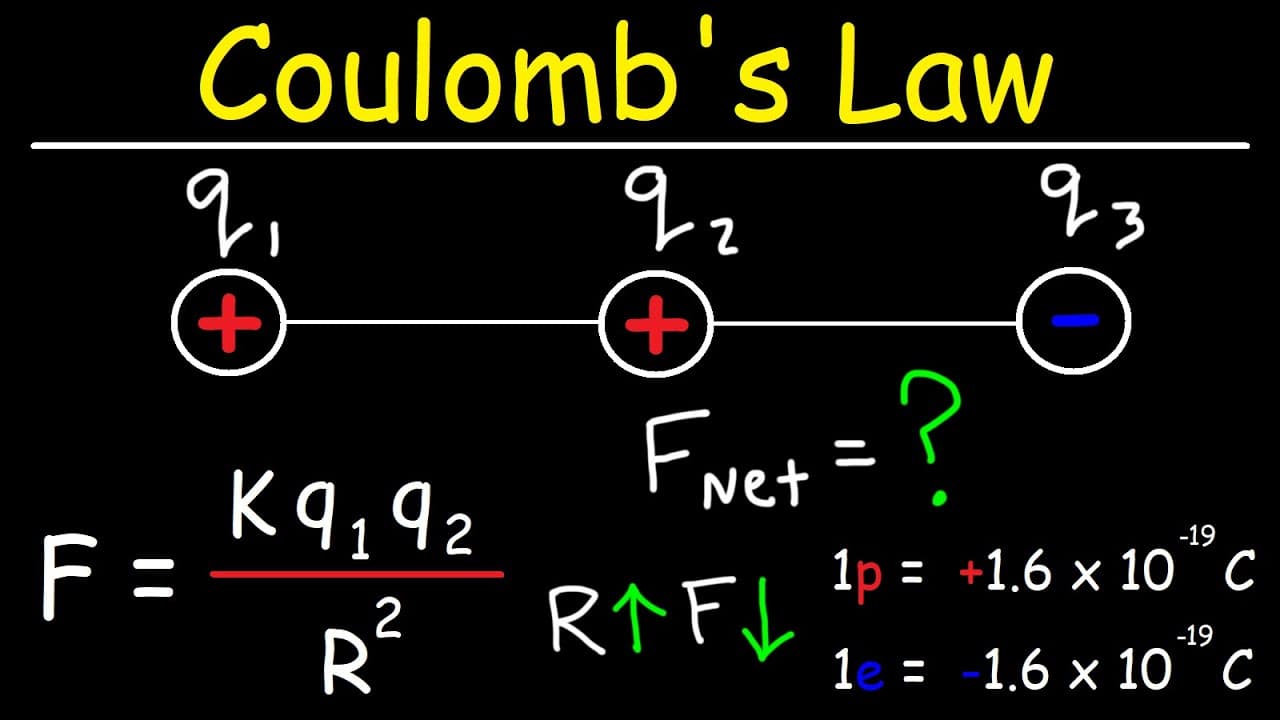
Coulomb's Law explains the relationship between electric charges and the force acting on them. Opposite charges attract, while like charges repel.
Transcript
in this video we're going to focus on coulomb's law we're also going to work on some problems associated with it but before we do that let's begin our discussion with the atom now at the center of an atom you have the nucleus and inside the nucleus of an atom there are subatomic particles known as protons and neutrons neutrons are neutral in charge... Read More
Key Insights
- 🔌 Electric charges exist in discrete amounts and have a fundamental value.
- 🔌 Coulomb's Law describes the relationship between electric force, charge magnitude, and distance.
- 🈂️ Opposite charges attract, while like charges repel.
- 👌 The proportionality constant, K, helps calculate the electric force between charges.
- 🈂️ Increasing the magnitude of charges increases the force, while increasing the distance between charges decreases the force.
- 😚 Electric force is strongest when charges are closer together or have larger magnitudes.
- 🇦🇪 The unit for charge is coulombs, which can be represented in smaller units like microcoulombs, millicoulombs, and nanocoulombs.
Install to Summarize YouTube Videos and Get Transcripts
Explore YouTube Video Summarizer or Get YouTube Transcript Extractor
Questions & Answers
Q: What is the difference between protons, neutrons, and electrons in terms of charge and location in an atom?
Protons carry a positive charge, neutrons have no charge, and electrons carry a negative charge. Protons and neutrons are located in the nucleus, while electrons orbit the nucleus.
Q: How does Coulomb's Law relate to the concept of opposite charges attracting and like charges repelling?
Coulomb's Law provides a mathematical equation to calculate the electric force between charges. Opposite charges attract each other, while like charges repel. The force is directly proportional to the magnitude of the charges and inversely proportional to the square of the distance between them.
Q: What is the importance of the proportionality constant, K, in Coulomb's Law?
The proportionality constant, K, in Coulomb's Law is 9 x 10^9 N*m^2/C^2. It helps calculate the magnitude of the electric force between charges. K is also equal to 1/(4πε₀), where ε₀ is the permittivity of free space.
Q: How does the magnitude of charges and the distance between them affect the electric force?
If the magnitude of one charge is doubled, the electric force will double. If the distance between the charges is doubled, the electric force will decrease to one-fourth of its original value.
Summary & Key Takeaways
-
Coulomb's Law describes the relationship between electric force, charge magnitude, and distance between charges.
-
Protons carry a positive charge, electrons carry a negative charge, and neutrons have no charge.
-
Electric charge is quantized and exists in discrete amounts, with the fundamental charge value being 1.6 x 10^-19 C.
Read in Other Languages (beta)
Share This Summary 📚
Summarize YouTube Videos and Get Video Transcripts with 1-Click
Try YouTube Summary with ChatGPT & Claude or YouTube Transcript Generator
Explore More Summaries from The Organic Chemistry Tutor 📚



Summarize YouTube Videos and Get Video Transcripts with 1-Click
Try YouTube Summary with ChatGPT & Claude or YouTube Transcript Generator