Drawing particulate models of reaction mixtures | Chemical reactions | AP Chemistry | Khan Academy
TL;DR
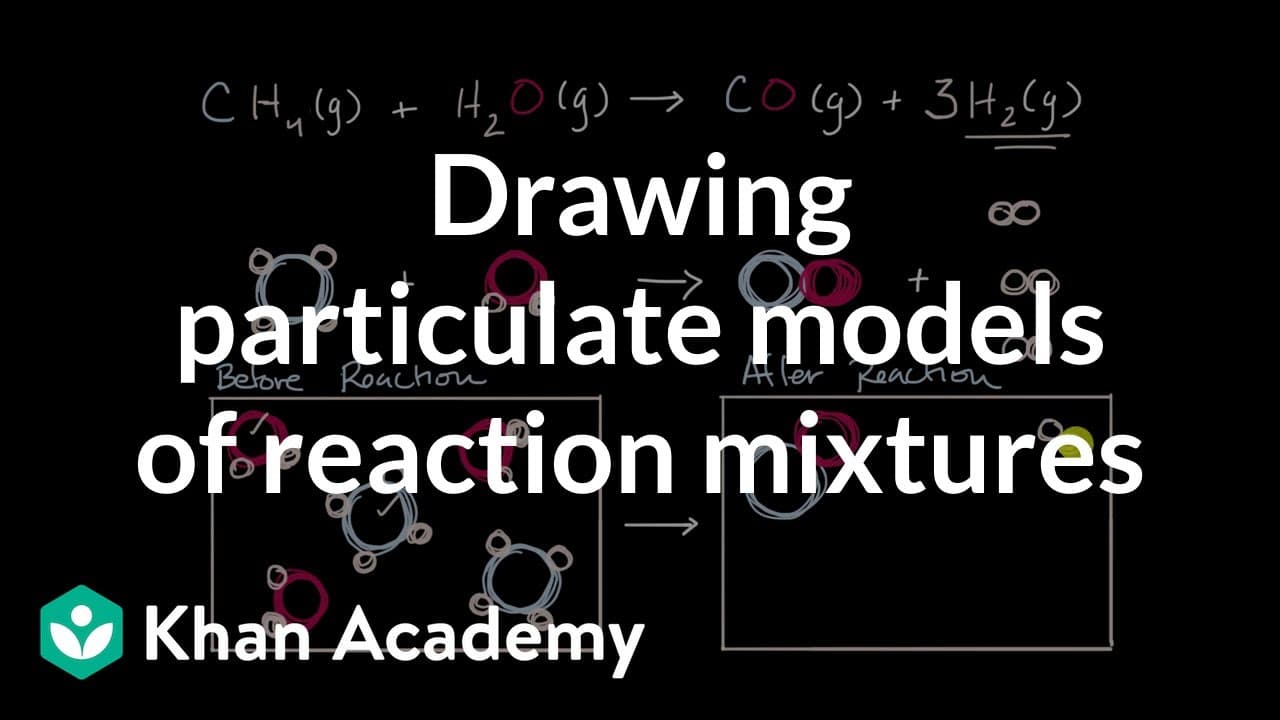
This video explains how to visualize a reaction using a particulate model, focusing on the reaction of methane and water to produce carbon monoxide and hydrogen.
Transcript
- [Instructor] In a previous video, we used a particulate model like this to understand a reaction, not just to understand the reaction, but to balance the chemical reaction as well. And when I hand drew these particles, the atoms in this particulate model here, I tried to draw it pretty close to their actual relative sizes. Carbon atoms are a litt... Read More
Key Insights
- 🫀 The particulate model helps visualize the reaction process on a molecular level, giving insights into the relative sizes and arrangements of atoms.
- 💁 Balancing a chemical reaction involves understanding the number and types of molecules involved in the reaction and the resulting products formed.
- 🆘 Visualization of reaction mixtures can help identify leftover reactant molecules that did not participate in the reaction.
- 🖐️ Temperature plays a significant role in reactions, as it affects the movement and energy of the reactant molecules.
- 👻 The particulate model allows scientists to conceptualize and predict reaction outcomes before conducting experiments.
- 💦 Carbon monoxide and hydrogen are common products of the reaction between methane and water.
- 🥳 The particulate model aids in understanding the stoichiometry of a reaction, determining the ratios of reactants and products.
Install to Summarize YouTube Videos and Get Transcripts
Explore YouTube Video Summarizer or Get YouTube Transcript Extractor
Questions & Answers
Q: What is the purpose of using a particulate model to understand chemical reactions?
The particulate model helps visualize the movement and interaction of reactant molecules, providing a better understanding of the reaction process and aiding in reaction balancing.
Q: How does the instructor represent the relative sizes of the atoms in the particulate model?
The instructor draws the atoms with carbon atoms slightly larger than oxygen atoms, and both larger than hydrogen atoms, representing their actual relative sizes.
Q: What is the outcome of the reaction between methane and water?
The reaction between methane and water produces carbon monoxide and molecular hydrogen. For every methane and water, one carbon monoxide and three hydrogen molecules are formed.
Q: Why is there a leftover water molecule after the reaction?
The leftover water molecule had no partner to react with in the given situation. It remains as a leftover reactant molecule because it did not participate in the reaction.
Summary & Key Takeaways
-
The video introduces a particulate model to understand and balance chemical reactions.
-
The instructor demonstrates how to visualize the reaction of methane and water, resulting in carbon monoxide and hydrogen.
-
The visualization helps understand the leftover reactant molecule after the reaction.
Read in Other Languages (beta)
Share This Summary 📚
Summarize YouTube Videos and Get Video Transcripts with 1-Click
Try YouTube Summary with ChatGPT & Claude or YouTube Transcript Generator
Explore More Summaries from Khan Academy 📚



Summarize YouTube Videos and Get Video Transcripts with 1-Click
Try YouTube Summary with ChatGPT & Claude or YouTube Transcript Generator