Buffer Solutions
TL;DR
Buffer solutions, consisting of a weak acid and its conjugate weak base, help maintain a constant pH level in a solution by resisting changes in pH.
Transcript
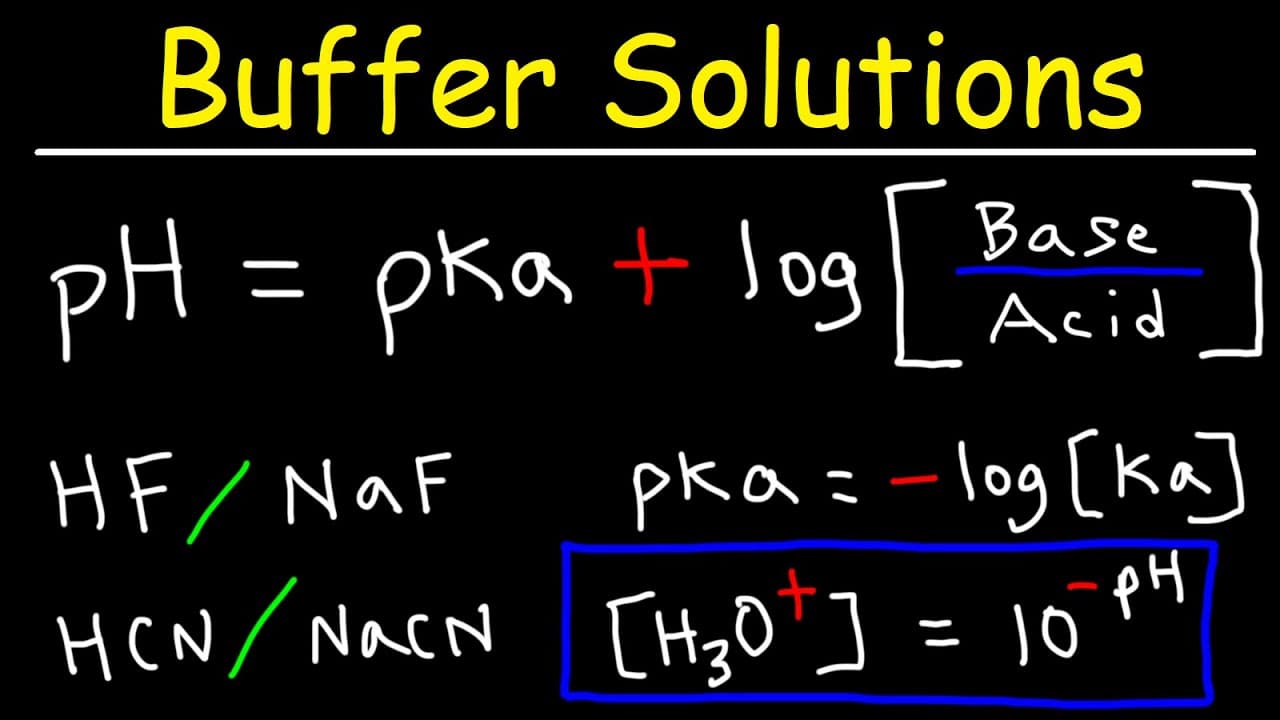
in this video we're going to talk about buffer solutions a buffer solution is composed of a weak acid and the conjugate weak base so let me give you some examples of that hf hydrofluoric acid that's a weak acid the conjugate base of hf is fluoride all you got to do is remove a hydrogen so we're going to pair up fluoride with sodium so here we have ... Read More
Key Insights
- 😥 Buffer solutions consist of a weak acid and its conjugate weak base, helping to maintain a constant pH in a solution.
- 😥 Buffer solutions resist changes in pH by reacting with acids or bases added to the solution.
- 🥳 The Henderson-Hasselbalch equation allows for the calculation of the pH of a buffer solution using the pKa of the weak acid and the ratio of base to acid concentrations.
Install to Summarize YouTube Videos and Get Transcripts
Explore YouTube Video Summarizer or Get YouTube Transcript Extractor
Questions & Answers
Q: What are some examples of buffer solutions?
Examples of buffer solutions are hydrofluoric acid (HF) paired with fluoride ion (F-), acetic acid (HC2H3O2) paired with acetate ion (C2H3O2-), and hydrocyanic acid (HCN) paired with cyanide ion (CN-).
Q: How do buffer solutions maintain a constant pH?
Buffer solutions contain both a weak acid and a weak base. When an acid is added, it reacts with the weak base component of the buffer to minimize changes in pH. Similarly, when a base is added, it reacts with the weak acid component to prevent significant pH increases.
Q: How can the pH of a buffer solution be calculated?
The pH of a buffer solution can be calculated using the Henderson-Hasselbalch equation: pH = pKa + log(base/acid). The pKa is the acid dissociation constant, and the base and acid refer to the concentrations of the weak base and weak acid components, respectively.
Q: What determines whether the pH of a buffer solution will be higher or lower than the pKa?
If the concentration of the weak base is greater than the weak acid in a buffer solution, the pH will be higher than the pKa. Conversely, if the concentration of the weak acid is greater, the pH will be lower than the pKa.
Summary & Key Takeaways
-
Buffer solutions are composed of a weak acid and its conjugate weak base, such as hydrofluoric acid (HF) and fluoride ion (F-), or acetic acid (HC2H3O2) and acetate ion (C2H3O2-).
-
The purpose of a buffer solution is to maintain a constant pH level by resisting changes in pH when acids or bases are added. It achieves this through the chemical reactions of the weak acid and weak base components.
-
The Henderson-Hasselbalch equation helps to calculate the pH of a buffer solution by using the pKa (acid dissociation constant) of the weak acid and the ratio of the concentration of the weak base to the weak acid.
Read in Other Languages (beta)
Share This Summary 📚
Summarize YouTube Videos and Get Video Transcripts with 1-Click
Try YouTube Summary with ChatGPT & Claude or YouTube Transcript Generator
Explore More Summaries from The Organic Chemistry Tutor 📚



Summarize YouTube Videos and Get Video Transcripts with 1-Click
Try YouTube Summary with ChatGPT & Claude or YouTube Transcript Generator