Case vs If Statement
TL;DR
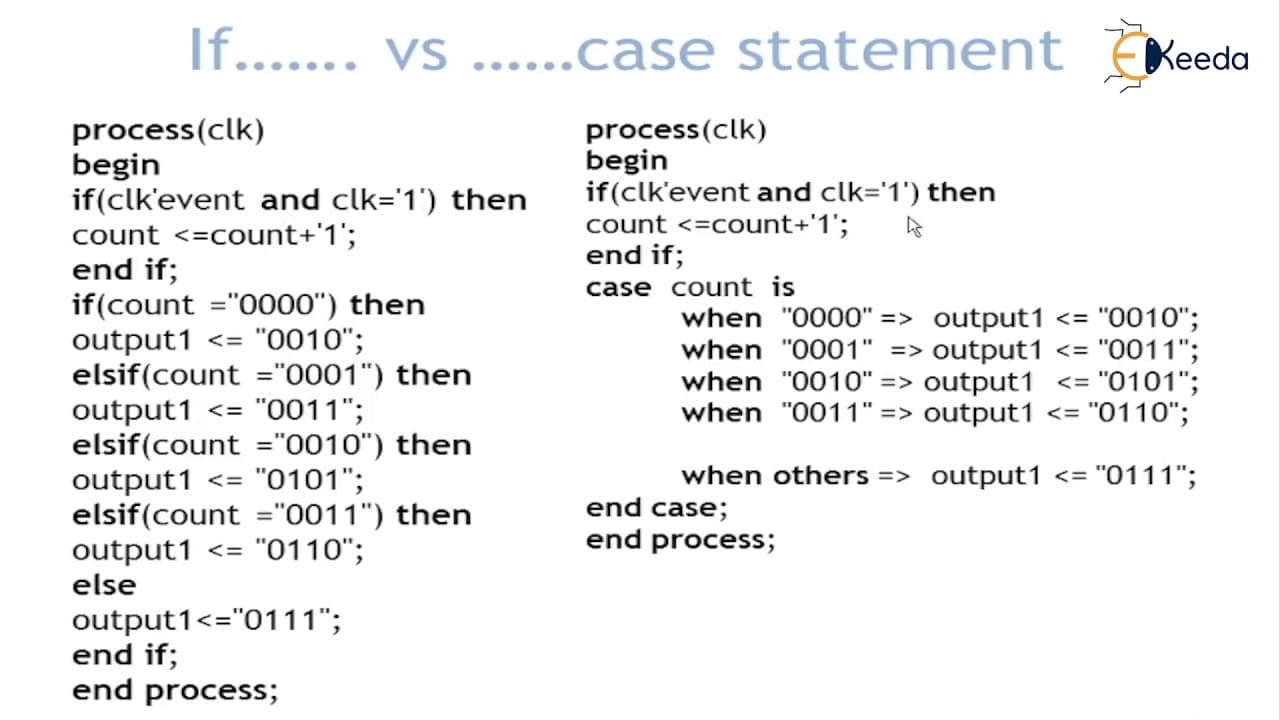
Understanding the differences between if-else and case statements in VHDL for circuit design.
Transcript
hello friends uh welcome to the village design course so today we are going to cover our last uh topic or last subsection of case versus if statement under the topic vsdl sequential statements so this is the last sub point uh from this chapter so let's start so already we have we have we have understood the uh case statement as well as if statement... Read More
Key Insights
- 🖐️ VHDL sequential statements like if-else and case play crucial roles in designing sequential and combinational circuits.
- 🔠 If-else statements prioritize condition order, while case statements handle mutually exclusive inputs efficiently.
- 👨💻 Case statements offer a compact coding style similar to switch constructs in C.
- 👨💻 Understanding the differences between if-else and case statements helps optimize VHDL coding practices.
- 👨💻 It's common to mix if-else and case statements in VHDL designs for better code structure.
- 💼 Both if-else and case statements generate the same synthesizable RTL when implemented in synthesis tools.
- 👨💻 The choice between if-else and case statements depends on the coding style and application requirements in VHDL.
Install to Summarize YouTube Videos and Get Transcripts
Explore YouTube Video Summarizer or Get YouTube Transcript Extractor
Questions & Answers
Q: What are the main differences between if-else and case statements in VHDL?
If-else statements prioritize multiple input conditions, while case statements are more suitable for mutually exclusive inputs. Case statements offer a compact way of writing code and are similar to switch constructs.
Q: When should one prefer using if-else statements over case statements in VHDL?
If-else statements are preferred when dealing with multiple branching and boolean expressions, whereas case statements are better for handling single-event conditions and multi-branching structures.
Q: Is one statement more efficient than the other in VHDL, if-else or case?
Both if-else and case statements have their advantages, with no definite efficiency comparison. The choice depends on coding styles and the specific application requirements in VHDL.
Summary & Key Takeaways
-
Case and if-else statements are sequential variable statements in VHDL used for circuit design.
-
If-else statements are preferred for comparing multiple input conditions, while case statements are useful for multi-branching and exclusive inputs.
-
Case statements are similar to switch constructs in C, offering efficient and compact coding compared to if-else structures.
Read in Other Languages (beta)
Share This Summary 📚
Summarize YouTube Videos and Get Video Transcripts with 1-Click
Try YouTube Summary with ChatGPT & Claude or YouTube Transcript Generator
Explore More Summaries from Ekeeda 📚






Summarize YouTube Videos and Get Video Transcripts with 1-Click
Try YouTube Summary with ChatGPT & Claude or YouTube Transcript Generator