NVIDIA’s Amazing AI Clones Your Voice! 🤐
TL;DR
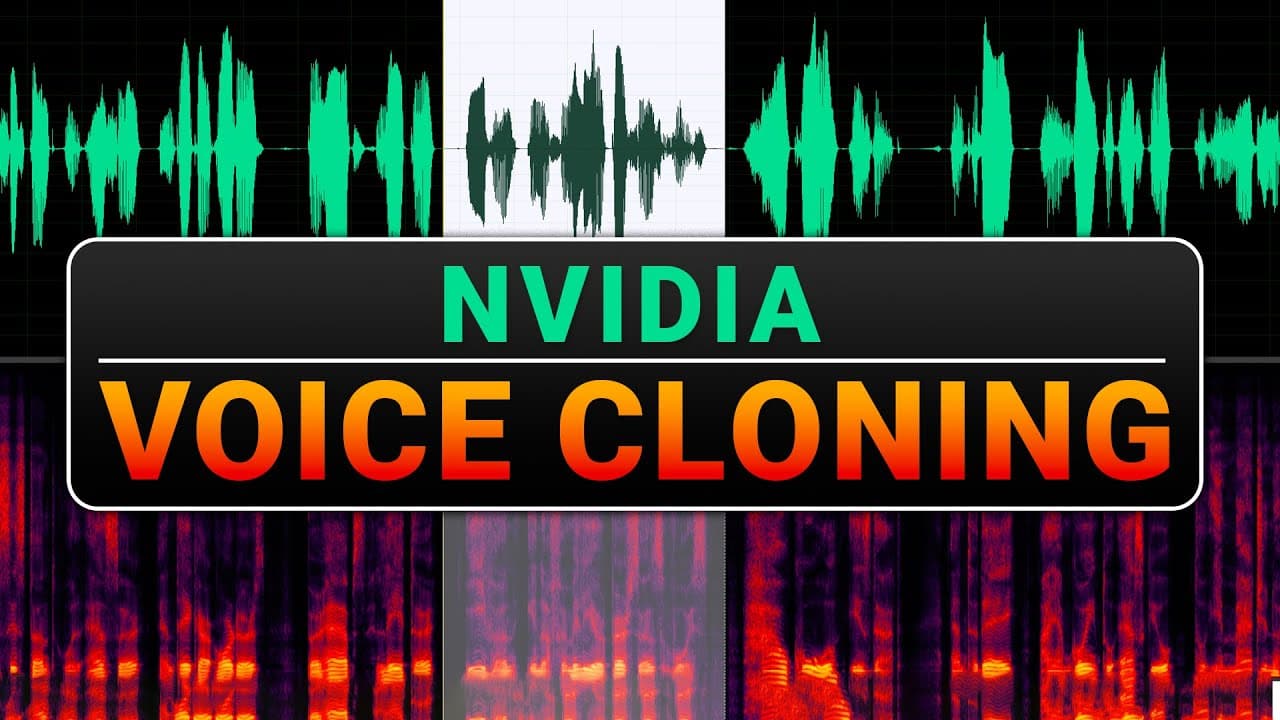
AI can clone human voices with high quality from just 30 minutes of voice samples, making way for personalized virtual assistants.
Transcript
Dear Fellow Scholars, this is Two Minute Papers with Dr. Károly Zsolnai-Fehér. Today we are going to clone real human voices using an AI. How? Well, in an earlier NVIDIA keynote, we had a look at Jensen Jr., an AI-powered virtual assistant of NVIDIA’s CEO, Jensen Huang. It could do, this! Look at the face of that proud man! I love how it ... Read More
Key Insights
- 💨 AI can clone real human voices accurately with as little as 30 minutes of voice samples, paving the way for personalized virtual assistants.
- ✋ The new AI technique offers higher quality voice synthesis, easier training, and better language generalization compared to previous methods like Tacotron.
- 🈸 NVIDIA's advancements in voice cloning technology demonstrate the rapid progress in AI capabilities for practical applications.
- 😋 Virtual AI assistants with personalized voices could revolutionize daily tasks like ordering food, driving, and more.
- 🍗 AI voice cloning technology has the potential to be widely accessible, as NVIDIA offers an early access program for interested individuals to try out the technology.
- 😒 The synthesized human voices from AI may not be flawless, but they are sufficiently realistic for practical use in virtual assistants.
- 🥺 Future advancements in AI voice cloning technology could lead to more sophisticated applications and possibilities for customization.
Install to Summarize YouTube Videos and Get Transcripts
Explore YouTube Video Summarizer or Get YouTube Transcript Extractor
Questions & Answers
Q: How much voice data is needed for AI to clone real human voices effectively?
The AI requires only 30 minutes of voice samples to accurately clone a human voice, analyzing timbre, prosody, and rhythm for synthesis.
Q: What makes this new AI voice cloning technique different from previous methods like Tacotron?
Unlike Tacotron, this new method uses more data for higher quality voice synthesis, easier training, and better generalization to multiple languages.
Q: How realistic are the synthesized human voices from the AI?
While the synthesized voices may not be perfect, they are realistic enough for human-like virtual assistants, showcasing promising potential for future applications.
Q: How can individuals get access to this AI voice cloning technology by NVIDIA?
Interested individuals can apply for NVIDIA's early access program to try out the voice cloning technology and potentially contribute valuable feedback for further development.
Summary & Key Takeaways
-
NVIDIA demonstrates AI technique for cloning real human voices with high quality using only 30 minutes of voice samples.
-
The AI analyzes timbre, prosody, and rhythm of the voice to synthesize realistic human-like voices for virtual assistants.
-
This advancement allows for personalized virtual AI assistants with individual voices for users.
Read in Other Languages (beta)
Share This Summary 📚
Summarize YouTube Videos and Get Video Transcripts with 1-Click
Try YouTube Summary with ChatGPT & Claude or YouTube Transcript Generator
Explore More Summaries from Two Minute Papers 📚


Summarize YouTube Videos and Get Video Transcripts with 1-Click
Try YouTube Summary with ChatGPT & Claude or YouTube Transcript Generator