Finding mean, median, and mode | Descriptive statistics | Probability and Statistics | Khan Academy
TL;DR
This video explains how to calculate the mean, median, and mode of a set of numbers and discusses their significance in measuring central tendency.
Transcript
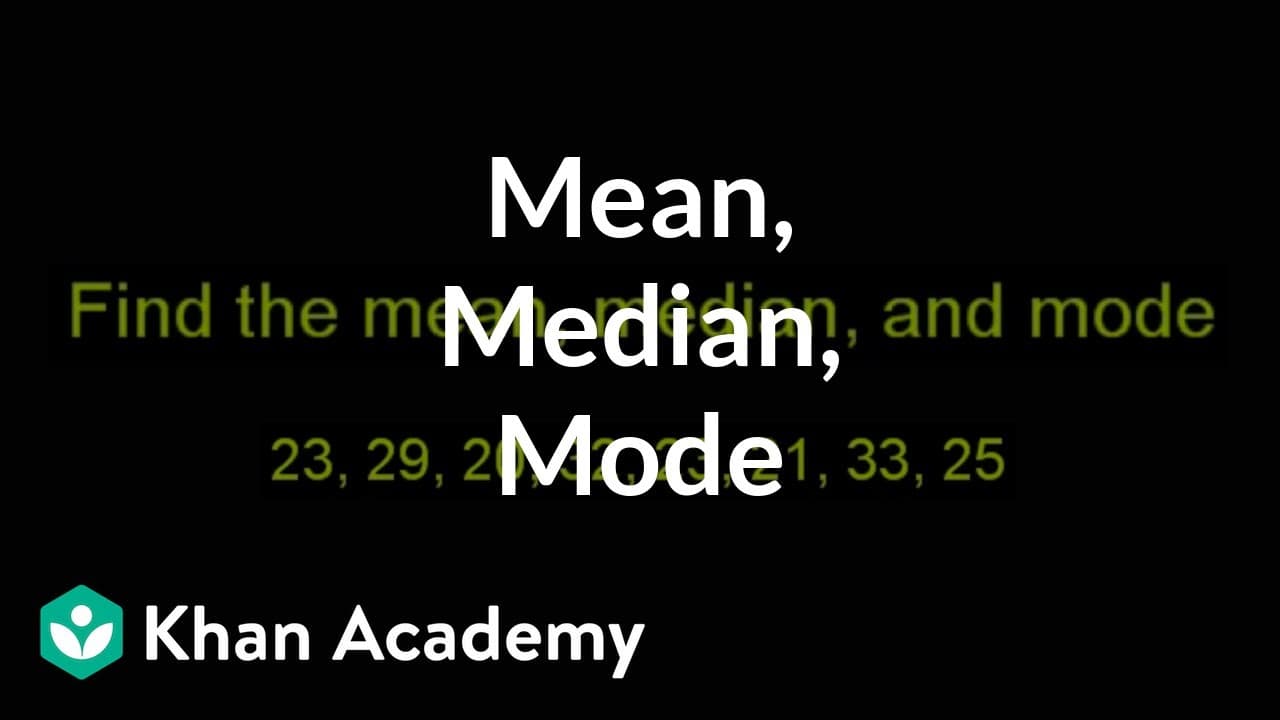
Find the mean, median, and mode of the following sets of numbers. And they give us the numbers right over here. So if someone just says the mean, they're really referring to what we typically, in everyday language, call the average. Sometimes it's called the arithmetic mean because you'll learn that there's other ways of actually calculating a mean... Read More
Key Insights
- 😫 Mean, median, and mode are measures of central tendency used to describe the average or middle value of a data set.
- 🍹 The mean is calculated by summing all the numbers and dividing by the count.
- 🖕 The median is found by arranging the numbers in order and selecting the middle value.
- 😫 The mode is the number that appears most frequently in the set.
- 🍵 Mean is influenced by outliers, while the median is more robust in handling extreme values.
- 🖕 In cases of an even count, the median is the average of the two middle numbers.
- 😫 The mode can be used to identify the most common value in the set.
Install to Summarize YouTube Videos and Get Transcripts
Explore YouTube Video Summarizer or Get YouTube Transcript Extractor
Questions & Answers
Q: What is the difference between mean, median, and mode?
The mean is the arithmetic average of a set of numbers, the median is the middle value when the numbers are ordered, and the mode is the number that appears most frequently.
Q: How is the mean calculated?
The mean is obtained by summing up all the numbers in the set and dividing by the total count of numbers. It represents the average value of the data set.
Q: What does the median represent?
The median represents the middle value in a set of numbers. It provides insight into the central tendency and is not affected by extreme outliers like the mean.
Q: Can there be multiple modes in a data set?
Yes, a data set can have multiple modes if multiple numbers have the same highest frequency. In the given example, the mode is 23, as it appears twice.
Summary & Key Takeaways
-
The mean, also known as the average, is calculated by summing up all the numbers in the set and dividing by the total count of numbers.
-
The median is determined by arranging the numbers in ascending order and selecting the middle number. If there is an even count, the median is the average of the two middle numbers.
-
The mode is the number that appears most frequently in the set. In the given example, the number 23 is the mode.
Read in Other Languages (beta)
Share This Summary 📚
Summarize YouTube Videos and Get Video Transcripts with 1-Click
Try YouTube Summary with ChatGPT & Claude or YouTube Transcript Generator
Explore More Summaries from Khan Academy 📚



Summarize YouTube Videos and Get Video Transcripts with 1-Click
Try YouTube Summary with ChatGPT & Claude or YouTube Transcript Generator