Disc method rotating around vertical line | AP Calculus AB | Khan Academy
TL;DR
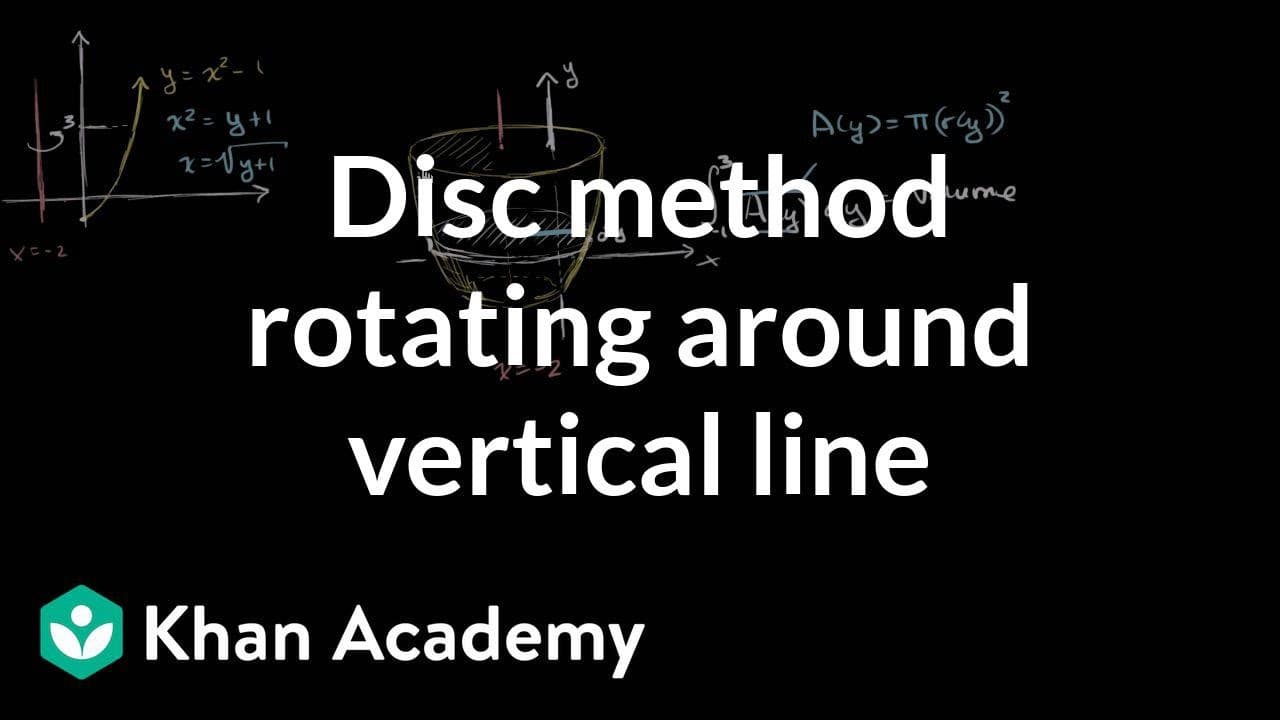
Find the volume of a gumball-shaped figure obtained by rotating the function y = x^2 - 1 around the vertical line x = -2 using the disc method.
Transcript
Let's do another example, and this time we're going to rotate our function around a vertical line that is not the y-axis. And if we do that-- so we're going to rotate y is equal to x squared minus 1-- or at least this part of it-- we're going to rotate it around the vertical line x is equal to negative 2. And if we do that, we get this gumball shap... Read More
Key Insights
- 🫥 Rotating a function around a vertical line can create unique 3D shapes.
- 🥏 The disc method is an integral technique commonly used to find volumes of rotation.
- 😀 Determining the radius as a function of y is crucial for accurately calculating the volume.
- 🥏 The definite integral is employed to evaluate the volume by integrating the product of the area and depth of each disc over the specified interval.
- 🧡 The disc method can be applied to a wide range of functions and rotation axes.
- 💠 The shape and dimensions of the rotated figure impact the complexity of the integral.
- 🥏 The disc method is a fundamental concept in calculus and has applications in various fields, including physics and engineering.
Install to Summarize YouTube Videos and Get Transcripts
Explore YouTube Video Summarizer or Get YouTube Transcript Extractor
Questions & Answers
Q: What is the disc method used for in calculus?
The disc method is a technique in calculus used to find the volume of a solid obtained by rotating a curve or function around an axis.
Q: How is the radius of each disc determined in this example?
The radius as a function of y, for each disc, is obtained by adding the value of the function (y = x^2 - 1) to 2, as this represents the distance from the curve to the axis of rotation.
Q: What is the interval for integration in this problem?
The interval for integration is from y = -1 to y = 3, which corresponds to the range of y-values for the rotated shape.
Q: How is the volume of each disc calculated?
The volume of each disc is determined by multiplying the area of the disc, given by pi times the square of the radius (pi * (sqrt(y + 1) + 2)^2), by the depth of the disc (dy).
Summary & Key Takeaways
-
The content explains how to find the volume of a 3D shape obtained by rotating a function around a vertical line.
-
The disc method is used to calculate the volume by constructing discs with varying depths and areas.
-
The key is to determine the area and radius of each disc as a function of y, which enables the evaluation of the double integral.
Read in Other Languages (beta)
Share This Summary 📚
Summarize YouTube Videos and Get Video Transcripts with 1-Click
Try YouTube Summary with ChatGPT & Claude or YouTube Transcript Generator
Explore More Summaries from Khan Academy 📚



Summarize YouTube Videos and Get Video Transcripts with 1-Click
Try YouTube Summary with ChatGPT & Claude or YouTube Transcript Generator