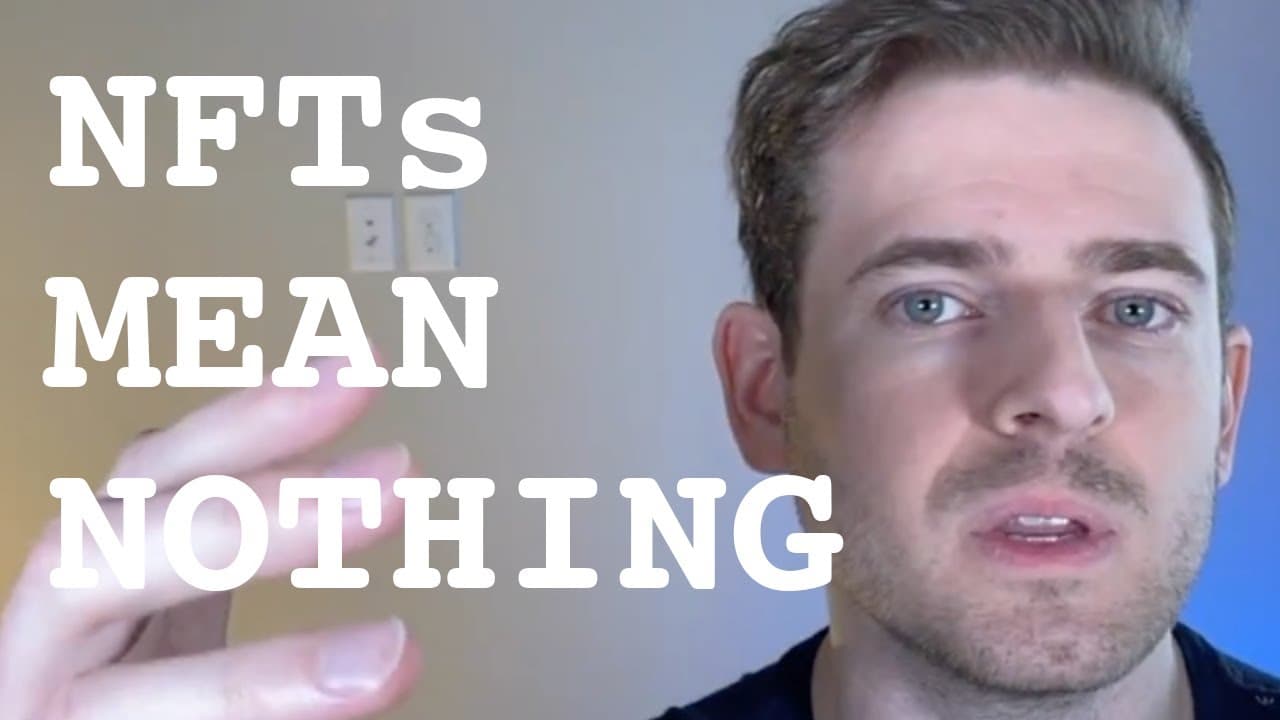
What are you actually owning when you buy an NFT?
TL;DR
A beginner's guide to understanding NFTs without technical jargon.
Transcript
how's it going everyone so for the past month or so i've been doing more research to kind of learn about nfts and how they actually work behind the scenes and more specifically i've been diving into like solidity contracts how can i deploy my own ecr 721 contract on the ethereum blockchain the polygon blockchain right so i kind of been learning stu... Read More
Key Insights
- ❣️ NFTs can be understood simply as unique records in a decentralized database without needing to delve into heavy technical details.
- 🪈 Buying an NFT means changing record ownership in a smart contract, not acquiring any copyright or physical ownership over digital assets.
- 🤨 The minting process of an NFT is akin to adding rows in a spreadsheet, clarifying how new entries reflect ownership.
- 🔇 The speaker highlights the disconnect between the perceived value of NFTs and their actual underlying technical nature.
- 👻 There are functions within NFT smart contracts, like transfer and burn, that allow for the management and lifecycle of an NFT.
- 🍵 Platforms like OpenSea streamline the trading process by handling approvals for NFT sales, reducing the need for direct owner interactions.
- 🥺 Many enthusiasts entering the NFT space may not fully grasp what they are purchasing, often leading to financial risks.
Install to Summarize YouTube Videos and Get Transcripts
Explore YouTube Video Summarizer or Get YouTube Transcript Extractor
Questions & Answers
Q: What is the primary focus of this video regarding NFTs?
The video focuses on providing a simple, non-technical explanation of NFTs, particularly for those new to the concept. It aims to clarify what an NFT truly is, navigating through complex jargon often found in the space. The video emphasizes understanding NFTs as records in a decentralized database, rather than getting lost in the technicalities of blockchain technology.
Q: How does the speaker differentiate between fungible and non-fungible tokens?
The speaker briefly mentions that many jargon-filled explanations, like differentiating fungible from non-fungible tokens, often complicate understanding for beginners. The video doesn't dwell on these concepts but aims to clarify that NFTs represent unique records, hence non-fungible, unlike cryptocurrencies, which are interchangeable, making them fungible.
Q: What analogy does the speaker use to explain the NFT minting process?
The speaker uses a spreadsheet analogy to explain the minting of NFTs. They compare the creation of an NFT to adding a new page in a Google Sheet, where each page represents a new collection. When an NFT is minted, it's analogous to entering a new record in that spreadsheet, clearly illustrating how ownership and data entry work behind the scenes.
Q: What does purchasing an NFT actually mean according to the speaker?
Purchasing an NFT, according to the speaker, means acquiring a record in a decentralized database rather than owning the actual image or multimedia linked to it. The speaker emphasizes that buyers should understand they're simply changing ownership details in a database and not obtaining copyright or ownership over the content itself.
Q: What is the speaker's opinion on the current NFT market?
The speaker expresses skepticism about the NFT market, describing it as potentially a scam or filled with hype and money laundering. They question the value people assign to NFTs, especially given that the technical aspects can be overly abstract and complicated. By the video's end, they are unsure about the overall potential of NFTs.
Q: How does the approval process work in NFT transactions?
The approval process in NFT transactions involves allowing platforms like OpenSea to manage trades on behalf of the NFT owner. When a collection is created, the owner grants permission to the platform, enabling it to execute transfers or sales without needing the owner's constant confirmation, streamlining the trading process.
Q: Can NFTs be deleted or 'burnt,' and how does that process work?
Yes, NFTs can be deleted or 'burnt.' The speaker mentions that there is a method in NFT contracts to burn an NFT, essentially wiping it out, rendering it impossible for anyone else to buy or sell it. This allows for the NFT to be completely removed from circulation, but it could also potentially be added back in later.
Summary & Key Takeaways
-
The video aims to demystify NFTs for non-technical viewers by breaking down complex concepts into simpler analogies, focusing on their real essence as database records.
-
It utilizes an analogy of a spreadsheet to explain the process of minting NFTs and how ownership works, highlighting that buying an NFT is effectively changing data in a decentralized database.
-
The discussion critiques the hype around NFTs, asserting that many people don’t realize they’re just purchasing a record rather than the tangible artwork or multimedia associated with it.
Read in Other Languages (beta)
Share This Summary 📚
Summarize YouTube Videos and Get Video Transcripts with 1-Click
Try YouTube Summary with ChatGPT & Claude or YouTube Transcript Generator
Explore More Summaries from Web Dev Cody 📚
Summarize YouTube Videos and Get Video Transcripts with 1-Click
Try YouTube Summary with ChatGPT & Claude or YouTube Transcript Generator