How to Dilate One Line onto Another in Geometry
TL;DR
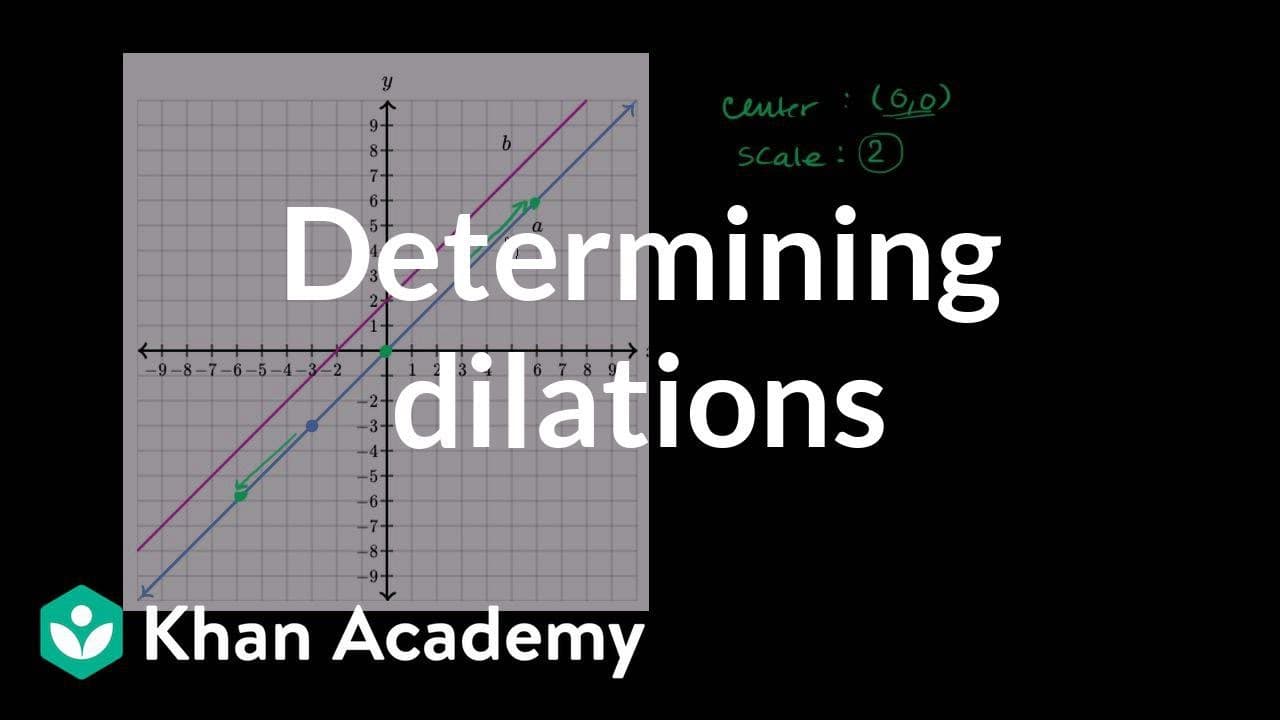
To dilate one line onto another, choose a center of dilation not on the lines and determine a scale factor based on the distance from that center to corresponding points on each line. When the center is on the line, it will map onto itself; thus, selecting a point off the line allows for effective transformation to another line segment.
Transcript
Define a dilation that maps line a onto line b by choosing a center and a scale factor. So let me get my scratch out to think about this a little bit. So let's, just for fun, let's imagine that we pick a point that sits on line a as our center of dilation. And for simplicity, let's pick the origin. So let's imagine that our center of dilation is at... Read More
Key Insights
- 😥 Dilations involve choosing a center and scale factor to resize points on a figure.
- 🫥 When the center of dilation is on a line, the line maps onto itself and stretches or shrinks along the same line.
- 🫥 Choosing a center of dilation that is not on the line allows for mapping the points onto a different line segment with the appropriate scale factor.
- 🫥 The scale factor is determined by the ratio of distances between the chosen center and corresponding points on the two lines.
- 😥 The choice of center and scale factor depends on the desired transformation and the specific points on the figure.
- 🫥 The center of dilation on a line can result in an infinite number of possible scale factors, while choosing a center off the line simplifies the calculation.
- 🆘 Geometric grids can help visualize and determine suitable centers of dilation.
Install to Summarize YouTube Videos and Get Transcripts
Explore YouTube Video Summarizer or Get YouTube Transcript Extractor
Questions & Answers
Q: What is a dilation?
A dilation is a transformation that stretches or shrinks points on a figure based on a chosen center and scale factor. It can be used to resize geometric shapes.
Q: What happens when the center of dilation is on a line?
When the center of dilation is on a line, the line will map onto itself regardless of the scale factor chosen. The points on the line will stretch or shrink along the same line.
Q: How do you determine the scale factor for a point not on the line?
To determine the scale factor, find the distance between the chosen center and the corresponding point on the other line. The scale factor is the ratio of these distances. For example, if the distance from the center to the point on line A is 1 and the corresponding point on line B is 3 units away from the center, the scale factor is 3.
Q: Can any point be chosen as the center of dilation?
Yes, any point can be chosen as the center of dilation. However, when the chosen point is not on the line, the scale factor needs to be carefully calculated to ensure proper stretching or shrinking.
Summary & Key Takeaways
-
A dilation is a transformation that stretches or shrinks points on a figure based on a chosen center and scale factor.
-
When the center of dilation is on a line, the line will map onto itself regardless of the scale factor chosen.
-
To find a suitable center of dilation, choose a point not on the line and determine the scale factor based on the distance from the chosen center to the corresponding point on the other line.
Read in Other Languages (beta)
Share This Summary 📚
Summarize YouTube Videos and Get Video Transcripts with 1-Click
Try YouTube Summary with ChatGPT & Claude or YouTube Transcript Generator
Explore More Summaries from Khan Academy 📚



Summarize YouTube Videos and Get Video Transcripts with 1-Click
Try YouTube Summary with ChatGPT & Claude or YouTube Transcript Generator