Products
Features
YouTube Video Summarizer
Summarize YouTube videos
Web & PDF Highlighter
Highlight web pages & PDFs
Chat with PDF
Ask any PDF questions with AI
Ask AI Clone
Chat with your highlights & memories
Audio Transcriber
Transcribe audio files to text
Glasp Reader
Read and highlight articles
Kindle Highlight Export
Export your Kindle highlights
Idea Hatch
Hatch ideas from your highlights
Integrations
Obsidian Plugin
Notion Integration
Pocket Integration
Instapaper Integration
Medium Integration
Readwise Integration
Snipd Integration
Hypothesis Integration
Apps & Extensions
Chrome Extension
Safari Extension
Edge Add-ons
Firefox Add-ons
iOS App
Android App
Discover
Discover
Ideas
Discover new ideas and insights
Articles
Curated articles and insights
Books
Book recommendations by great minds
Posts
Essays and notes from readers
Quotes
Inspiring quotes collection
Videos
Curated videos and summaries
Explore Glasp
Glasp Newsletter
Weekly insights and updates
Glasp Talk
Interview series with great minds
Glasp Blog
Latest news and articles
Glasp Use Cases
Learn how others use Glasp
Build & Support
Glasp API
Access Glasp's API for developers
MCP Connector
Connect Glasp to Claude & ChatGPT
Community
Glasp Reddit Community
Students
Student discount and benefits
FAQs
Frequently Asked Questions
AboutPricing
DashboardLog inSign up

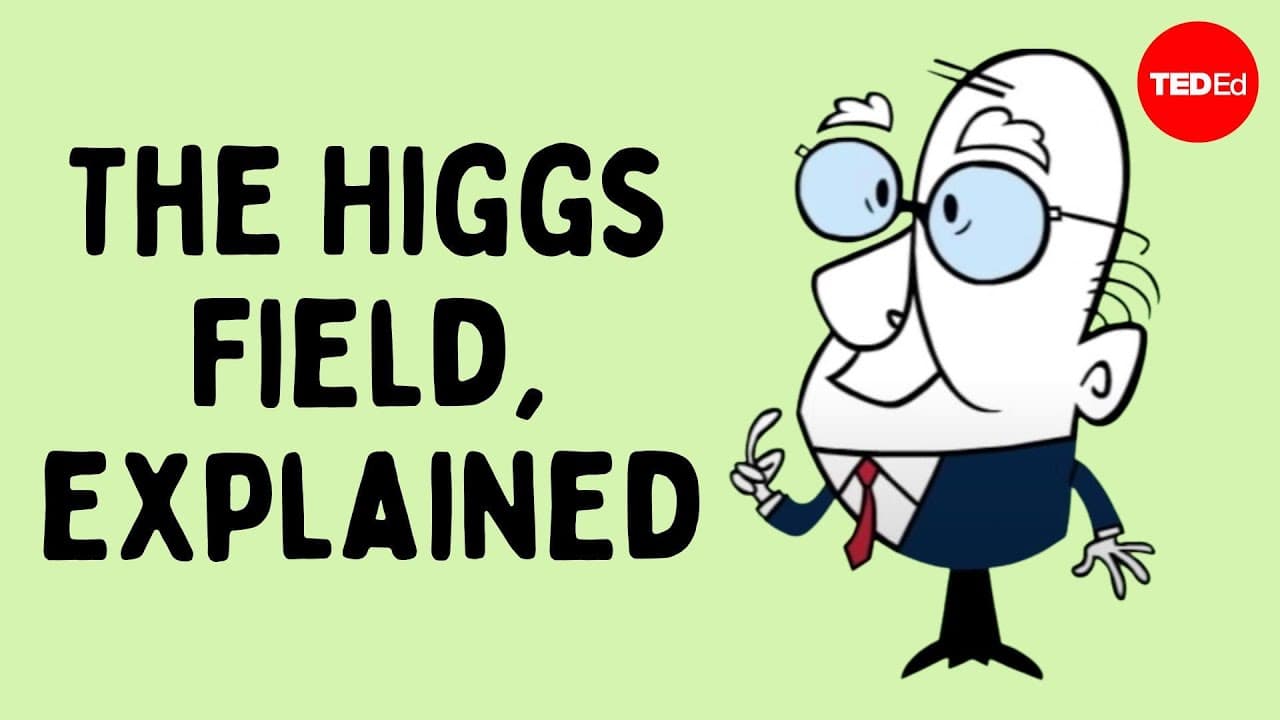
The Higgs Field, explained - Don Lincoln
992.8K views
•
August 27, 2013
by
TED-Ed
YouTube video player
The Higgs Field, explained - Don Lincoln

TL;DR

The Higgs boson gives mass to particles through interactions with the Higgs Field.

Transcript

Without a doubt, the most exciting scientific observation of 2012 was the discovery of a new particle at the CERN laboratory that could be the Higgs boson, a particle named after physicist Peter Higgs. The Higgs Field is thought to give mass to fundamental, subatomic particles like the quarks and leptons that make up ordinary matter. The Higgs boso... Read More

Key Insights

  • 💋 The Higgs boson's discovery at CERN in 2012 marked a significant advancement in particle physics understanding.
  • 💆 The Higgs Field is theorized to provide mass to fundamental particles through interactions.
  • 🥳 The Higgs mechanism, explained through a party analogy, simplifies the concept of mass acquisition for particles.
  • 💆 Massless particles don't interact with the Higgs Field, remaining without mass.
  • 🏑 The Higgs boson is compared to a rumor moving through a crowd, representing a clump in the field.
  • 💆 Interactions with the Higgs Field determine the mass of particles, illustrating the importance of particle-field interactions.
  • 🥳 The analogy of a party crowd helps visualize the complex concept of particles gaining mass through field interactions.

Install to Summarize YouTube Videos and Get Transcripts

Explore YouTube Video Summarizer or Get YouTube Transcript Extractor

Questions & Answers

Q: What was the most significant scientific observation of 2012?

The discovery at CERN of a new particle that could be the Higgs boson, crucial in understanding how particles gain mass through interactions with the Higgs Field.

Q: How does the Higgs Field give mass to particles?

Just like different people moving through a party crowd at different speeds based on popularity, particles gain mass depending on their interactions with the Higgs Field.

Q: Why is the Higgs boson compared to a rumor moving through a crowd?

The Higgs boson is seen as a clump in the Higgs Field, similar to how a rumor creates a clump in a party crowd, illustrating particle interactions and mass acquisition.

Q: What was the explanation for the Higgs mechanism using a party analogy?

The winning explanation likened the Higgs Field to a party crowd, where particles interacting gain mass while those that don't remain massless, with the Higgs boson as a clump in the field.

Summary & Key Takeaways

  • The Higgs boson, discovered in 2012 at CERN, interacts with the Higgs Field to give particles mass.

  • The Higgs Field is like a party crowd; particles that interact gain mass, while massless ones don't.

  • The Higgs boson is a clump in the field, akin to a rumor moving through the crowd.


Read in Other Languages (beta)

English

Share This Summary 📚

Summarize YouTube Videos and Get Video Transcripts with 1-Click

Download browser extensions on:

Try YouTube Summary with ChatGPT & Claude or YouTube Transcript Generator

Explore More Summaries from TED-Ed 📚
Why Do We Eat Popcorn at the Movies? thumbnail
Why Do We Eat Popcorn at the Movies?
TED-Ed
What causes cavities? - Mel Rosenberg thumbnail
What causes cavities? - Mel Rosenberg
TED-Ed
Could you survive the real Twilight Zone? - Philip Renaud and Kenneth Kostel thumbnail
Could you survive the real Twilight Zone? - Philip Renaud and Kenneth Kostel
TED-Ed
History vs. Vladimir Lenin - Alex Gendler thumbnail
History vs. Vladimir Lenin - Alex Gendler
TED-Ed
A day in the life of a Roman soldier - Robert Garland thumbnail
A day in the life of a Roman soldier - Robert Garland
TED-Ed
Can you solve the fish riddle? -  Steve Wyborney thumbnail
Can you solve the fish riddle? - Steve Wyborney
TED-Ed

Summarize YouTube Videos and Get Video Transcripts with 1-Click

Download browser extensions on:

Try YouTube Summary with ChatGPT & Claude or YouTube Transcript Generator

Apps & Extensions

  • Chrome Extension
  • Safari Extension
  • Edge Add-ons
  • Firefox Add-ons
  • iOS App
  • Android App

Key Features

  • YouTube Video Summarizer
  • Web & PDF Summarizer
  • Web & PDF Highlighter
  • Chat with PDF
  • Ask AI Clone
  • Audio Transcriber
  • Glasp Reader
  • Kindle Highlight Export
  • Idea Hatch

Integrations

  • Obsidian Plugin
  • Notion Integration
  • Pocket Integration
  • Instapaper Integration
  • Medium Integration
  • Readwise Integration
  • Snipd Integration
  • Hypothesis Integration

More Features

  • APIs
  • MCP Connector
  • Blog & Post
  • Embed Links
  • Image Highlight
  • Personality Test
  • Quote Shots

Company

  • About us
  • Blog
  • Community
  • FAQs
  • Job Board
  • Newsletter
  • Pricing
Terms

•

Privacy

•

Guidelines

© 2026 Glasp Inc. All rights reserved.