A Hackers' Guide to Language Models
TL;DR
This content provides a code-first approach to understanding and using language models, with a focus on practical applications.
Transcript
hi I am Jeremy Howard from fast.ai and this is a hacker's guide to language models when I say a hacker's guide what we're going to be looking at is a code first approach to understanding how to use language models in practice so before we get started we should probably talk about what is a language model I would say that this is going to make more ... Read More
Key Insights
- 🔑 Language models predict next words or fill in missing words based on context and probabilities.
- ❓ OpenAI offers powerful language models like GPT-4, which provide advanced text generation capabilities.
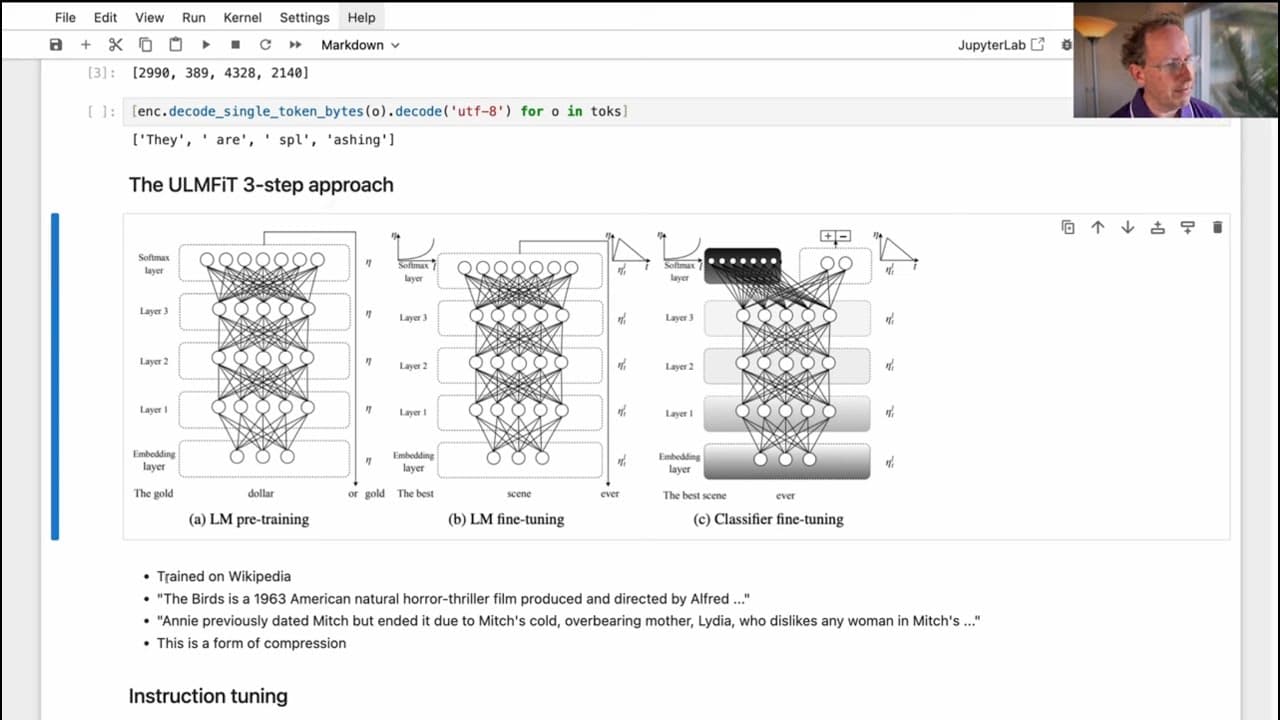
- 😑 Language models go through pre-training, fine-tuning, and classifier fine-tuning stages to enhance their performance.
- 🆘 Instruction tuning and RLHF (reinforcement learning from human feedback) help improve language models' ability to provide accurate and meaningful responses.
- 💁 Using language models requires understanding the context, prompt format, and available functions for effective usage.
- 💨 GPU acceleration and dedicated hardware can enhance the performance of language models for faster and more efficient computation.
- 📜 Retrieval augmented generation enables language models to leverage external documents for better response generation.
- 🥠 Language models can be fine-tuned for specific tasks or domains to improve their performance and relevance.
Install to Summarize YouTube Videos and Get Transcripts
Explore YouTube Video Summarizer or Get YouTube Transcript Extractor
Questions & Answers
Q: How do language models predict the next word in a sentence?
Language models use training data to learn the patterns and probabilities of word sequences, allowing them to make predictions based on context.
Q: Can language models fill in missing words in a sentence?
Yes, language models can fill in missing words by considering the context and predicting the most likely word based on the input.
Q: What are the different stages of training a language model?
Language model training involves pre-training, fine-tuning, and classifier fine-tuning stages to optimize the model's ability to generate accurate and coherent text.
Q: What is the purpose of instruction tuning in language models?
Instruction tuning helps language models gain specialized knowledge by training them on specific datasets or tasks, enabling them to generate more relevant and accurate responses.
Key Insights:
- Language models predict next words or fill in missing words based on context and probabilities.
- OpenAI offers powerful language models like GPT-4, which provide advanced text generation capabilities.
- Language models go through pre-training, fine-tuning, and classifier fine-tuning stages to enhance their performance.
- Instruction tuning and RLHF (reinforcement learning from human feedback) help improve language models' ability to provide accurate and meaningful responses.
- Using language models requires understanding the context, prompt format, and available functions for effective usage.
- GPU acceleration and dedicated hardware can enhance the performance of language models for faster and more efficient computation.
- Retrieval augmented generation enables language models to leverage external documents for better response generation.
- Language models can be fine-tuned for specific tasks or domains to improve their performance and relevance.
- Understanding the limitations and potential biases of language models is essential for responsible and effective use.
Summary & Key Takeaways
-
Language models can predict the next word or fill in missing words in a sentence.
-
OpenAI offers language models like GPT-3 and GPT-4 that can be used for creative brainstorming and text generation.
-
Language models are trained through pre-training, fine-tuning, and classifier fine-tuning stages to optimize their capabilities.
Read in Other Languages (beta)
Share This Summary 📚
Summarize YouTube Videos and Get Video Transcripts with 1-Click
Try YouTube Summary with ChatGPT & Claude or YouTube Transcript Generator
Explore More Summaries from Jeremy Howard 📚
Summarize YouTube Videos and Get Video Transcripts with 1-Click
Try YouTube Summary with ChatGPT & Claude or YouTube Transcript Generator