What Is Practical Deep Learning for Coders?
TL;DR
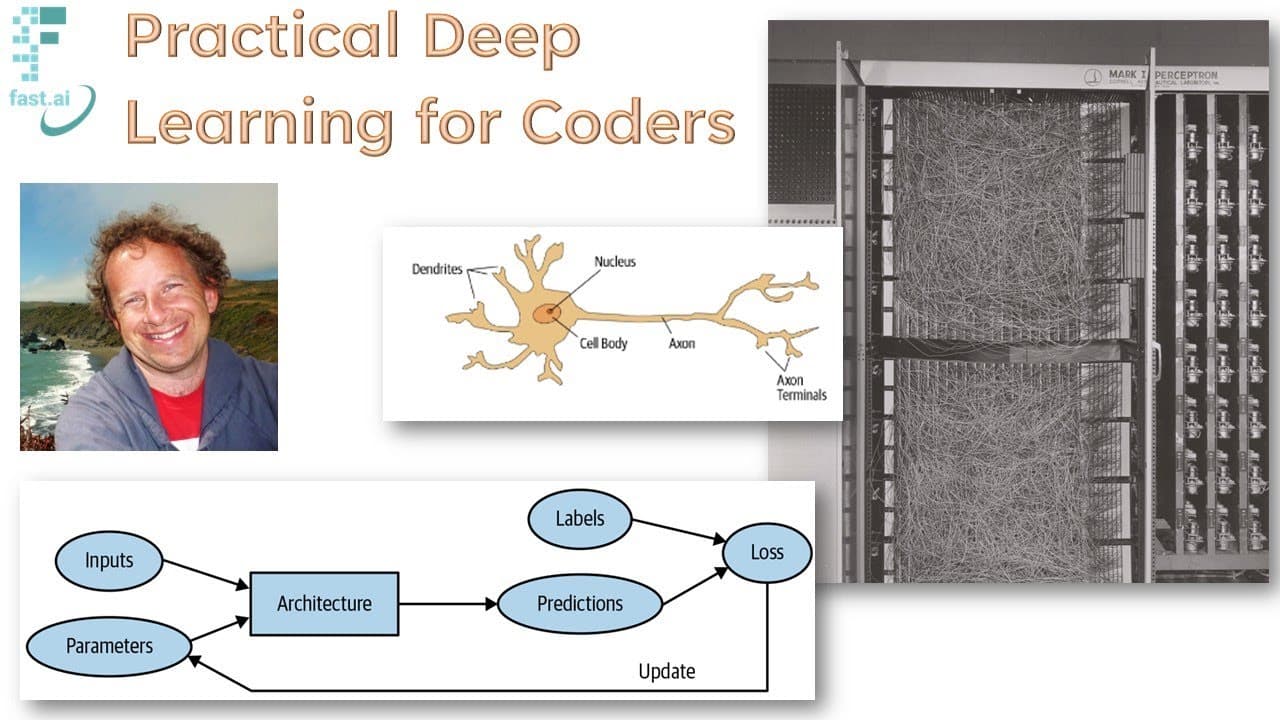
Practical Deep Learning for Coders teaches hands-on approaches to building models, such as image recognition systems, in a few minutes without extensive coding or complex math. The course uses tools like fast.ai and Jupyter notebooks to make deep learning accessible, efficient, and effective even for beginners, proving that advanced AI tasks can be achieved using simple systems on personal laptops.
Transcript
Welcome to Practical Deep Learning for coders, lesson one. This is version five of this course, and it's the first new one we've done in two years. So, we've got a lot of cool things to cover! It's amazing how much has changed. Here is an xkcd from the end of 2015. Who here has seen xkcd comics before? …Pretty much everybody. Not surprisi... Read More
Key Insights
- 🤖 Building a computer vision "is it a bird" system for free in 2 minutes demonstrates how much has changed over the years.
- 📐 Images are made of numbers, so they can be used as inputs for computer programs, allowing recognition of objects, such as birds versus non-birds, using deep learning models.
- 🖼️ Practical deep learning models make it easy to check and analyze your data, which is especially useful for computer vision models.
- 💻 Practical deep learning for coders does not require extensive code or complex math. It is accessible and efficient, even on personal laptops.
- ✨ AI-based models using deep learning algorithms are capable of generating new pictures and interpreting complex tasks like explaining jokes.
- 🎛️ Fast.ai is a powerful library that simplifies the process of using deep learning models and provides pre-trained weights for quick and efficient training.
- 🔬 Deep learning is a rapidly evolving field, and recent advancements, such as transfer learning and integrating various models, have made it more accessible and efficient.
- 📺 Jupyter notebooks provide a user-friendly environment for coding, experimentation, exploration, and even creating presentations using extensions like "Rise."
Install to Summarize YouTube Videos and Get Transcripts
Explore YouTube Video Summarizer or Get YouTube Transcript Extractor
Questions & Answers
Q: What are the different types of models covered in the Practical Deep Learning for Coders course?
The course covers various models, including image recognition, segmentation, tabular analysis, and collaborative filtering.
Q: How does the data block concept simplify the process of building models in fast.ai?
The data block in fast.ai allows users to define the input, output, label, and transforms of their data in a flexible and concise way, making it easier to create models.
Q: What are the advantages of using pre-trained models in deep learning?
Pre-trained models save time and resources by providing pre-trained weights and allowing models to be fine-tuned for specific tasks, leading to faster and more accurate results.
Q: How does the collaborative filtering model work in recommendation systems?
Collaborative filtering uses user-item ratings to find similar users and recommends items based on what those similar users liked, enabling personalized recommendations.
Summary & Key Takeaways
-
Introduction to the Practical Deep Learning for Coders course.
-
Building an "is it a bird" image recognition system.
-
Exploring different types of models: segmentation, tabular analysis, and collaborative filtering.
Read in Other Languages (beta)
Share This Summary 📚
Summarize YouTube Videos and Get Video Transcripts with 1-Click
Try YouTube Summary with ChatGPT & Claude or YouTube Transcript Generator
Explore More Summaries from Jeremy Howard 📚

Summarize YouTube Videos and Get Video Transcripts with 1-Click
Try YouTube Summary with ChatGPT & Claude or YouTube Transcript Generator