How Does Le Chatelier's Principle Affect Equilibrium?
TL;DR
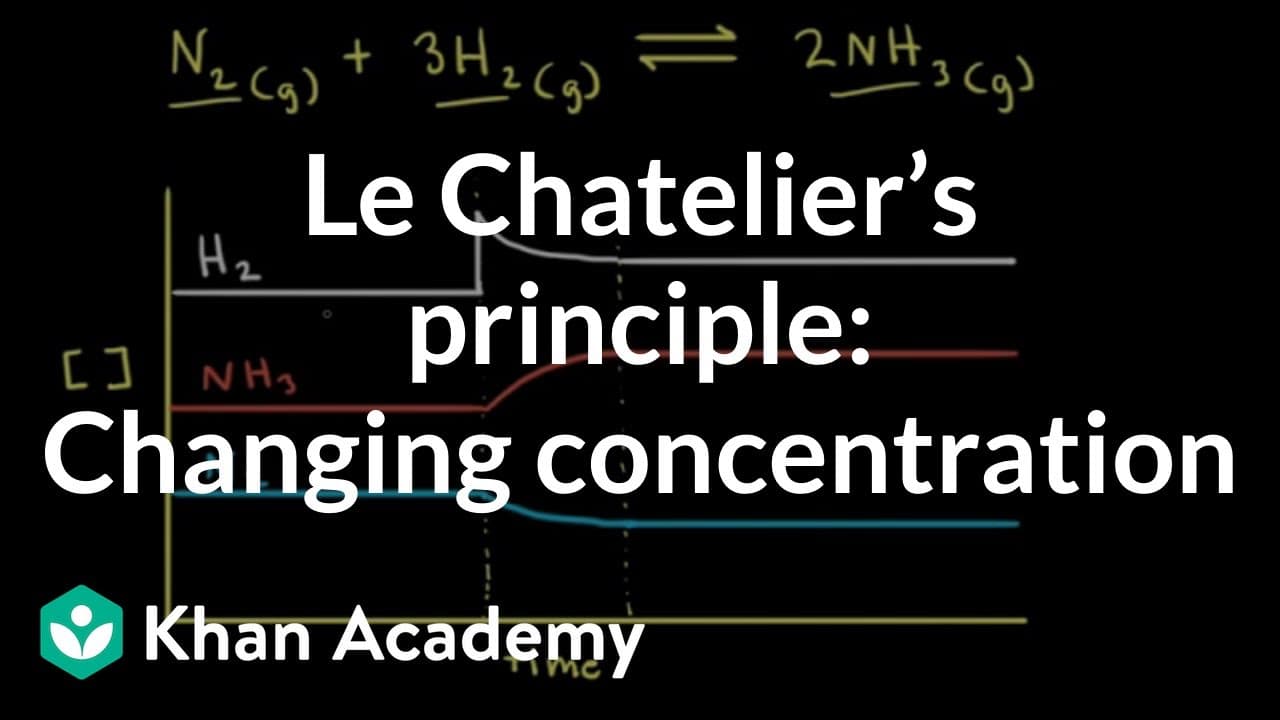
Le Chatelier's principle states that increasing the concentration of a reactant will shift the net reaction to the right, while increasing a product will shift it to the left. This principle helps predict how reactions adjust to stresses like concentration changes. By calculating reaction quotients, we can understand and forecast the direction of these shifts in equilibrium reactions.
Transcript
- [Instructor] Le Chatelier's principle says, if a stress is applied to a reaction mixture at equilibrium, the net reaction goes in the direction that relieves the stress. Change in the concentration of a reactant or product is one way to place a stress on a reaction at equilibrium. For example, let's consider the hypothetical reaction where gas A ... Read More
Key Insights
- ♌ Le Chatelier's principle explains how equilibrium reactions respond to stresses.
- 🪐 Changes in concentration can be used as a stress to shift the net reaction in a desired direction.
- 🪐 By calculating the reaction quotient (Qc) and comparing it to the equilibrium constant (Kc), we can predict the direction of the net reaction shift.
- 🥺 Increasing the concentration of a reactant leads to a shift to the right, while increasing the concentration of a product leads to a shift to the left.
Install to Summarize YouTube Videos and Get Transcripts
Explore YouTube Video Summarizer or Get YouTube Transcript Extractor
Questions & Answers
Q: What is Le Chatelier's principle?
Le Chatelier's principle states that if a stress is applied to a reaction at equilibrium, the net reaction will shift in a way that reduces the impact of the stress. This principle allows us to predict how equilibrium systems will respond to changes.
Q: How can we determine the direction of the net reaction shift?
By using particulate diagrams and calculating the reaction quotient (Qc), we can determine whether Qc is greater than or less than the equilibrium constant (Kc). If Qc is greater than Kc, the net reaction will shift to the right. If Qc is less than Kc, the net reaction will shift to the left.
Q: How does increasing the concentration of a reactant affect the net reaction?
Increasing the concentration of a reactant causes the net reaction to shift to the right. This occurs because the increased concentration creates an imbalance, and the reaction proceeds in the forward direction to relieve the stress by consuming more of the reactant.
Q: What happens if we increase the concentration of a product in an equilibrium reaction?
If we increase the concentration of a product, the net reaction will shift to the left. This is because the increased concentration of the product creates an imbalance, and the reaction proceeds in the reverse direction to decrease the amount of the product.
Summary & Key Takeaways
-
Le Chatelier's principle explains that if a stress, such as a change in concentration, is applied to a reaction at equilibrium, the net reaction will shift in the direction that relieves the stress.
-
By using particulate diagrams and calculating the reaction quotient (Qc), it is possible to determine the direction in which the net reaction will shift.
-
Increasing the concentration of a reactant will cause the net reaction to shift to the right, while increasing the concentration of a product will cause the net reaction to shift to the left.
Read in Other Languages (beta)
Share This Summary 📚
Summarize YouTube Videos and Get Video Transcripts with 1-Click
Try YouTube Summary with ChatGPT & Claude or YouTube Transcript Generator
Explore More Summaries from Khan Academy 📚



Summarize YouTube Videos and Get Video Transcripts with 1-Click
Try YouTube Summary with ChatGPT & Claude or YouTube Transcript Generator