Factor markets worked example | Microeconomics | Khan Academy
TL;DR
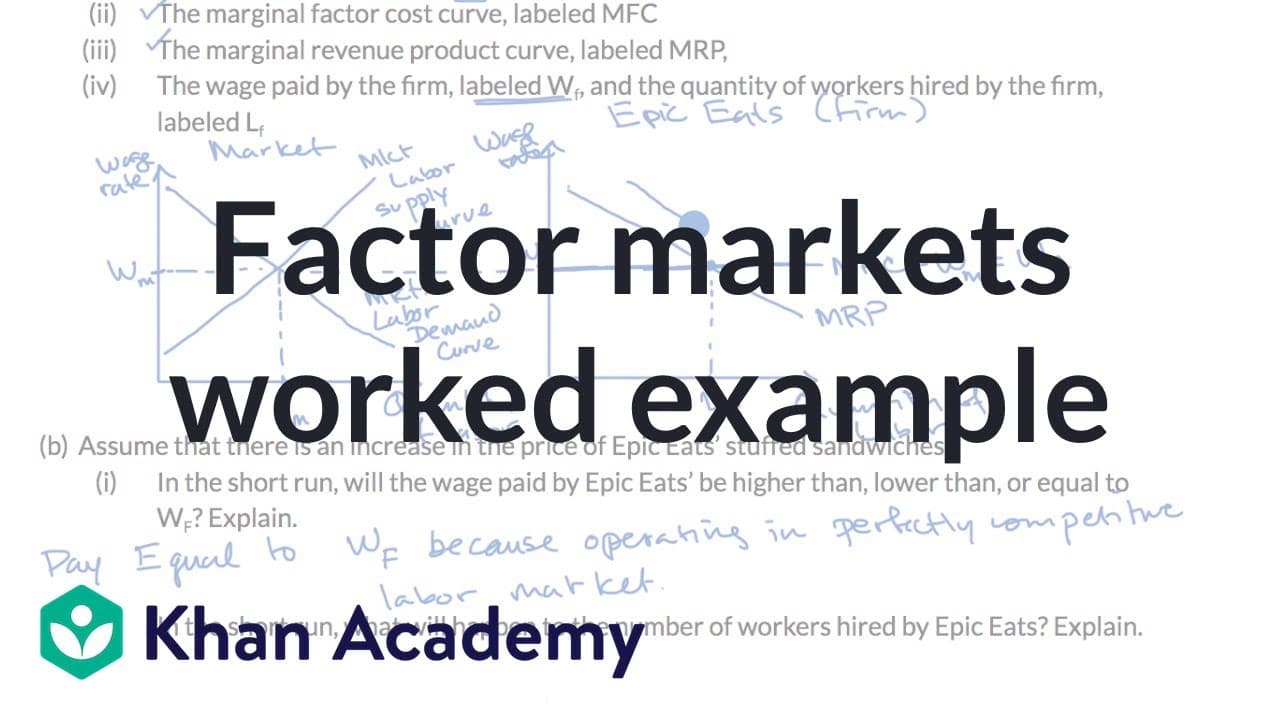
This video analyzes the labor market and firm behavior of Epic Eats, a perfectly competitive producer of stuffed sandwiches, and explains concepts like market equilibrium, marginal factor cost, and marginal revenue product.
Transcript
- [Narrator] We're told that Epic Eats is a perfectly competitive, profit-maximizing producer of stuffed sandwiches, and hires workers in a perfectly competitive labor market. Part A says, draw side-by-side graphs for the labor market and for Epic Eats and show each of the following. So pause this video and see if you could have a go at it before w... Read More
Key Insights
- ⚾ Perfectly competitive firms, like Epic Eats, determine the quantity of labor to hire based on the intersection of the MRP and MFC curves.
- 🔬 The market wage is determined by the equilibrium between labor demand and labor supply in the market.
- 🏃 In the short run, the firm pays the market wage, regardless of the quantity of labor hired.
- 🥺 An increase in the product price can lead to an increase in the number of workers hired by the firm.
Install to Summarize YouTube Videos and Get Transcripts
Explore YouTube Video Summarizer or Get YouTube Transcript Extractor
Questions & Answers
Q: How is the market wage determined and how does it affect the quantity of labor demanded?
The market wage is determined by the intersection of labor demand and labor supply curves. A high wage rate reduces labor demand, while a low wage rate increases labor demand. As the market wage increases, more people will be willing to work, leading to a higher quantity of labor demanded.
Q: What is the relationship between the marginal factor cost (MFC) curve and the wage paid by the firm?
The MFC curve represents the cost to Epic Eats of hiring additional workers. In a perfectly competitive labor market, the firm pays the market wage, which is equal to the wage paid by the firm. Therefore, the MFC curve and the wage paid by the firm are the same.
Q: How does an increase in the price of Epic Eats' stuffed sandwiches impact the number of workers hired by the firm in the short run?
An increase in the price of stuffed sandwiches will lead to an increase in the marginal revenue product (MRP) of labor. This shift in MRP will cause the firm to hire more workers, increasing the quantity of labor hired by Epic Eats in the short run.
Q: How is the wage rate determined when Epic Eats minimizes costs?
When Epic Eats minimizes costs, it invests in labor and capital in a way that maximizes the number of units per dollar. The wage rate is determined by equating the marginal product of capital divided by the price of capital with the marginal product of labor divided by the price of labor.
Summary & Key Takeaways
-
The video discusses the labor market and firm behavior of Epic Eats, using side-by-side graphs to illustrate the quantity of labor, wages, labor demand, and labor supply in the market.
-
It explains the concept of marginal factor cost (MFC) and marginal revenue product (MRP), showing how they influence the quantity of workers hired by Epic Eats.
-
In the short run, the wage paid by Epic Eats will be equal to the market wage, and an increase in the price of stuffed sandwiches will lead to an increase in the number of workers hired by Epic Eats.
-
The video also calculates the wage rate by considering the marginal product of capital, marginal product of labor, and rental rate of capital.
Read in Other Languages (beta)
Share This Summary 📚
Summarize YouTube Videos and Get Video Transcripts with 1-Click
Try YouTube Summary with ChatGPT & Claude or YouTube Transcript Generator
Explore More Summaries from Khan Academy 📚



Summarize YouTube Videos and Get Video Transcripts with 1-Click
Try YouTube Summary with ChatGPT & Claude or YouTube Transcript Generator