Flow Through Pipes Problem 7 - Flow Through Pipes - Fluid Mechanics
TL;DR
Solving pipe flow numericals to calculate diameter and efficiency based on power transmission concepts.
Transcript
Do subscribe to Ekeeda Channel and press bell icon to get updates about latest engineering HSC and IIT JEE main and advanced videos so we've already seen the theory part of flow through pipes I've seen different types of losses major losses minor losses now let's few new numericals and try to understand how the formula and everything is related ... Read More
Key Insights
- 🌸 Pipe flow calculations involve determining head, pressure, and friction losses.
- ✊ Efficiency in pipe flow depends on the input and output power considerations.
- 🤕 Pipe diameter calculation requires knowledge of head losses and friction factor.
- ✊ Power transmission concepts are integral to solving pipe flow numericals.
- 🤕 Understanding the relationship between pressure, head, losses, and efficiency is crucial.
- ❓ Calculating pipe characteristics like diameter involves utilizing known parameters like velocity and discharge.
- ✊ Efficiency calculation in pipe flow provides insights into power transmission effectiveness.
Install to Summarize YouTube Videos and Get Transcripts
Explore YouTube Video Summarizer or Get YouTube Transcript Extractor
Questions & Answers
Q: How do you calculate the head at the inlet of a pipe?
The head at the inlet of a pipe can be calculated by dividing the pressure by the product of density and acceleration due to gravity, using the formula h = P/(ρg).
Q: What is the formula to calculate head loss due to friction in a pipe?
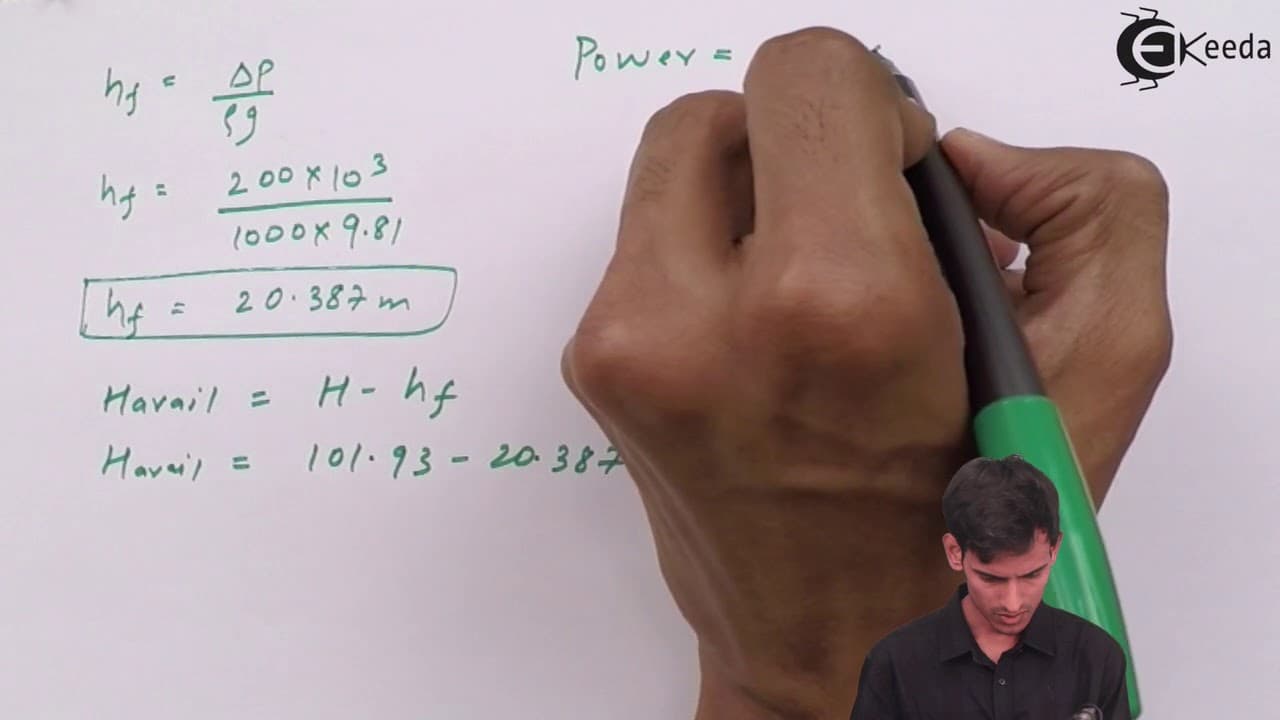
The head loss due to friction in a pipe can be calculated by dividing the pressure drop by the product of density and acceleration due to gravity, using the formula hf = ΔP/(ρg).
Q: How is efficiency in pipe flow defined and calculated?
Efficiency in pipe flow is defined as the ratio of output power (head available at the outlet) to input power (head at the inlet). It is calculated as efficiency = (H - Hf) / H.
Q: How can the diameter of a pipe be calculated using pipe flow numericals?
The diameter of a pipe can be calculated by using the head loss due to friction, the friction factor, the length of the pipe, and the known discharge. Rearranging the Darcy's equation will give the diameter value.
Summary & Key Takeaways
-
Analyzing pipe flow numericals to find diameter and efficiency for power transmission.
-
Calculating head, pressure, and friction losses to determine pipe characteristics.
-
Demonstrating the relationship between power, pressure, head, diameter, and efficiency in pipe flow calculations.
Read in Other Languages (beta)
Share This Summary 📚
Summarize YouTube Videos and Get Video Transcripts with 1-Click
Try YouTube Summary with ChatGPT & Claude or YouTube Transcript Generator
Explore More Summaries from Ekeeda 📚





Summarize YouTube Videos and Get Video Transcripts with 1-Click
Try YouTube Summary with ChatGPT & Claude or YouTube Transcript Generator