What Is a Transfer Function in Control Systems?
TL;DR
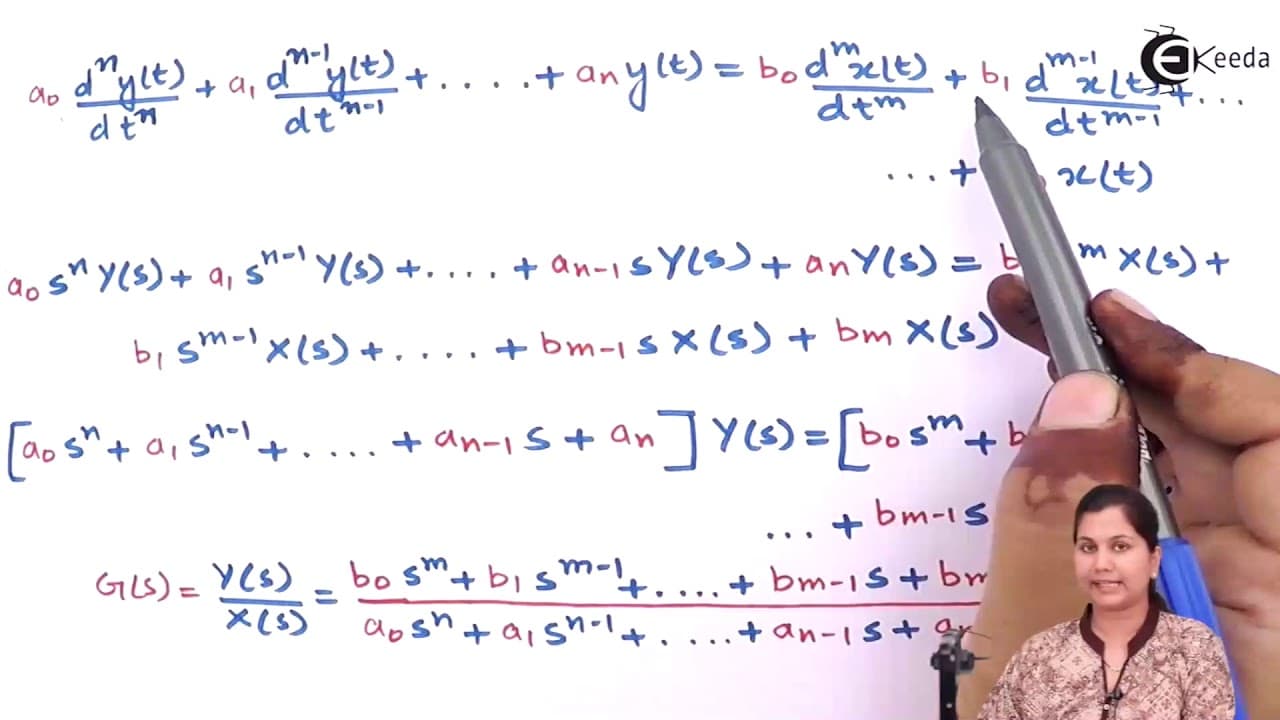
A transfer function is the ratio of the Laplace transform of a system's output to the Laplace transform of its input, assuming zero initial conditions. It characterizes the input-output relationship of linear time-invariant systems, allowing for easier analysis of their behavior in response to various inputs.
Transcript
hello friends in this video we are going to see that what is a transfer function a simple system or element it may be represented by a first order or a second order differential equation when several elements suppose n elements are connected in sequence and each element is having first order then the total order of the system is n a system or a col... Read More
Key Insights
- ⌛ Transfer functions simplify system analysis by relating input to output in linear time-invariant systems.
- 🦻 Laplace transforms aid in converting differential equations into manageable algebraic equations.
- 0️⃣ Zero initial conditions assumption ensures transfer functions accurately represent system behavior.
- 🥳 The transfer function ratio of Laplace transforms reflects the input-output relationship under ideal conditions.
- 🎮 Transfer functions are fundamental in engineering for system modeling, analysis, and control design.
- 🖐️ They play a crucial role in understanding and predicting the dynamic behavior of complex systems.
- 🎮 Transfer functions provide a concise representation of system dynamics for control and optimization purposes.
Install to Summarize YouTube Videos and Get Transcripts
Explore YouTube Video Summarizer or Get YouTube Transcript Extractor
Questions & Answers
Q: What is a transfer function in control systems?
A transfer function is the ratio of the Laplace transform of the output to the Laplace transform of the input, assuming all initial conditions are zero. It represents the system's input-output relationship.
Q: How are transfer functions derived from differential equations?
By taking the Laplace transform of differential equations, terms are simplified into algebraic form, allowing for the determination of the transfer function relating input to output.
Q: Why is it important to assume zero initial conditions in transfer function analysis?
Assuming zero initial conditions ensures the transfer function solely reflects the relationship between input and output without the influence of initial system states.
Q: How do transfer functions characterize systems in engineering?
Transfer functions help engineers understand and analyze the behavior of systems described by linear time-invariant differential equations, offering insights into system dynamics and control.
Summary & Key Takeaways
-
Transfer functions represent the relationship between input and output in systems described by linear differential equations.
-
Laplace transforms are used to simplify differential equations into algebraic equations.
-
The transfer function ratio of output to input Laplace transforms characterizes system behavior.
Read in Other Languages (beta)
Share This Summary 📚
Summarize YouTube Videos and Get Video Transcripts with 1-Click
Try YouTube Summary with ChatGPT & Claude or YouTube Transcript Generator
Explore More Summaries from Ekeeda 📚



Summarize YouTube Videos and Get Video Transcripts with 1-Click
Try YouTube Summary with ChatGPT & Claude or YouTube Transcript Generator