Problems on Regular Grammer Part 05
TL;DR
Solving questions involving finite automata, regular expression, and regular grammar for binary alphabets of different lengths.
Transcript
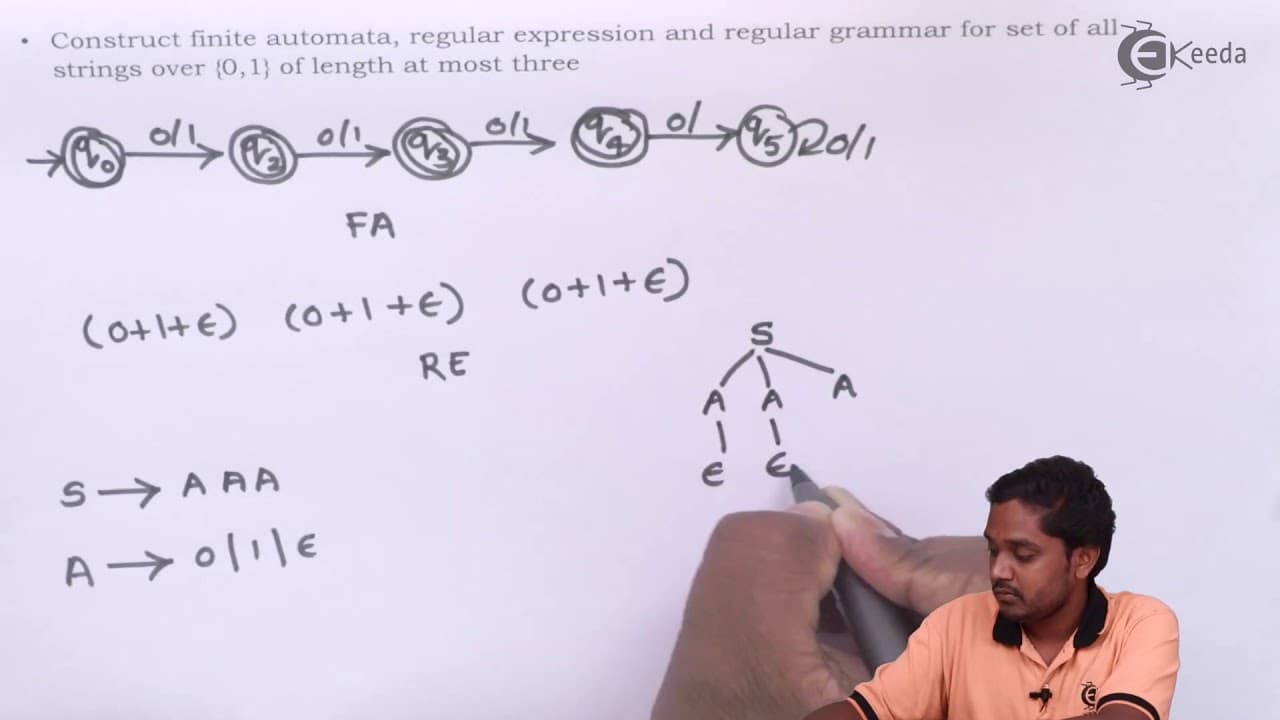
click the Bell icon to get latest videos from equator hello friends let us try to solve few more questions on pointing finite automata regular expression and regular grammar the first question over here is finding the regular expression regular grammar and finite automata for the set of straight or binary alphabet which has length at least 3 here t... Read More
Key Insights
- 😑 Conversion between finite automata, regular expressions, and regular grammar requires a deep understanding of language theory concepts.
- 😑 Regular expressions capture the patterns and sequences of characters in a language, aiding in systematic string recognition.
- 📏 Regular grammar production rules dictate the generation of strings with specific characteristics and lengths, enabling precise language modeling.
- 🛟 Finite automata serve as abstract machines that recognize strings based on defined states and transitions.
- 😑 Understanding the relationship between finite automata, regular expressions, and regular grammar is fundamental for solving language processing problems.
- 🚱 Mathematical representations of language components, such as non-terminals, terminals, and productions, streamline the analysis of language structures.
- 🌲 Parse trees visually represent the derivation of strings in a language, showcasing the step-by-step generation process.
Install to Summarize YouTube Videos and Get Transcripts
Explore YouTube Video Summarizer or Get YouTube Transcript Extractor
Questions & Answers
Q: What is the process of finding regular expressions, regular grammars, and finite automata for binary alphabets?
The process involves determining the structures for binary strings with specific lengths and converting between finite automata, regular expressions, and regular grammar.
Q: How are regular expressions derived from finite automata?
Regular expressions are derived by defining the combinations of characters that lead to specific states in the finite automata, capturing the language's structure.
Q: What role do non-terminals and terminals play in regular grammars?
Non-terminals represent variables while terminals represent constants, guiding the production rules to generate strings following specific patterns in regular grammar.
Q: How does the construction of finite automata ensure the acceptance of strings of varying lengths?
By defining states and transitions in the finite automata, it can accurately depict the acceptance of strings based on their lengths, leading to precise language recognition.
Summary & Key Takeaways
-
Determines regular expressions, regular grammars, and finite automata for binary alphabets of at least length 3.
-
Illustrates the conversion of finite automata to regular expressions and regular grammar step-by-step.
-
Presents the construction of finite automata, regular expression, and regular grammar for binary strings of specific lengths.
Read in Other Languages (beta)
Share This Summary 📚
Summarize YouTube Videos and Get Video Transcripts with 1-Click
Try YouTube Summary with ChatGPT & Claude or YouTube Transcript Generator
Explore More Summaries from Ekeeda 📚




Summarize YouTube Videos and Get Video Transcripts with 1-Click
Try YouTube Summary with ChatGPT & Claude or YouTube Transcript Generator