Products
Features
YouTube Video Summarizer
Summarize YouTube videos
Web & PDF Highlighter
Highlight web pages & PDFs
Chat with PDF
Ask any PDF questions with AI
Ask AI Clone
Chat with your highlights & memories
Audio Transcriber
Transcribe audio files to text
Glasp Reader
Read and highlight articles
Kindle Highlight Export
Export your Kindle highlights
Idea Hatch
Hatch ideas from your highlights
Integrations
Obsidian Plugin
Notion Integration
Pocket Integration
Instapaper Integration
Medium Integration
Readwise Integration
Snipd Integration
Hypothesis Integration
Apps & Extensions
Chrome Extension
Safari Extension
Edge Add-ons
Firefox Add-ons
iOS App
Android App
Discover
Discover
Ideas
Discover new ideas and insights
Articles
Curated articles and insights
Books
Book recommendations by great minds
Posts
Essays and notes from readers
Quotes
Inspiring quotes collection
Videos
Curated videos and summaries
Explore Glasp
Glasp Newsletter
Weekly insights and updates
Glasp Talk
Interview series with great minds
Glasp Blog
Latest news and articles
Glasp Use Cases
Learn how others use Glasp
Build & Support
Glasp API
Access Glasp's API for developers
MCP Connector
Connect Glasp to Claude & ChatGPT
Community
Glasp Reddit Community
Students
Student discount and benefits
FAQs
Frequently Asked Questions
AboutPricing
DashboardLog inSign up

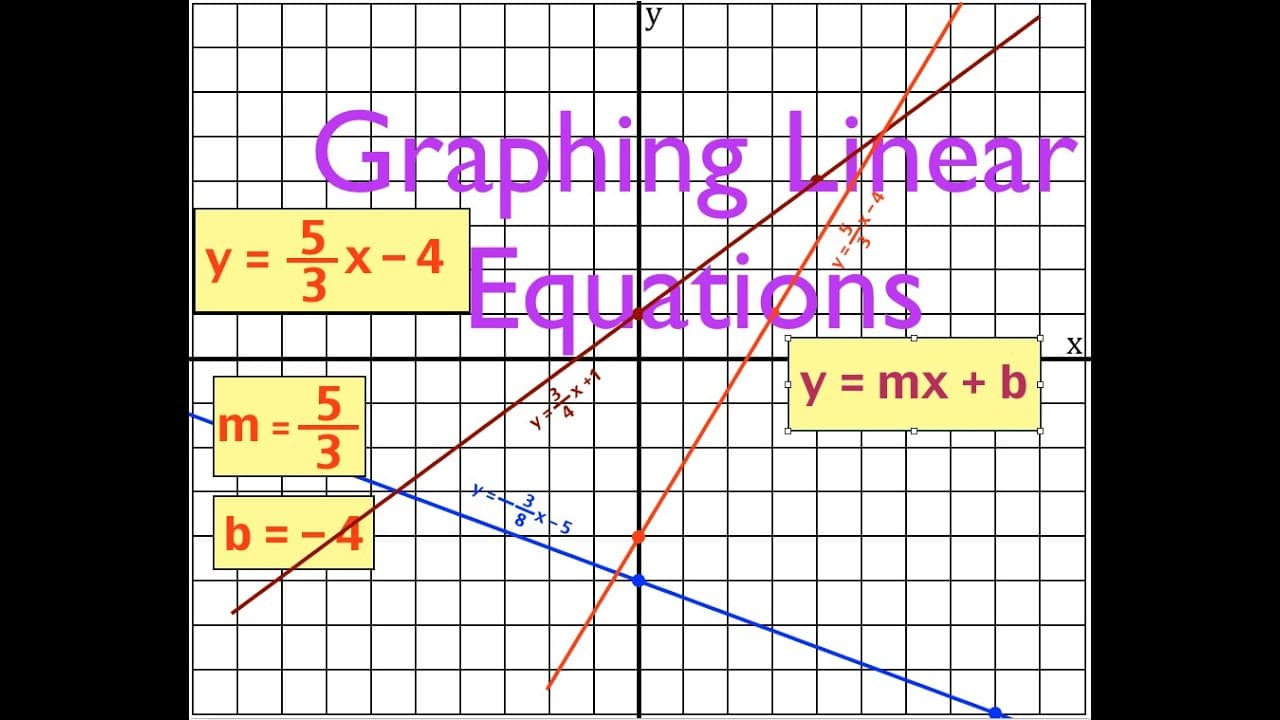
How to Graph Linear Equations in Slope-Intercept Form
1.9K views
•
December 9, 2014
by
Step by Step Science
YouTube video player
How to Graph Linear Equations in Slope-Intercept Form

TL;DR

To graph linear equations using slope-intercept form (y = mx + b), identify the y-intercept (b) and slope (m) for each equation. Start by plotting the y-intercept on the graph, and then use the slope to find a second point. Draw the line through these points to complete the graph.

Transcript

okay in today's video i'm going to show you how to graph the following seven linear equations and this is the situation we have we have our x and y coordinate system the y-axis the x-axis and these are the equations that we're going to graph you will notice that each of the seven equations that we're going to graph are already in the form y equals ... Read More

Key Insights

  • 💁‍♂️ Slope-intercept form (y=mx+b) is essential for graphing linear equations.
  • 😵 Y-intercept represents where the line crosses the y-axis.
  • 🫥 Slope indicates the line's direction and steepness.
  • 🆘 Plotting points using y-intercept and slope helps graph linear equations accurately.
  • 😮 Fractional slopes clarify the rise and run movement for graphing.
  • 📉 Negative slopes lead to downward sloping lines on the graph.
  • 😥 Following a systematic approach of plotting points ensures correct linear equation graphs.

Install to Summarize YouTube Videos and Get Transcripts

Explore YouTube Video Summarizer or Get YouTube Transcript Extractor

Questions & Answers

Q: What is the significance of the y-intercept in graphing linear equations?

The y-intercept is the point where the line crosses the y-axis, crucial for plotting the initial point when graphing linear equations.

Q: How does the slope affect the graph of a linear equation?

The slope determines the direction and steepness of the line; a positive slope goes up and a negative slope goes down, guiding the placement of the second point on the graph.

Q: Why is it important to write down the slope as a fraction when graphing linear equations?

Writing the slope as a fraction, such as rise over run, clarifies the direction and magnitude of the line's movement, aiding in accurate graphing.

Q: What are the key steps to follow when graphing linear equations using slope-intercept form?

The key steps include identifying the y-intercept, determining the slope, plotting the first point at the y-intercept, and then using the slope to find the second point for graphing the line.

Summary & Key Takeaways

  • Tutorial on graphing linear equations in slope-intercept form.

  • Emphasis on identifying y-intercept and slope for graphing.

  • Step-by-step guide to plotting points and drawing lines for linear equations.


Read in Other Languages (beta)

English

Share This Summary 📚

Summarize YouTube Videos and Get Video Transcripts with 1-Click

Download browser extensions on:

Try YouTube Summary with ChatGPT & Claude or YouTube Transcript Generator

Explore More Summaries from Step by Step Science 📚
Chemical Reactions (7 of 11) Stoichiometry: Grams to Moles thumbnail
Chemical Reactions (7 of 11) Stoichiometry: Grams to Moles
Step by Step Science
Momentum (4 of 16) Force vs Time Graph thumbnail
Momentum (4 of 16) Force vs Time Graph
Step by Step Science
Energy, Work & Power (11 of 31) Work Energy Principle, Net Work Done on an Object thumbnail
Energy, Work & Power (11 of 31) Work Energy Principle, Net Work Done on an Object
Step by Step Science
From the Molecular Formula to the Empirical Formula thumbnail
From the Molecular Formula to the Empirical Formula
Step by Step Science
Set Equal to Each Other, Systems of Linear Equations, No. 2 thumbnail
Set Equal to Each Other, Systems of Linear Equations, No. 2
Step by Step Science
Farsighteness vs. Nearsightedness, An Explanation thumbnail
Farsighteness vs. Nearsightedness, An Explanation
Step by Step Science

Summarize YouTube Videos and Get Video Transcripts with 1-Click

Download browser extensions on:

Try YouTube Summary with ChatGPT & Claude or YouTube Transcript Generator

Apps & Extensions

  • Chrome Extension
  • Safari Extension
  • Edge Add-ons
  • Firefox Add-ons
  • iOS App
  • Android App

Key Features

  • YouTube Video Summarizer
  • Web & PDF Summarizer
  • Web & PDF Highlighter
  • Chat with PDF
  • Ask AI Clone
  • Audio Transcriber
  • Glasp Reader
  • Kindle Highlight Export
  • Idea Hatch

Integrations

  • Obsidian Plugin
  • Notion Integration
  • Pocket Integration
  • Instapaper Integration
  • Medium Integration
  • Readwise Integration
  • Snipd Integration
  • Hypothesis Integration

More Features

  • APIs
  • MCP Connector
  • Blog & Post
  • Embed Links
  • Image Highlight
  • Personality Test
  • Quote Shots

Company

  • About us
  • Blog
  • Community
  • FAQs
  • Job Board
  • Newsletter
  • Pricing
Terms

•

Privacy

•

Guidelines

© 2026 Glasp Inc. All rights reserved.