Solution Of Differential Equation Using Inverse Z-Transform in Signals and Systems | Problem 3
TL;DR
- Learn step-by-step how to solve a differential equation using inverse Z-transforms for a system's step response.
Transcript
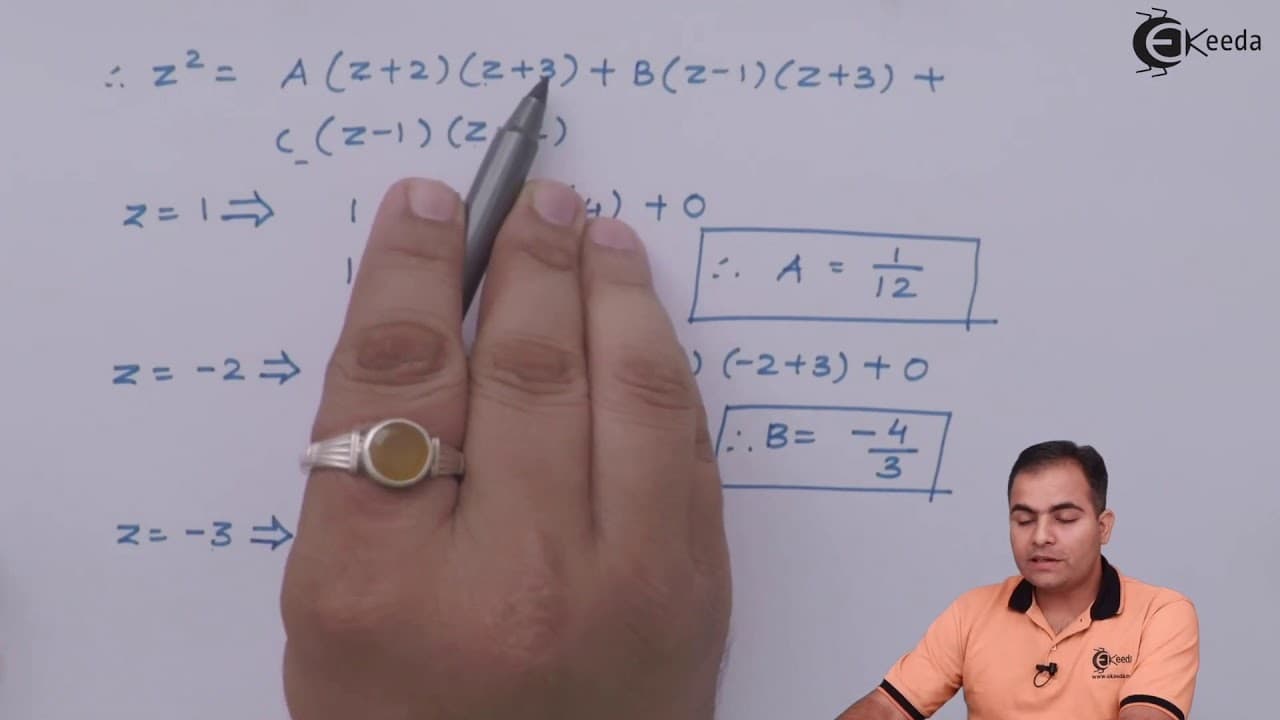
click the bell icon to get latest videos from ekeeda hello friends and today we are going to study a numerical or problem number three which is based on solution of differential equation using inverse z transform now we'll see the question 3 first a problem number 3 obtained step response of the system described by this differential equation 6y of ... Read More
Key Insights
- 🔠 Understanding how to substitute input as a unit step function for a system's step response.
- 🤪 Applying Z-transforms to differential equations to simplify the calculation process.
- 🍳 Importance of partial fractions in breaking down complex equations for constant determination.
- 💤 Solving for constants by substituting specific values of Z to find the system's step response accurately.
- 🍉 Step-by-step process outlined from transforming terms to determining system's step response.
- 🤪 Utilizing mathematical properties like time scaling to simplify Z-transform equations.
- ❓ Final step involves finding constants and deriving the system's step response.
Install to Summarize YouTube Videos and Get Transcripts
Explore YouTube Video Summarizer or Get YouTube Transcript Extractor
Questions & Answers
Q: How is the step response of a system described by a differential equation obtained?
The step response is obtained by substituting the input as a unit step function and applying Z-transforms to the differential equation.
Q: How are the Z-transforms of different terms in the equation calculated?
Each term in the equation is transformed using Z-transforms, considering constants and delays present in the equation.
Q: What is the importance of performing partial fractions in obtaining the system's step response?
Partial fractions help in breaking down the equation into simpler terms, making it easier to solve for the constants and eventually find the system's step response.
Q: How are the constants determined in the final step to find the system's step response?
By substituting specific values of Z into the equation and solving for the constants using the resulting equations, the system's step response can be calculated accurately.
Summary & Key Takeaways
-
The video discusses solving a differential equation for a system's step response using inverse Z-transforms.
-
Step-by-step instructions on substituting values and applying Z-transforms to the equation are provided.
-
Utilizing partial fractions and solving for constants to finally obtain the system's step response.
Read in Other Languages (beta)
Share This Summary 📚
Summarize YouTube Videos and Get Video Transcripts with 1-Click
Try YouTube Summary with ChatGPT & Claude or YouTube Transcript Generator
Explore More Summaries from Ekeeda 📚

Summarize YouTube Videos and Get Video Transcripts with 1-Click
Try YouTube Summary with ChatGPT & Claude or YouTube Transcript Generator