2015 AP Calculus AB 5a | AP Calculus AB solved exams | AP Calculus AB | Khan Academy
TL;DR
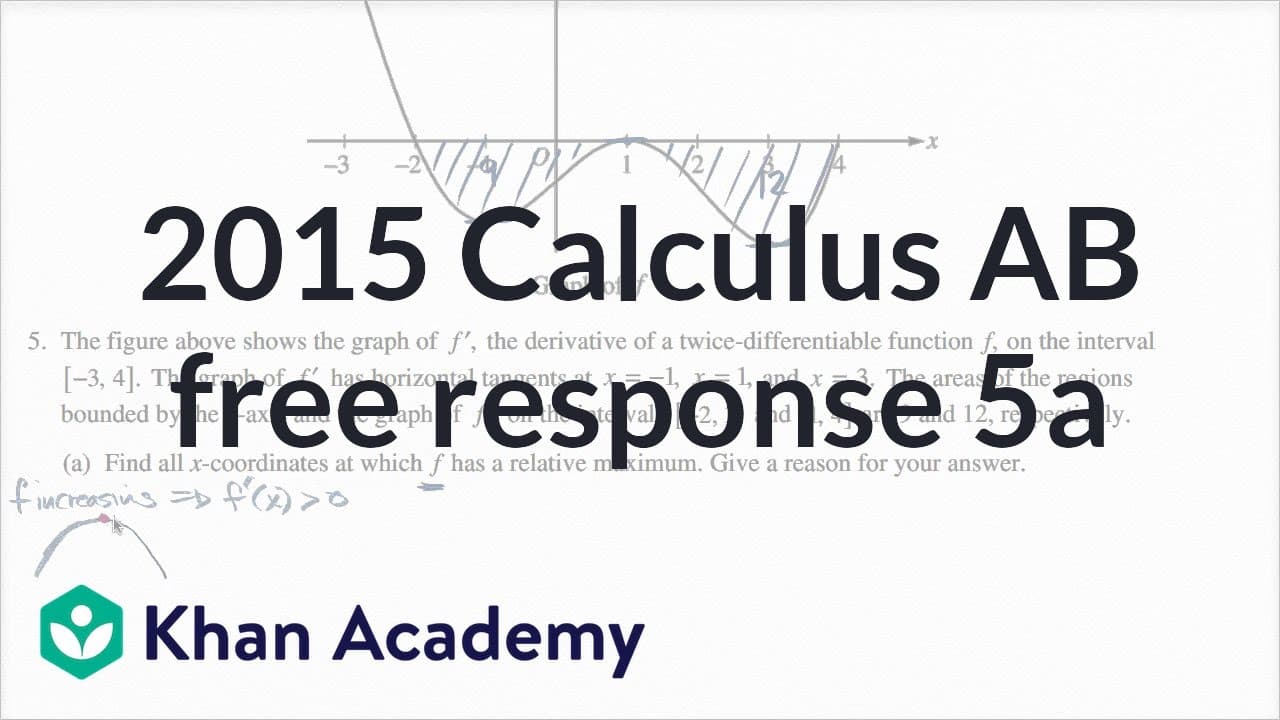
The video explains how to find the x-coordinates of relative maximum points by analyzing the graph of f prime.
Transcript
- [Voiceover] The figure above shows the graph of f prime, the derivative of a twice-differentiable function f, on the interval, that's a closed interval, from negative three to four. The graph of f prime has horizontal tangents at x equals negative one, x equals one, and x equals three. So you have a horizontal tangent right over, a horizontal tan... Read More
Key Insights
- ☺️ The graph of f prime shows horizontal tangents at x-values that might correspond to relative maximums for the function f.
- 😥 To determine if f has a relative maximum at a point, we analyze the behavior of f prime as it transitions from positive to negative.
- 😀 Observing the slopes of f and f prime helps identify increasing and decreasing regions of f.
- ☺️ The x-values where f prime transitions from positive to negative are the x-coordinates of relative maximums for f.
- 😀 Proper analysis of f prime and its transitions is crucial in finding relative maximums accurately.
- 😥 The video emphasizes understanding the relationship between f and f prime to solve for relative maximum points.
- 👻 Differentiable functions have specific patterns for relative maximums, allowing us to make informed conclusions.
Install to Summarize YouTube Videos and Get Transcripts
Explore YouTube Video Summarizer or Get YouTube Transcript Extractor
Questions & Answers
Q: How can we use the graph of f prime to find relative maximums of f?
By analyzing the points where f prime has horizontal tangents and looking for transitions from positive to negative, we can identify x-values for relative maximums.
Q: What does it mean for f to have a relative maximum?
A relative maximum occurs when the function reaches a high point within a local region. It is characterized by a positive slope approaching the maximum and a negative slope after.
Q: How does the graph of f prime help determine if f is increasing or decreasing?
The graph of f prime indicates the slope of f. If f prime is positive, f is increasing. If f prime is negative, f is decreasing.
Q: Why is it important to analyze the transitions of f prime from positive to negative?
The transitions from positive to negative in f prime correspond to the x-values where f has a relative maximum. This understanding helps us find the x-coordinates of these maximum points.
Summary & Key Takeaways
-
The video explores a graph of f prime, the derivative of a function f, and identifies x-values where f has relative maximums.
-
The points where f prime has horizontal tangents indicate possible relative maximums for f.
-
To find the x-values of relative maximums, we look for where f prime transitions from positive to negative.
Read in Other Languages (beta)
Share This Summary 📚
Summarize YouTube Videos and Get Video Transcripts with 1-Click
Try YouTube Summary with ChatGPT & Claude or YouTube Transcript Generator
Explore More Summaries from Khan Academy 📚



Summarize YouTube Videos and Get Video Transcripts with 1-Click
Try YouTube Summary with ChatGPT & Claude or YouTube Transcript Generator