Solving the logistic differential equation part 1 | Khan Academy
TL;DR
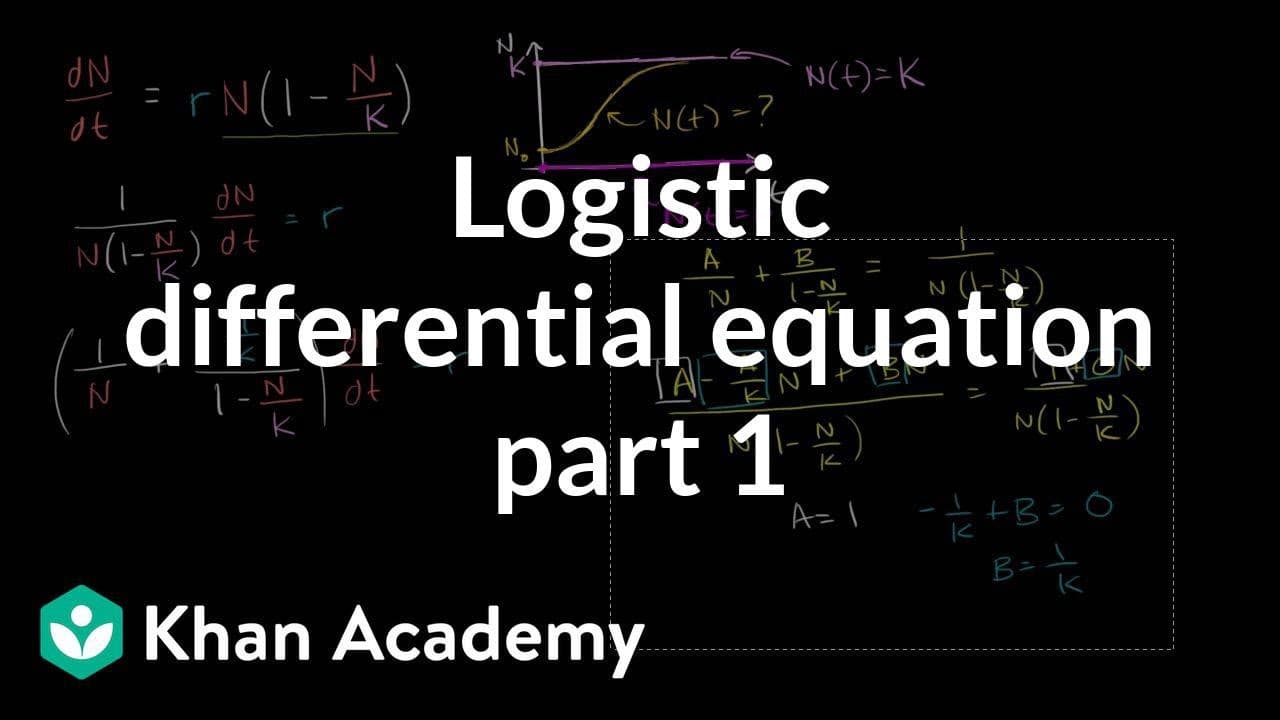
This video explores the solution for the logistic differential equation, which models population growth and saturation.
Transcript
-Let's now attempt to find a solution for the logistic differential equation. And we already found some constant solutions, we can think through that a little bit just as a little bit of review from the last few videos. So if this is the t-axis and this is the N-axis we already saw that if N of zero, if a time equals zero, or a population is zero, ... Read More
Key Insights
- 0️⃣ The logistic differential equation has constant solutions for zero population and the maximum capacity.
- ⌛ If the initial population is below the maximum capacity, the population will approach the maximum over time.
- ❓ The logistic differential equation can be solved through separation and partial fraction expansion.
Install to Summarize YouTube Videos and Get Transcripts
Explore YouTube Video Summarizer or Get YouTube Transcript Extractor
Questions & Answers
Q: What are the constant solutions of the logistic differential equation?
The constant solutions occur when the population is either zero or at its maximum capacity. The population remains unchanged in both cases.
Q: What happens to the population if it is initially below the maximum capacity?
If the initial population is below the maximum capacity, the rate of change of population increases as it approaches the maximum capacity.
Q: What is the logistic differential equation used to model?
The logistic differential equation is commonly used to model population growth, where the growth rate is proportional to both the population size and the available resources.
Q: How is the logistic differential equation solved?
The logistic differential equation is separable, and by using partial fraction expansion, an algebraic expression for the population can be derived.
Summary & Key Takeaways
-
The logistic differential equation has two constant solutions: when the population is zero and when it is at its maximum capacity.
-
If the initial population is between zero and the maximum capacity, the population will approach the maximum over time.
-
To find the analytic expression for the population, the differential equation is separated and partial fraction expansion is used.
Read in Other Languages (beta)
Share This Summary 📚
Summarize YouTube Videos and Get Video Transcripts with 1-Click
Try YouTube Summary with ChatGPT & Claude or YouTube Transcript Generator
Explore More Summaries from Khan Academy 📚



Summarize YouTube Videos and Get Video Transcripts with 1-Click
Try YouTube Summary with ChatGPT & Claude or YouTube Transcript Generator