Dynamically Equivalent System Numerical - Dynamics of Machinery
TL;DR
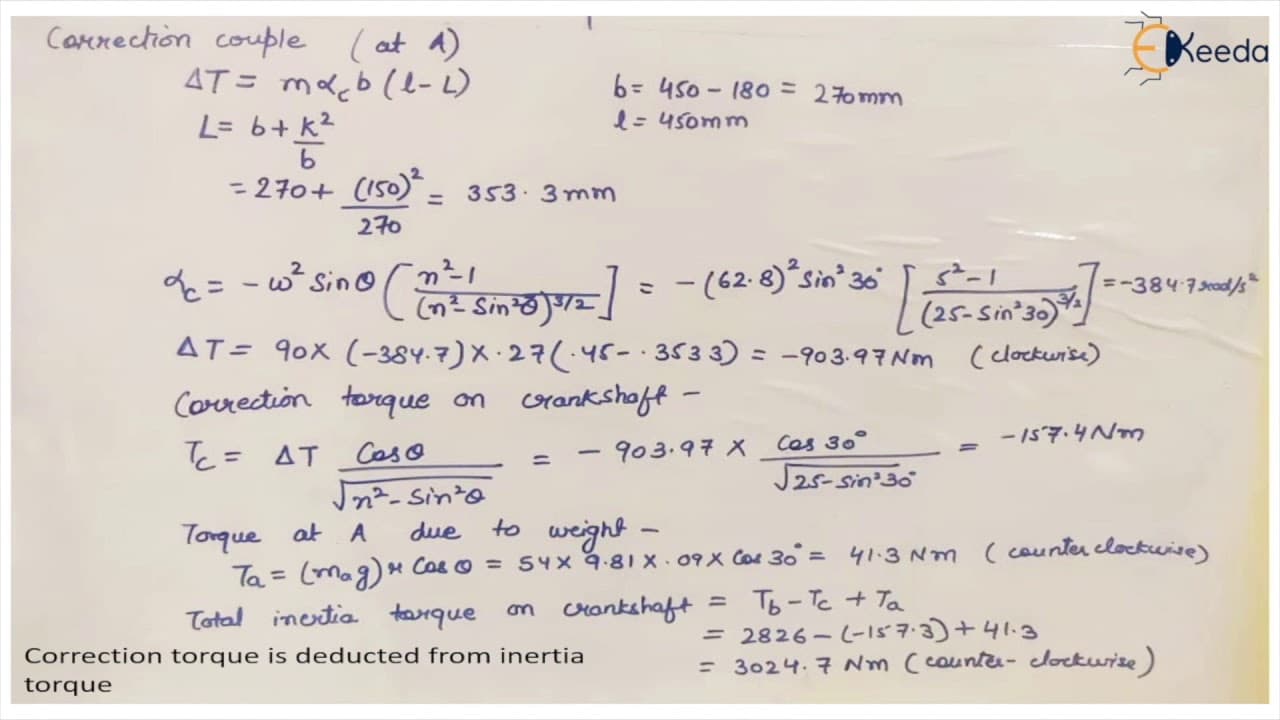
Solving for inertia torque in a reciprocating engine with given parameters and calculations for total torque on the crankshaft.
Transcript
hello everyone in this video we'll discuss a numerical of dynamically equivalent system so the question says that the data is given for a horizontal reciprocating engine where the mass of the reciprocating parts is given that means the mass at the piston is given which is 120 kilogram the crank length is given so let's say this is the crank so r is... Read More
Key Insights
- ❓ Understanding the parameter significance in determining the inertia torque in a reciprocating system.
- 🏋️ Breakdown of torque components: reciprocating part torque, correction torque, added weight torque.
- ❓ Calculation steps for finding total torque on the crankshaft with dynamic equivalent system analysis.
- 💆 Impact of angular acceleration and additional mass on the overall torque direction.
- 🧑🏭 Importance of considering various factors when analyzing torque in reciprocating engines.
- 🈸 Practical application of torque calculations in engineering systems.
- 🚒 Significance of direction and magnitude of torque in engine performance and design.
Install to Summarize YouTube Videos and Get Transcripts
Explore YouTube Video Summarizer or Get YouTube Transcript Extractor
Questions & Answers
Q: What are the key parameters provided for analyzing the dynamically equivalent system in a reciprocating engine?
The parameters include reciprocating parts mass, crank length, engine speed, connecting rod details, distance of center of mass, and radius of gyration.
Q: How is the torque due to the reciprocating parts calculated in the crankshaft analysis?
The torque due to reciprocating parts is found by considering the mass, acceleration, length of the crank, and angle theta, leading to the magnitude and direction of inertia torque.
Q: Why is the calculation of correction torque essential in determining the total torque on the crankshaft?
Correction torque accounts for the angular acceleration of the connecting rod and its effect on reducing the angle beta, contributing to the total torque along with reciprocating part torque.
Q: How does the added weight at the crank pin impact the total inertia torque on the crankshaft?
The added weight at the crank pin generates a torque proportional to the weight, distance from the crank pin, and the angle theta, influencing the total inertia torque in the opposite direction.
Summary & Key Takeaways
-
Given data for a reciprocating engine: reciprocating parts mass, crank length, engine speed, connecting rod details.
-
Calculate inertia torque in the crank shaft when crank is turned 30 degrees from inner dead center.
-
Breakdown of calculations for finding total torque on the crankshaft considering reciprocating part torque, correction torque, and added weight torque.
Read in Other Languages (beta)
Share This Summary 📚
Summarize YouTube Videos and Get Video Transcripts with 1-Click
Try YouTube Summary with ChatGPT & Claude or YouTube Transcript Generator
Explore More Summaries from Ekeeda 📚




Summarize YouTube Videos and Get Video Transcripts with 1-Click
Try YouTube Summary with ChatGPT & Claude or YouTube Transcript Generator