Multiplication and division relationship for fractions
TL;DR
Learn how to express the relationship between multiplication and division with fractions and how to rewrite division problems as multiplication problems.
Transcript
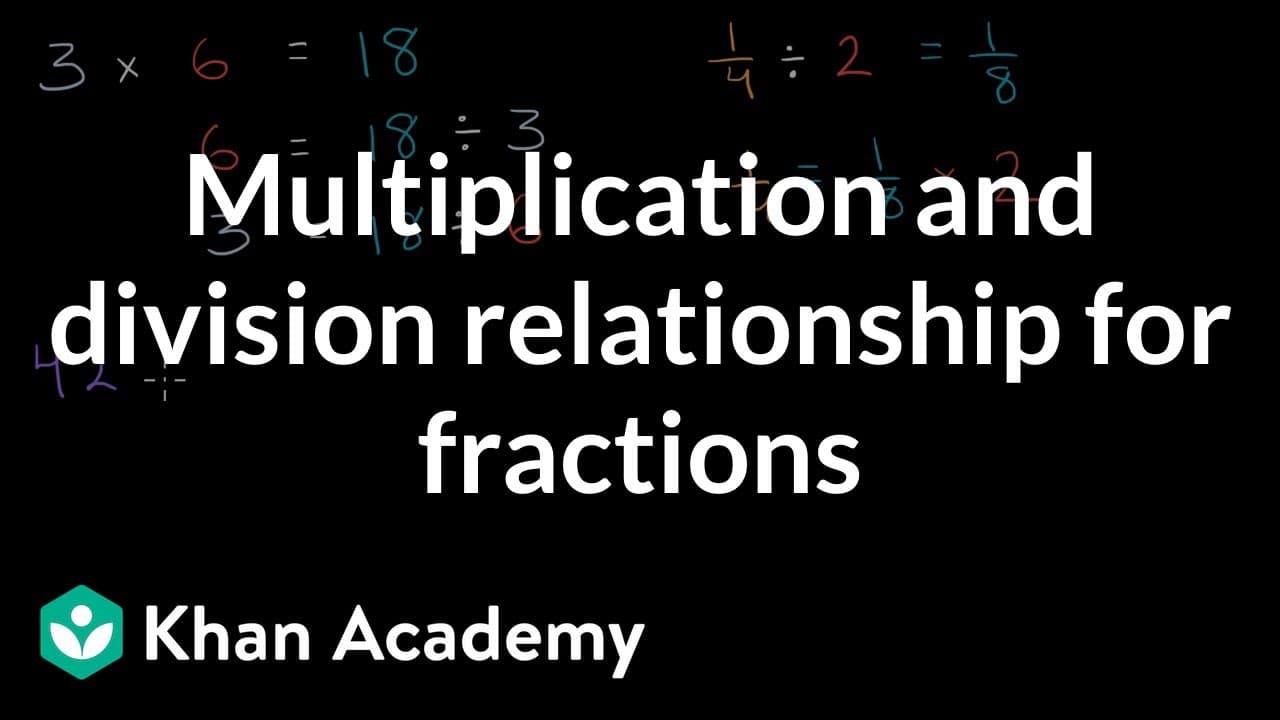
- [Instructor] You are likely already familiar with the relationship between multiplication and division. For example, we know that three times six is equal to 18. But another way to express that same relationship is to say, all right, if three times six is 18, then if I were to start with 18 and divide it by three, that would be equal to six. Or y... Read More
Key Insights
- ✖️ Multiplication and division are interconnected operations.
- 😑 Division can be expressed as multiplication by taking the reciprocal of the divisor.
- 😑 Expressions involving fractions can be rewritten using multiplication to show the same relationship.
- 🗂️ The relationship is consistent; only the numbers being multiplied or divided change.
- ✖️ Fractions can be represented with variables and still maintain the relationship between multiplication and division.
- 💦 The examples demonstrate the usefulness of understanding the relationship between multiplication and division when working with fractions.
- ✖️ Multiplying by the reciprocal is a strategy to rewrite division problems as multiplication problems.
Install to Summarize YouTube Videos and Get Transcripts
Explore YouTube Video Summarizer or Get YouTube Transcript Extractor
Questions & Answers
Q: How can we express the relationship between 1/4 divided by 2 equals 1/8 using multiplication?
By multiplying 1/8 by 2, we get 1/4. This shows that 1/4 is equal to 1/8 times 2.
Q: If 42 is equal to 7 divided by 1/6, how can we express this relationship using multiplication?
By multiplying 42 by 1/6, we get 7. Therefore, 42 times 1/6 is equal to 7.
Q: If 1/4 divided by 6 equals t, how can we rewrite this relationship using multiplication?
By multiplying t by 6, we will obtain 1/4. Thus, t times 6 is equal to 1/4.
Q: How does the relationship between multiplication and division change when dealing with fractions?
The relationship remains the same, but instead of whole numbers, we use fractions and sometimes represent some of the numbers with letters.
Summary & Key Takeaways
-
Multiplication and division are closely related, and expressions involving fractions can be rewritten using these operations.
-
For example, if 1/4 divided by 2 equals 1/8, then 1/8 times 2 will equal 1/4.
-
Similarly, if 42 is equal to 7 divided by 1/6, then 42 times 1/6 is equal to 7.
Read in Other Languages (beta)
Share This Summary 📚
Summarize YouTube Videos and Get Video Transcripts with 1-Click
Try YouTube Summary with ChatGPT & Claude or YouTube Transcript Generator
Explore More Summaries from Khan Academy 📚



Summarize YouTube Videos and Get Video Transcripts with 1-Click
Try YouTube Summary with ChatGPT & Claude or YouTube Transcript Generator