Multi-step word problem with Pythagorean theorem | Geometry | Khan Academy
TL;DR
Calculate the total number of lights in a string by finding the length of the string and multiplying it by the number of lights per meter.
Transcript
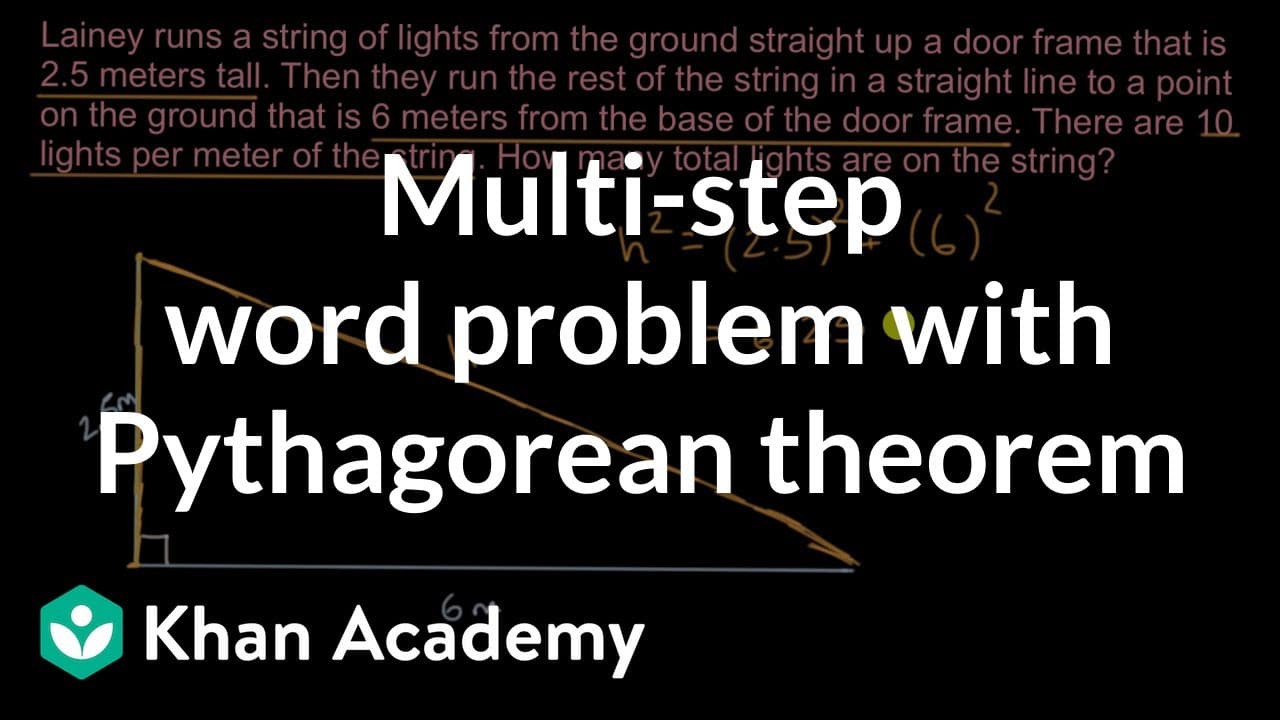
- [Instructor] We're told that Lainey runs a string of lights from the ground straight up to a door frame that is 2.5 meters tall. Then they run the rest of the string in a straight line to a point on the ground that is six meters from the base of the door frame. There are 10 lights per meter of the string. How many total lights are on the string? ... Read More
Key Insights
- 🙂 The total number of lights in a string can be calculated by finding the length of the string and multiplying it by the number of lights per meter.
- 🗯️ The length of the string includes the height of the structure and the length of the hypotenuse in the case of a right triangle.
- ❓ The Pythagorean theorem is useful in finding the length of the hypotenuse.
- 🙂 In this scenario, there are 90 lights in total.
Install to Summarize YouTube Videos and Get Transcripts
Explore YouTube Video Summarizer or Get YouTube Transcript Extractor
Questions & Answers
Q: How do we calculate the length of the string?
To calculate the length of the string, we need to find the height of the door frame (2.5 meters) and the length of the hypotenuse of the right triangle formed by the door frame and the point on the ground. By using the Pythagorean theorem, we can find the hypotenuse.
Q: Why do we need to add the height of the door frame to the length of the hypotenuse?
The total length of the string includes the height of the door frame because the lights are strung up to the top of the door frame. Therefore, we need to add 2.5 meters to the length of the hypotenuse to find the total length of the string.
Q: How do we calculate the total number of lights?
To calculate the total number of lights, multiply the total length of the string by the number of lights per meter. In this case, if there are 10 lights per meter and the total length of the string is 9 meters, then the total number of lights is 90.
Q: Is there one extra light at the beginning of the string?
While it is possible to argue that there is one extra light if the lights are set up like fence posts, for the purpose of this calculation, it is assumed that on average there are 10 lights per meter. Therefore, in this scenario, there are 90 lights in total.
Summary & Key Takeaways
-
Lainey is running a string of lights from the ground to a door frame that is 2.5 meters tall and then continues the string to a point on the ground 6 meters away from the base of the door frame.
-
To find the total number of lights, we need to calculate the length of the string, which includes the height of the door frame and the hypotenuse of a right triangle formed by the door frame and the point on the ground.
-
After finding the total length of the string, we multiply it by the number of lights per meter to get the total number of lights.
Read in Other Languages (beta)
Share This Summary 📚
Summarize YouTube Videos and Get Video Transcripts with 1-Click
Try YouTube Summary with ChatGPT & Claude or YouTube Transcript Generator
Explore More Summaries from Khan Academy 📚



Summarize YouTube Videos and Get Video Transcripts with 1-Click
Try YouTube Summary with ChatGPT & Claude or YouTube Transcript Generator