X Ray Radiography - Non Destructive Testing - Metrology and Quality Engineering
TL;DR
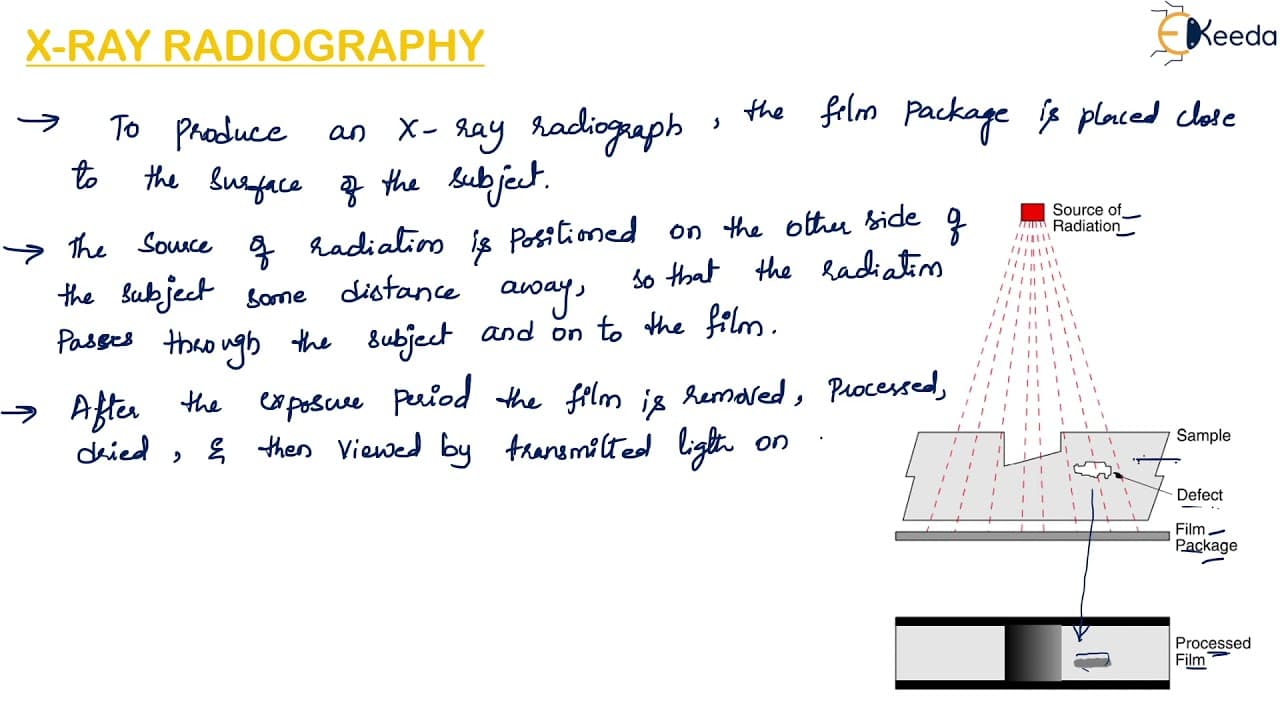
X-Ray radiography is used to detect internal defects in materials by generating penetrating radiation that creates latent images on photographic films.
Transcript
hello students today we will discuss one more ndt method that is x-ray radiography so first of all introduction to x-ray radiography so this technique is suitable for detection of internal defects in ferrous non-ferrous and any other material so x-ray radiography can be used in any type of material for detection of defects so this technique is suit... Read More
Key Insights
- 🕵️ X-Ray radiography is used for non-destructive testing to detect internal defects in materials.
- ❓ The method involves generating electrically generated penetrating radiation to create latent images.
- 🤔 Advantages include providing pictorial information, a permanent record, and sensitivity for thin sections.
- 💉 Disadvantages include health hazards, challenges with thick materials, and the need for accurate beam direction.
- 🕵️ Surface defects are not easily detected, and the method is not suitable for automation.
Install to Summarize YouTube Videos and Get Transcripts
Explore YouTube Video Summarizer or Get YouTube Transcript Extractor
Questions & Answers
Q: How does X-ray radiography detect internal defects in materials?
X-ray radiography generates penetrating radiation that is absorbed differentially by materials, creating latent images on films to visually detect defects.
Q: What are the advantages of using X-ray radiography in non-destructive testing?
X-ray radiography provides pictorial information, permanent records, and sensitivity for thin sections, making it suitable for various materials.
Q: What are the disadvantages of X-ray radiography in non-destructive testing?
X-ray radiography may not be suitable for very thick materials, poses health hazards with prolonged exposure, and requires accurate beam direction for defect detection.
Q: Why is X-ray radiography not suitable for surface defect detection?
X-ray radiography does not indicate the depth of defects below the surface and is not designed for automation, making it challenging to detect surface defects accurately.
Summary & Key Takeaways
-
X-Ray radiography is a non-destructive testing method suitable for detecting defects in various materials.
-
X-Rays, electrically generated, penetrate materials and create latent images on films.
-
The method requires film packages, radiation monitors, and processing chemicals for accurate defect detection.
Read in Other Languages (beta)
Share This Summary 📚
Summarize YouTube Videos and Get Video Transcripts with 1-Click
Try YouTube Summary with ChatGPT & Claude or YouTube Transcript Generator
Explore More Summaries from Ekeeda 📚





Summarize YouTube Videos and Get Video Transcripts with 1-Click
Try YouTube Summary with ChatGPT & Claude or YouTube Transcript Generator