Related Rates - Airplane Problems
TL;DR
Analyzing related rates problems involving airplanes in motion and calculating the rate of change of distances.
Transcript
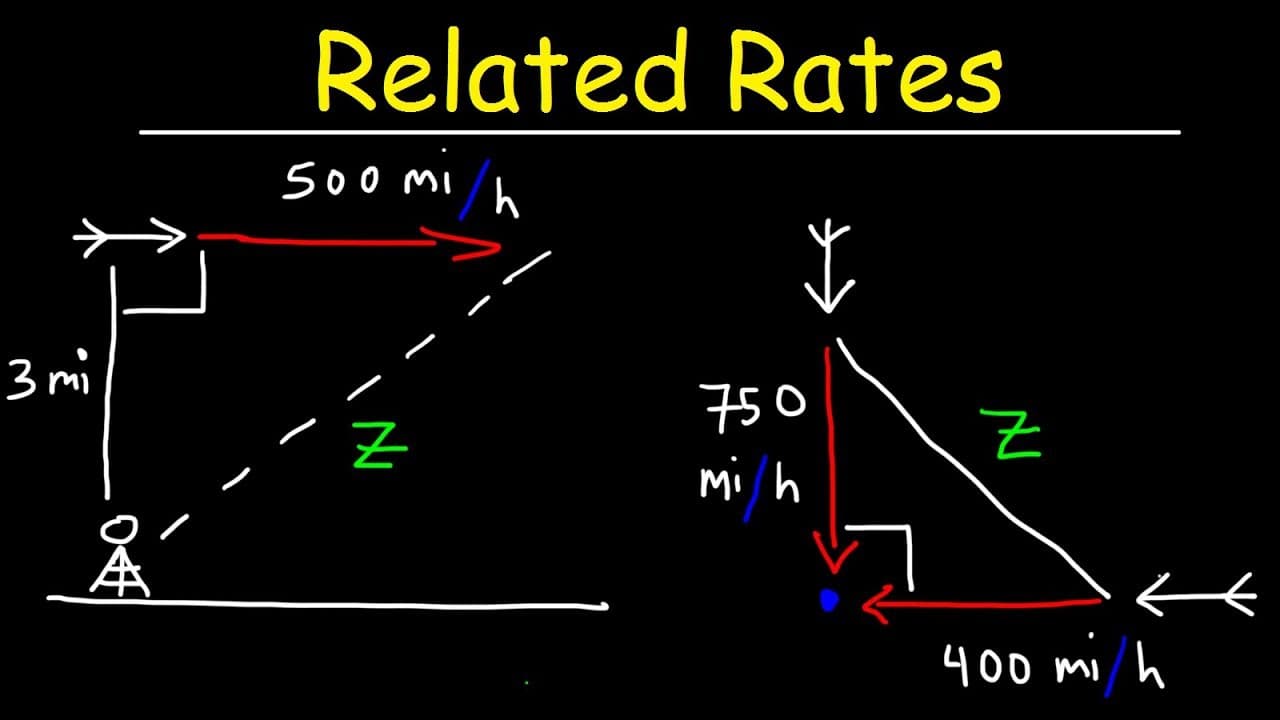
now let's focus on some airplane problems as it relates to related rates an airplane is flying horizontally with a speed of 400 miles per hour at an altitude of three miles above a radar station let's draw a picture so let's say this is the ground and we're going to say this is the radar station and let's say this is the airplane and so it's travel... Read More
Key Insights
- ☠️ Related rates problems involve calculating the rate of change of different variables within a given scenario.
- ☠️ The Pythagorean theorem is often utilized in related rates problems involving right triangles.
- ☠️ The rates at which distances are changing can be positive or negative depending on the motion of the objects involved.
- ☠️ Implicit differentiation is a common technique used to find the derivative of equations in related rates problems.
Install to Summarize YouTube Videos and Get Transcripts
Explore YouTube Video Summarizer or Get YouTube Transcript Extractor
Questions & Answers
Q: What is the initial information given in the first problem?
In the first problem, an airplane is traveling horizontally at 400 miles per hour at an altitude of 3 miles above a radar station.
Q: How is the distance between the airplane and the radar station represented?
The distance is represented by letter 'z', and it is the direct distance between the plane and the radar station.
Q: What is the value of y in the first problem and why?
In the first problem, y is equal to 3 because the plane is traveling at an altitude of 3 miles above the radar station.
Q: How is the rate at which the distance between the plane and the radar station changing calculated?
The rate is calculated by taking the derivative of the equation and substituting the given values, which results in a rate of 320 miles per hour.
Q: What information is provided in the second problem regarding the two airplanes?
The second problem describes two airplanes that are about to intersect at a single point. The first plane is traveling west, while the second plane is traveling south.
Q: What are the given values in the second problem?
In the second problem, x is 160 miles east, y is 300 miles north, dx/dt is -400 miles per hour (westward), and dy/dt is -750 miles per hour (southward).
Q: How is the rate at which the distance between the two planes changing calculated?
By applying the related rates formula and substituting the given values into the equation, the rate is determined to be -850 miles per hour.
Q: Is there an alternate method to calculate the rate of change for the distance between the two planes?
Yes, an alternate method is using the formula dz/dt = sqrt((dx/dt)^2 + (dy/dt)^2), which yields the same result of -850 miles per hour.
Summary & Key Takeaways
-
An airplane is flying horizontally at a speed of 400 miles per hour, 3 miles above a radar station. The goal is to calculate how fast the distance between the airplane and the radar station is changing when the plane is 5 miles away.
-
Two airplanes are about to intersect at a single point. The first plane is traveling west at 400 miles per hour and is currently 160 miles east from the convergence point. The second plane is traveling south at 750 miles per hour and is currently 300 miles north from the convergence point. The task is to determine the rate at which the distance between the two planes is changing.
Read in Other Languages (beta)
Share This Summary 📚
Summarize YouTube Videos and Get Video Transcripts with 1-Click
Try YouTube Summary with ChatGPT & Claude or YouTube Transcript Generator
Explore More Summaries from The Organic Chemistry Tutor 📚




Summarize YouTube Videos and Get Video Transcripts with 1-Click
Try YouTube Summary with ChatGPT & Claude or YouTube Transcript Generator