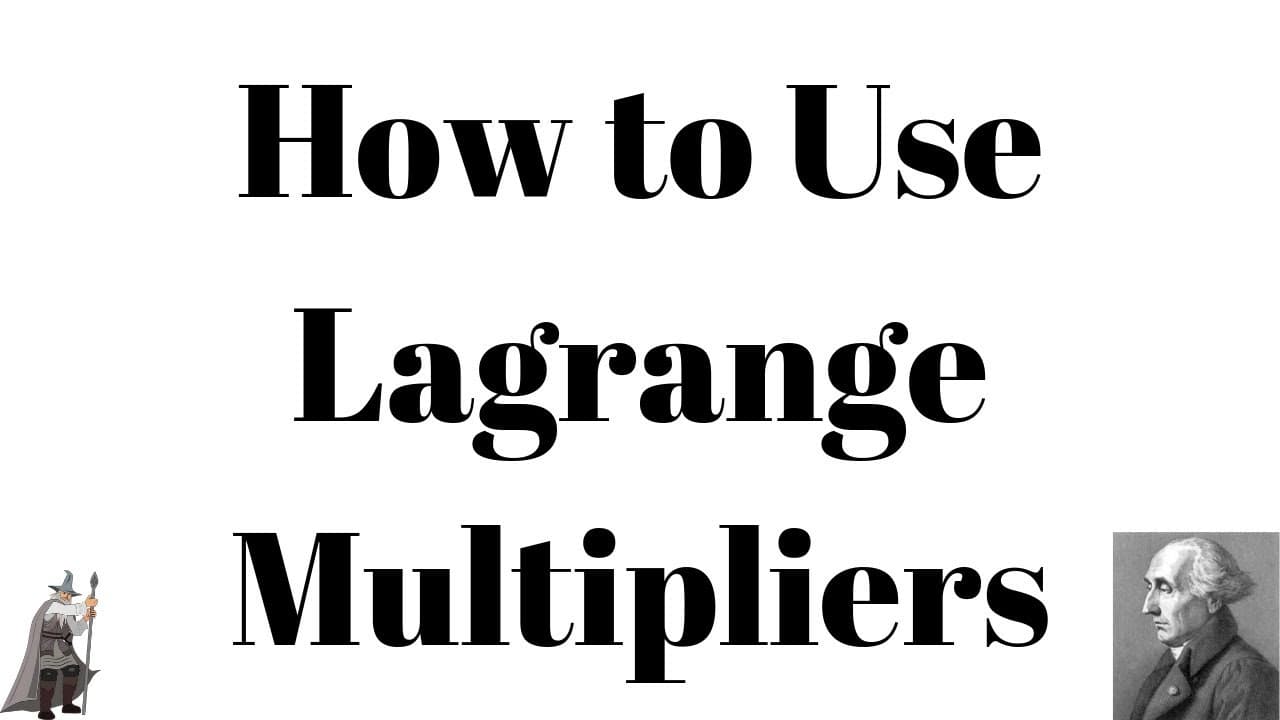
How to Use Lagrange Multipliers to Find Maximums and Minimums Subject to Constraints
TL;DR
Maximize/Minimize functions subject to constraints using Lagrange multipliers, solving equations to find optimal values.
Transcript
hi everyone in this video we're going to talk about something called Lagrange multipliers so the goal of the grunge multipliers is to maximize or minimize so I'll write maximize slash minimize some function say f of X Y this is a function of two variables you can do the same thing with three variables f of X Y Z so maximize minimize some function f... Read More
Key Insights
- ❓ Lagrange multipliers optimize functions under constraints by solving gradient equations.
- ❓ The process involves finding constants such as lambda to determine optimal values.
- 💻 Algebraic manipulations and utilizing constraints help in computing maximum or minimum values.
- ❓ Lagrange multipliers ensure accurate solutions for optimization problems.
- 🖐️ Constraints play a crucial role in determining the optimal values for functions.
- 🔌 Solving for optimal values involves plugging back the solutions into the original function.
- ❓ Continuous first partial derivatives for functions are essential for using Lagrange multipliers.
Install to Summarize YouTube Videos and Get Transcripts
Explore YouTube Video Summarizer or Get YouTube Transcript Extractor
Questions & Answers
Q: What is the goal of Lagrange multipliers?
Lagrange multipliers aim to maximize or minimize functions under given constraints by solving equations and finding optimal values that satisfy the conditions.
Q: How do you use Lagrange multipliers to find maximum or minimum values?
By solving gradient equations with the constraint equation and manipulating algebraically, we can determine the optimal values that yield the maximum or minimum of the function.
Q: What are the assumptions required for using Lagrange multipliers?
Lagrange multipliers require that the functions involved have continuous first partial derivatives and that the constraint curve is smooth to ensure accurate solutions.
Q: Can Lagrange multipliers be used for functions with more than two variables?
Yes, Lagrange multipliers can be extended to functions with three or more variables by following the same steps of solving gradient equations and constraints.
Summary & Key Takeaways
-
Lagrange multipliers are used to maximize or minimize functions subject to constraints like equations.
-
Steps include solving gradient equations, finding constants, and plugging values back into the original function.
-
The process involves algebraic manipulation and using constraints to determine optimal values.
Read in Other Languages (beta)
Share This Summary 📚
Summarize YouTube Videos and Get Video Transcripts with 1-Click
Try YouTube Summary with ChatGPT & Claude or YouTube Transcript Generator
Explore More Summaries from The Math Sorcerer 📚


Summarize YouTube Videos and Get Video Transcripts with 1-Click
Try YouTube Summary with ChatGPT & Claude or YouTube Transcript Generator