Visually understanding long division
TL;DR
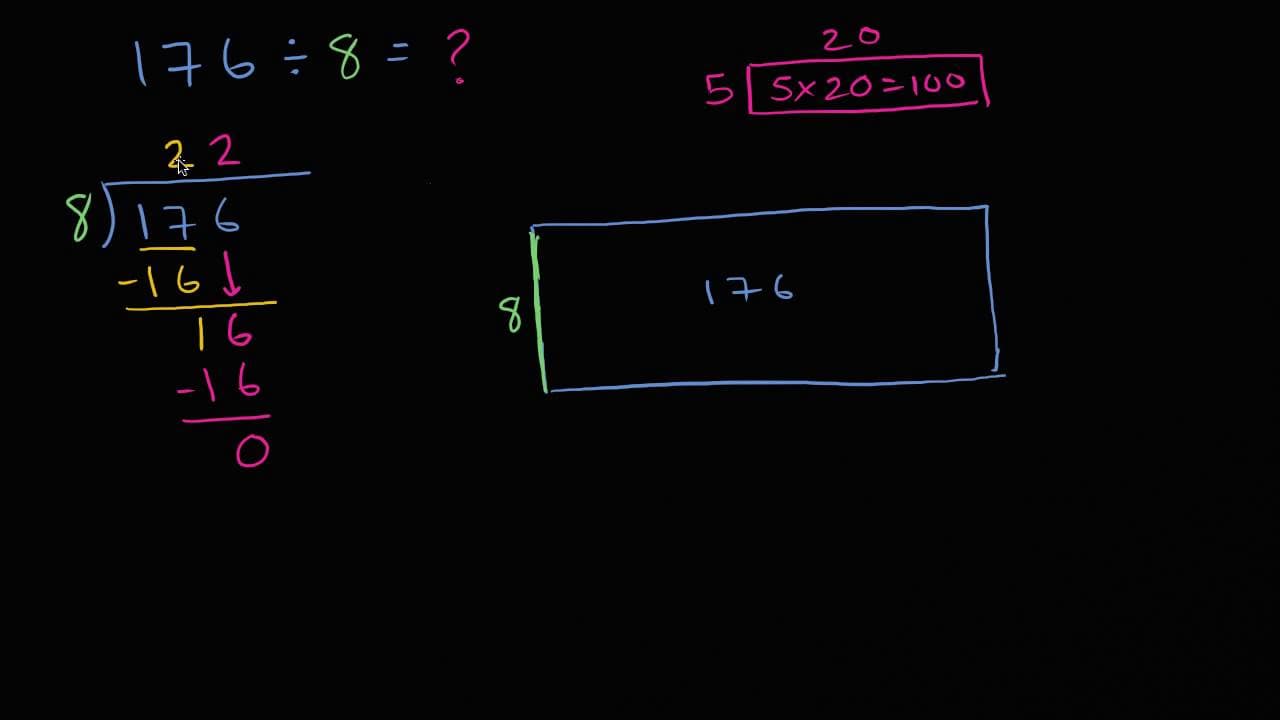
This content explains the visual understanding of division, using the example of dividing 176 by 8, and how it logically makes sense.
Transcript
we've already seen multiple examples of doing something like dividing 176 by 8 and we're going to do it again but this time we're going to use we're going to try to visually understand why what we're doing actually works so we've seen you take an 8 and you divide it into 176 176 actually for practice it doesn't hurt if you want to pause the video a... Read More
Key Insights
- 🤔 Division can be thought of as an area problem, with rectangles representing the numbers involved.
- ➗ Long division involves step-by-step division and subtraction to determine the quotient and remainder.
- 🥇 Place value is essential in accurately performing long division calculations.
- ➗ Understanding the logical process behind division helps in visualizing and comprehending the concept.
- ➗ The remainder indicates the leftover portion after division and is crucial for completing the division.
- 🦻 Using rectangles as a visual aid can simplify and clarify the division process.
- 🥇 Dividing numbers involves considering their place value to determine the correct quotient at each step.
Install to Summarize YouTube Videos and Get Transcripts
Explore YouTube Video Summarizer or Get YouTube Transcript Extractor
Questions & Answers
Q: How does the long division process work for dividing 176 by 8?
The process involves dividing each digit of the dividend by the divisor and subtracting the product from the dividend, thus finding the quotient and remainder at each step until the division is completed. For example, in dividing 176 by 8, 8 goes into 17 two times, and the remainder is 1.
Q: Why does using rectangles help with understanding division?
Using rectangles as a visual representation helps understand division as an area problem. The dimensions of the rectangle represent the divisor and dividend, and by finding the area of the rectangle, we can determine the quotient and remainder.
Q: How does place value affect the long division process?
Place value is crucial in the long division process. Each digit in the dividend has a specific place value, and considering this helps determine the correct quotient and remainder at each step. It ensures that the division is accurate and properly aligned.
Q: What is the significance of the remainder in division?
The remainder represents the remaining portion of the dividend that could not be evenly divided by the divisor. It is critical in division as it indicates that the division is incomplete and helps in finding the final quotient.
Summary & Key Takeaways
-
The content demonstrates the long division process of dividing 176 by 8, emphasizing the step-by-step approach.
-
It introduces the concept of thinking about division as an area problem, using rectangles to understand the process.
-
The content explains the importance of place value and how it helps in finding the quotient and remainder.
Read in Other Languages (beta)
Share This Summary 📚
Summarize YouTube Videos and Get Video Transcripts with 1-Click
Try YouTube Summary with ChatGPT & Claude or YouTube Transcript Generator
Explore More Summaries from Khan Academy 📚



Summarize YouTube Videos and Get Video Transcripts with 1-Click
Try YouTube Summary with ChatGPT & Claude or YouTube Transcript Generator