CA Geometry: Area, pythagorean theorem | Worked examples | Geometry | Khan Academy
TL;DR
The video explains various geometry concepts, including the sum of angles in a quadrilateral, the properties of a parallelogram, finding the lateral area of a cone, and calculating the area of a kite.
Transcript
All right. We're on problem 26. For the quadrilateral shown below, a quadrilateral has four sides, measure of angle A plus the measure of angle C is equal to what? And here, you should know that the sum of all the angles in a quadrilateral are equal to 360 degrees. And you might say, OK, I'll add that to my memory bank of things to memorize. Like t... Read More
Key Insights
- 🔺 The sum of angles in a quadrilateral is always equal to 360 degrees, and this can be proven by breaking down the quadrilateral into triangles.
- 🫤 In a parallelogram, the diagonals bisect each other, meaning they divide each other into two equal halves.
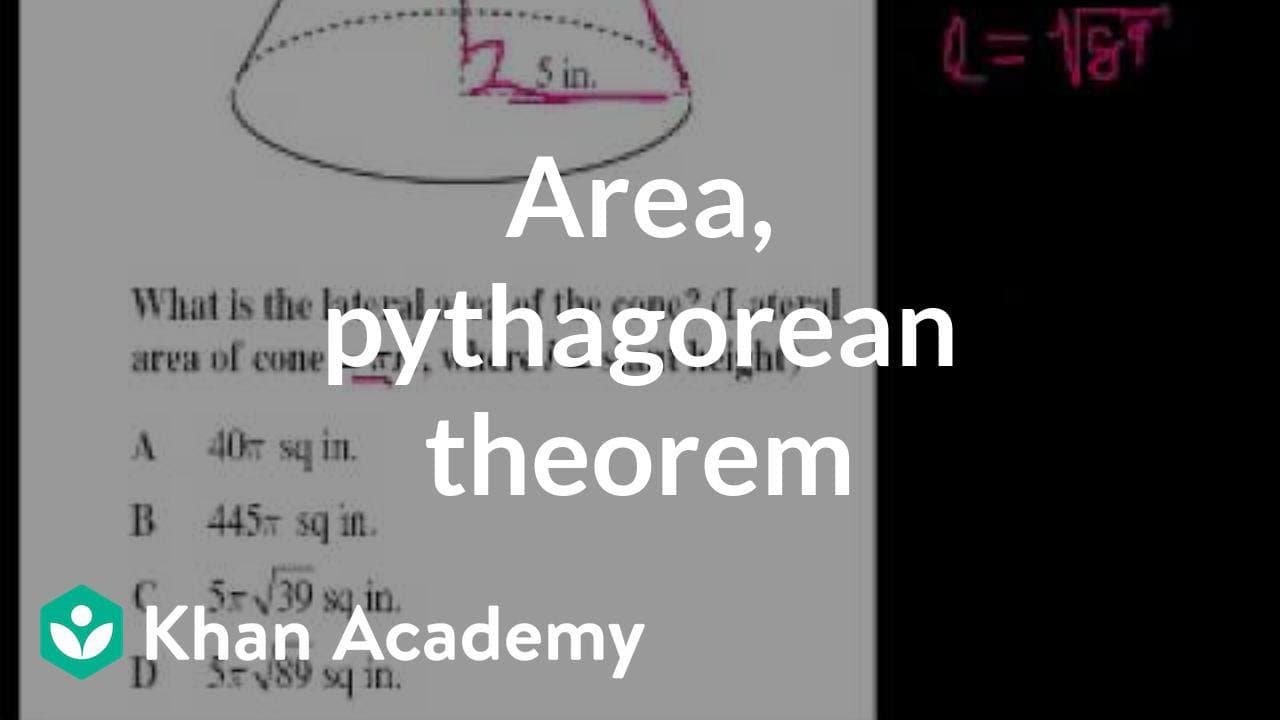
- ⌛ The lateral area of a cone can be calculated using the formula pi times the radius times the slant height.
Install to Summarize YouTube Videos and Get Transcripts
Explore YouTube Video Summarizer or Get YouTube Transcript Extractor
Questions & Answers
Q: How can you prove that the sum of angles in a quadrilateral is always equal to 360 degrees?
By breaking down the quadrilateral into triangles, it can be shown that the sum of the angles in each triangle is 180 degrees. Since a quadrilateral can be divided into two triangles, the sum of their angles will be 360 degrees.
Q: What is the relationship between the diagonals in a parallelogram?
The diagonals of a parallelogram bisect each other. This means that they divide each other into two equal halves, allowing us to find the length of the diagonals.
Q: What is the formula for calculating the lateral area of a cone?
The formula is pi times the radius of the cone times the slant height. By substituting the given values for radius and slant height, the lateral area can be calculated.
Q: How can you find the area of a kite?
The area of a kite can be found by dividing it into two triangles and calculating the area of each triangle using the formula 1/2 times base times height. Then, the areas of the two triangles can be added together to find the total area of the kite.
Summary & Key Takeaways
-
The video introduces the concept that the sum of angles in a quadrilateral is always equal to 360 degrees, and demonstrates how this can be proven using the angles in triangles.
-
It explains that in a parallelogram, the diagonals bisect each other, meaning that the length of the diagonal can be determined by dividing it into two equal halves.
-
The video then shows how to calculate the lateral area of a cone using the formula pi times the radius times the slant height.
-
Finally, the video demonstrates how to find the area of a kite by breaking it down into triangles and calculating the area of each triangle.
Read in Other Languages (beta)
Share This Summary 📚
Summarize YouTube Videos and Get Video Transcripts with 1-Click
Try YouTube Summary with ChatGPT & Claude or YouTube Transcript Generator
Explore More Summaries from Khan Academy 📚



Summarize YouTube Videos and Get Video Transcripts with 1-Click
Try YouTube Summary with ChatGPT & Claude or YouTube Transcript Generator