Battles of Verdun, Somme and the Hindenburg Line | The 20th century | World history | Khan Academy
TL;DR
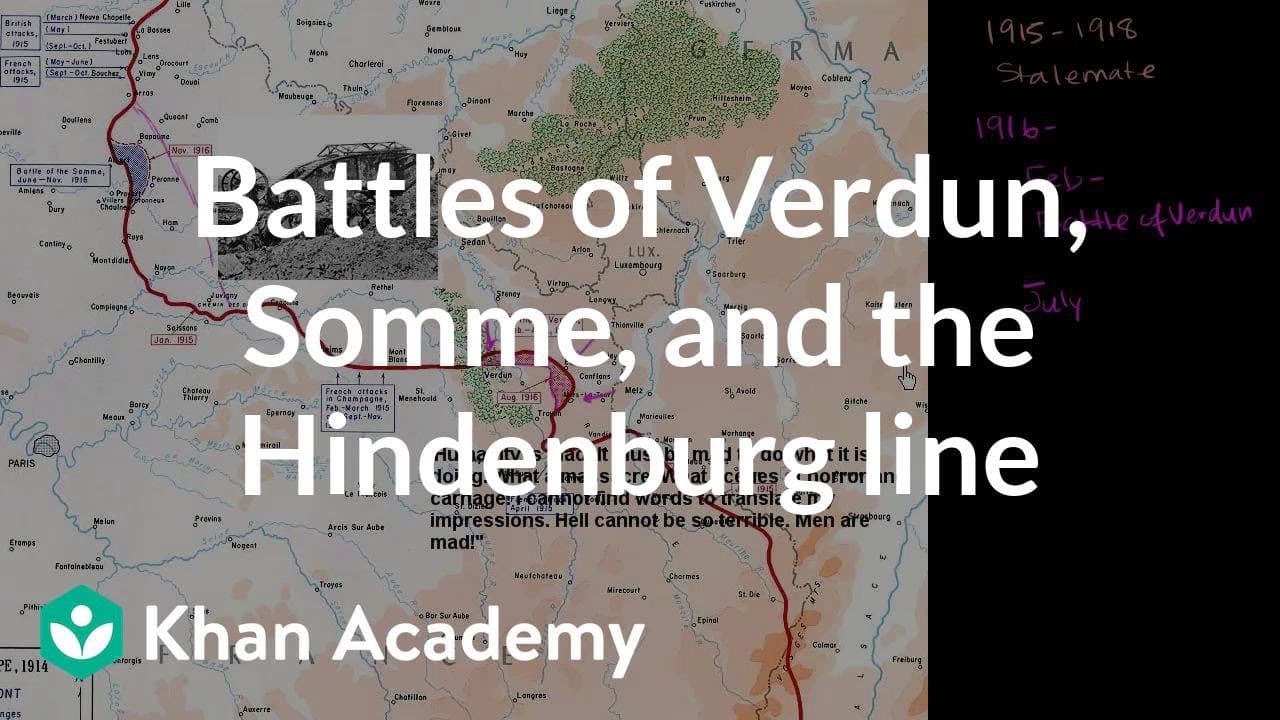
The period between 1915 and 1918 on the Western Front was a bloody stalemate, with major battles like Verdun and the Somme resulting in massive casualties.
Transcript
At a very high level, the period between 1915 and 1918 on the Western Front is usually considered to be a stalemate. It's considered to be a stalemate because you did not have a major movement on the front. There were some movement, but the front pretty much looked the way that it looks in this diagram right over here. That's not to say that it was... Read More
Key Insights
- 💋 The period between 1915 and 1918 on the Western Front was marked by a stalemate, with minimal front movement despite intense battles.
- 🛄 The Battle of Verdun in 1916 aimed to cripple the French with casualties rather than territorial gain.
- 🙃 The Battle of the Somme in 1916 resulted in heavy casualties on both sides and saw the debut of tanks in warfare.
- 🫥 The German losses at Verdun and the Somme, along with increasing pressure on the Eastern Front, led them to re-trench and establish the Hindenburg line.
Install to Summarize YouTube Videos and Get Transcripts
Explore YouTube Video Summarizer or Get YouTube Transcript Extractor
Questions & Answers
Q: Why was the period between 1915 and 1918 considered a stalemate on the Western Front?
The lack of major movement on the front, despite intense battles, led to the period being considered a stalemate. The front remained relatively unchanged.
Q: What was the German objective in the Battle of Verdun?
The Germans aimed to force the French to commit a large number of troops and cause significant casualties, potentially leading to the French being driven out of the war.
Q: What was significant about the Battle of the Somme?
The Battle of the Somme was notable for being the first use of tanks and resulted in heavy casualties on both sides. It also forced the Germans to divert troops from other areas.
Q: How did the Germans change their strategy after the battles at Verdun and the Somme?
The Germans decided to re-trench and bring more troops to the Eastern Front. They established the Hindenburg line, a shorter defensive line to protect against Allied advances.
Summary & Key Takeaways
-
The Western Front between 1915 and 1918 was a stalemate with minimal movement despite intense bloodshed.
-
In 1916, the Battle of Verdun occurred with the Germans aiming to inflict heavy casualties on the French, resulting in massive loss of life.
-
The Battle of the Somme in 1916 was an Anglo-French offensive and the first use of tanks, causing heavy casualties but ultimately leading to little territorial gain.
Read in Other Languages (beta)
Share This Summary 📚
Summarize YouTube Videos and Get Video Transcripts with 1-Click
Try YouTube Summary with ChatGPT & Claude or YouTube Transcript Generator
Explore More Summaries from Khan Academy 📚



Summarize YouTube Videos and Get Video Transcripts with 1-Click
Try YouTube Summary with ChatGPT & Claude or YouTube Transcript Generator