Introduction To Space Vector Modulation - Inverter - Power Electronics
TL;DR
Space vector modulation controls PWM pulses to drive AC motors at varying speeds using phasor diagrams.
Transcript
click the Bell icon to get latest videos from akira hello friends today we are going to discuss about an introduction to space vector modulation so friends as we all discuss about what a PWM converter or what a pwm technique is just to revise the pwm technique is a technique where we can control any switching device so that we can vary the output v... Read More
Key Insights
- ⚡ PWM converter controls switching devices for voltage variation.
- 🔙 Space vector modulation creates AC waveforms for driving AC motors.
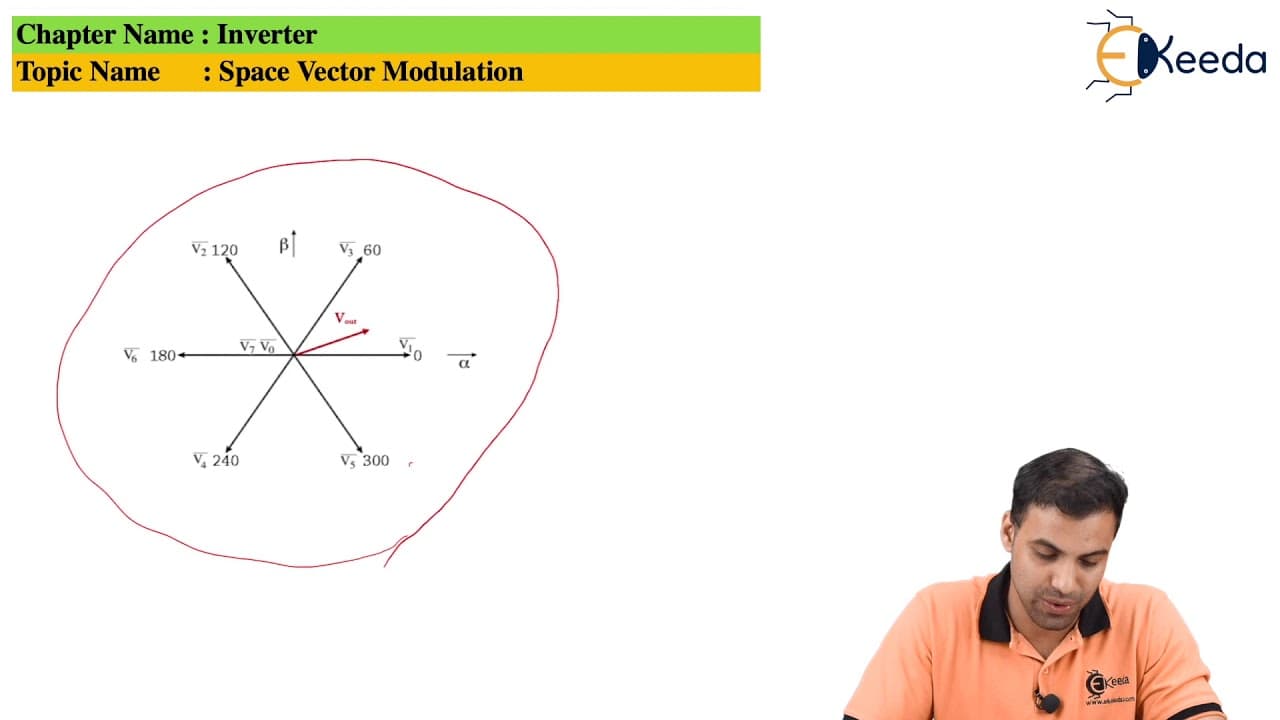
- ⚡ Phasor diagrams represent voltages in vectors separated by 60 degrees.
- 🎮 Controlling alpha and beta determine null vector placement in the phasor diagram.
- 👾 Resultant output in space vector modulation is the sum of all null vectors.
- 👾 Space vector modulation efficiently drives three-phase AC motors at varying speeds.
- 🍉 It is crucial to represent voltages in terms of vectors with a 60-degree phase angle.
Install to Summarize YouTube Videos and Get Transcripts
Explore YouTube Video Summarizer or Get YouTube Transcript Extractor
Questions & Answers
Q: What is the primary function of space vector modulation?
Space vector modulation controls PWM pulses to vary output voltages for driving AC motors at different speeds efficiently through algorithms and phasor diagrams.
Q: How does space vector modulation differ from traditional PWM techniques?
Space vector modulation specifically focuses on creating AC waveforms for driving AC motors by strategically placing vectors 60 degrees apart, unlike traditional PWM techniques that control voltage pulses.
Q: Why is controlling alpha and beta crucial in space vector modulation?
Controlling alpha and beta in space vector modulation is essential because they determine the placement of null vectors in the phasor diagram, ultimately affecting the output voltage of the system.
Q: What are the key advantages of using space vector modulation in driving three-phase AC motors?
The advantages of using space vector modulation include precise control over output voltages, efficient conversion of DC to AC power, and the ability to drive three-phase AC motors at varying speeds with minimal distortion.
Summary & Key Takeaways
-
PWM technique controls switching devices with on and off times to vary output voltage.
-
Space vector modulation uses algorithms to create PWM signals for driving AC motors.
-
Phasor diagrams in space vector modulation represent voltages in vectors separated by 60 degrees, with the resultant being the output.
Read in Other Languages (beta)
Share This Summary 📚
Summarize YouTube Videos and Get Video Transcripts with 1-Click
Try YouTube Summary with ChatGPT & Claude or YouTube Transcript Generator
Explore More Summaries from Ekeeda 📚





Summarize YouTube Videos and Get Video Transcripts with 1-Click
Try YouTube Summary with ChatGPT & Claude or YouTube Transcript Generator