3rd Numerical of Stopping Sight Distance - Highway Geometric Design - Transportation Engineering 1
TL;DR
Solving for ascending gradient in a highway emergency scenario at 70 km/h with specific variables given.
Transcript
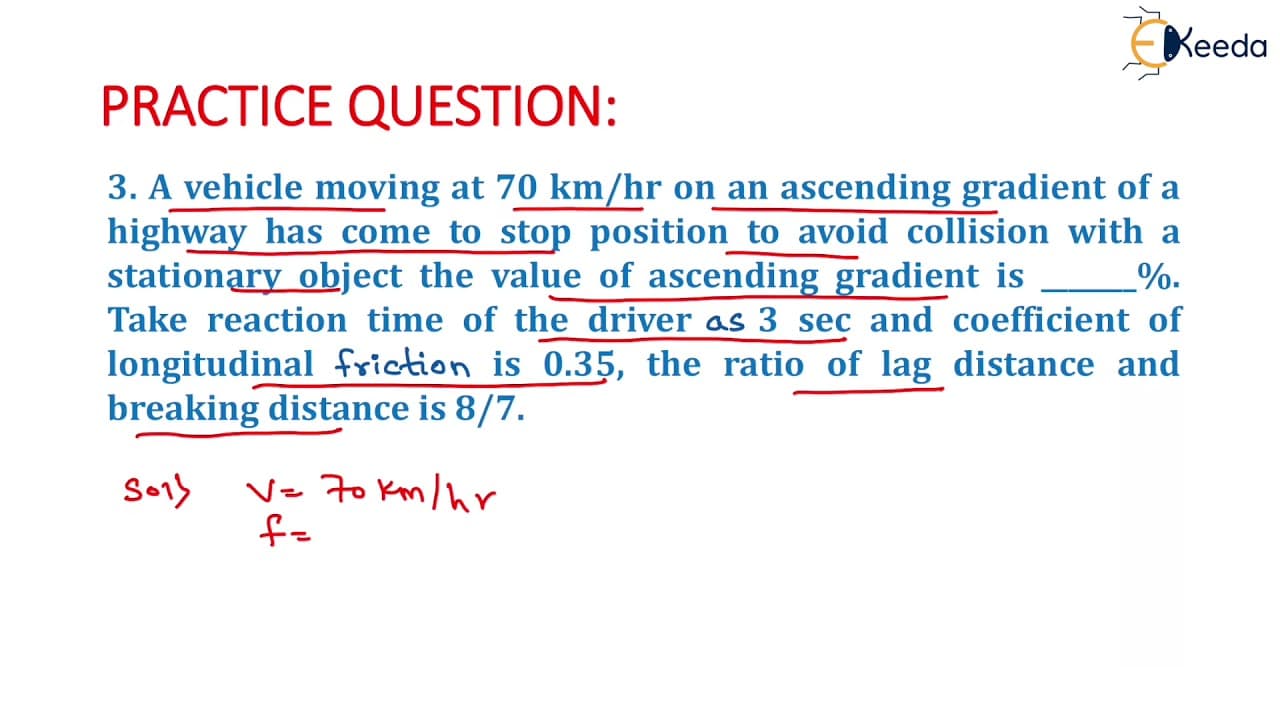
hello students today we are going to solve third numerical of stopping sight distance question is given as a vehicle moving at 70 kilometer per hour on an ascending gradient of a highway has come to stop position to avoid collision with a stationary object the value of ascending gradient is dash percent now we have to compute the value of ascending... Read More
Key Insights
- 🥳 Design speed, friction coefficient, reaction time, and lag-breaking distance ratio are crucial in determining the ascending gradient.
- 🐎 Lag distance, affected by speed and reaction time, is calculated separately from breaking distance, influenced by speed, friction, and gradient.
- ✋ The formula for calculating ascending gradient involves specific inputs to ensure the safety of the vehicle in emergency stopping situations on an ascending gradient.
- 🎨 An accurate computation of the ascending gradient percentage is essential for highway safety and infrastructure design.
- ✋ Understanding the relationship between speed, friction, and gradient is vital for determining the required ascending gradient in emergency stopping scenarios.
- 🤩 The values of key variables like design speed and reaction time significantly impact the final calculation of the ascending gradient.
- ✋ The numerical example provides a practical application of theoretical concepts in stopping sight distance analysis.
Install to Summarize YouTube Videos and Get Transcripts
Explore YouTube Video Summarizer or Get YouTube Transcript Extractor
Questions & Answers
Q: What variables are crucial in determining the ascending gradient in the given scenario?
The key variables essential in solving the numerical are design speed, coefficient of longitudinal friction, reaction time, and the ratio of lag distance to breaking distance. Each of these factors contributes to calculating the required ascending gradient percentage.
Q: How do lag distance and breaking distance impact the computation of the ascending gradient?
Lag distance, determined by the vehicle's speed and reaction time, along with breaking distance, influenced by speed, friction coefficient, and gradient, play a vital role in the formula for calculating the ascending gradient percentage in the scenario described.
Q: Why is it necessary to consider the design speed and specific variables in determining the ascending gradient?
Design speed sets the base for the calculations, while variables like friction coefficient, reaction time, and the lag-breaking distance ratio provide the necessary inputs to accurately determine the ascending gradient needed for the vehicle to stop safely in the scenario.
Q: How does the ratio of lag distance to breaking distance affect the overall calculation of the ascending gradient?
The ratio of lag distance to breaking distance, specified as 8:7 in the scenario, impacts the final determination of the ascending gradient by influencing the proportions of the two components in the formula, thus playing a crucial role in the overall computation process.
Summary & Key Takeaways
-
Solving a numerical involving a vehicle stopping on an ascending gradient to avoid collision with a stationary object.
-
Given variables include design speed, coefficient of longitudinal friction, reaction time, and ratio of lag distance to breaking distance.
-
Formulae for lag distance, breaking distance, and gradient calculation are applied to find the ascending gradient percentage.
Read in Other Languages (beta)
Share This Summary 📚
Summarize YouTube Videos and Get Video Transcripts with 1-Click
Try YouTube Summary with ChatGPT & Claude or YouTube Transcript Generator
Explore More Summaries from Ekeeda 📚

Summarize YouTube Videos and Get Video Transcripts with 1-Click
Try YouTube Summary with ChatGPT & Claude or YouTube Transcript Generator