Statistical significance of experiment | Probability and Statistics | Khan Academy
TL;DR
Children who watched food commercials ate 10 grams more goldfish crackers on average compared to children who watched non-food commercials.
Transcript
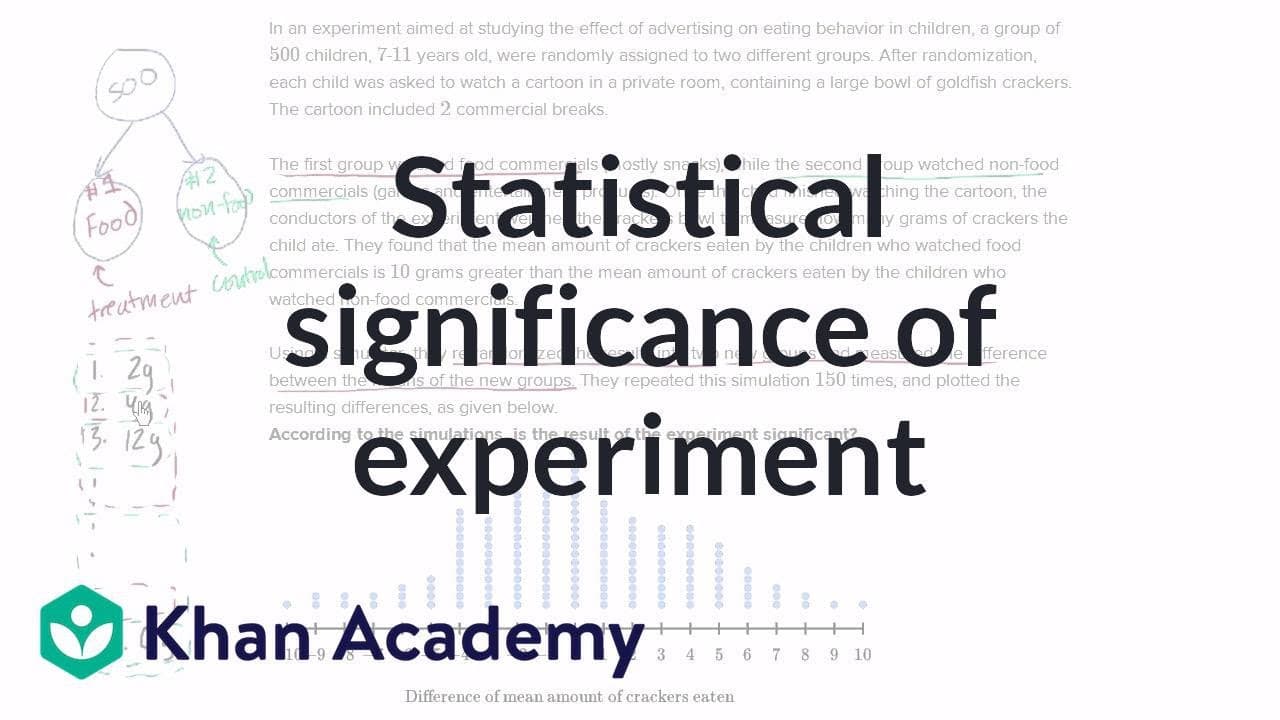
Voiceover:In an experiment aimed at studying the effect of advertising on eating behavior in children, a group of 500 children, seven to 11 years old were randomly assigned to two different groups. After randomization, each child was asked to watch a cartoon in a private room, containing a large bowl of goldfish crackers. The cartoon included two c... Read More
Key Insights
- 😋 The experiment found that children who watched food commercials ate more goldfish crackers on average than those who watched non-food commercials.
- ❓ To determine if this difference was significant, a simulation was conducted by re-randomizing the results and measuring the differences in means.
- 🤲 The probability of getting the observed results by chance was less than 1%, indicating the experiment's significance.
- ❓ Random assignment of participants is crucial for drawing valid conclusions in experiments.
- 😅 The experiment contributes to understanding the impact of advertising on children's eating behavior.
- 😋 The results highlight the potential influence of food commercials on children's consumption choices.
- 😅 Future studies could explore the long-term effects of advertising on children's eating behavior.
Install to Summarize YouTube Videos and Get Transcripts
Explore YouTube Video Summarizer or Get YouTube Transcript Extractor
Questions & Answers
Q: What was the purpose of the experiment?
The experiment aimed to study the effect of advertising on children's eating behavior by comparing the amount of goldfish crackers consumed by children who watched food commercials versus those who watched non-food commercials.
Q: How were the children assigned to different groups?
The children were randomly assigned to the two groups, ensuring that the distribution of participants with different characteristics was similar between the groups.
Q: Why did they re-randomize the results?
Re-randomizing the results allowed researchers to assess the probability of getting the observed difference in means by chance. It helped determine if the difference between the groups' cracker consumption was truly due to the type of commercials they watched.
Q: What did the simulation reveal about the probability of chance?
The simulation showed that the probability of getting a 10-gram difference in mean cracker consumption by randomly assigning children to the two groups was less than 1%. This suggests that the observed difference in the experiment was unlikely to be purely due to chance.
Summary & Key Takeaways
-
500 children aged seven to 11 were randomly assigned to two groups: one group watched food commercials and the other watched non-food commercials.
-
After watching a cartoon with commercial breaks, it was found that children who watched food commercials ate 10 grams more goldfish crackers on average.
-
To determine if this difference was due to chance, a simulation was conducted by re-randomizing the results and measuring the differences in means. The probability of getting the observed results by chance was less than 1%.
Read in Other Languages (beta)
Share This Summary 📚
Summarize YouTube Videos and Get Video Transcripts with 1-Click
Try YouTube Summary with ChatGPT & Claude or YouTube Transcript Generator
Explore More Summaries from Khan Academy 📚



Summarize YouTube Videos and Get Video Transcripts with 1-Click
Try YouTube Summary with ChatGPT & Claude or YouTube Transcript Generator