Human population dynamics| Human populations| AP Environmental Science| Khan Academy
TL;DR
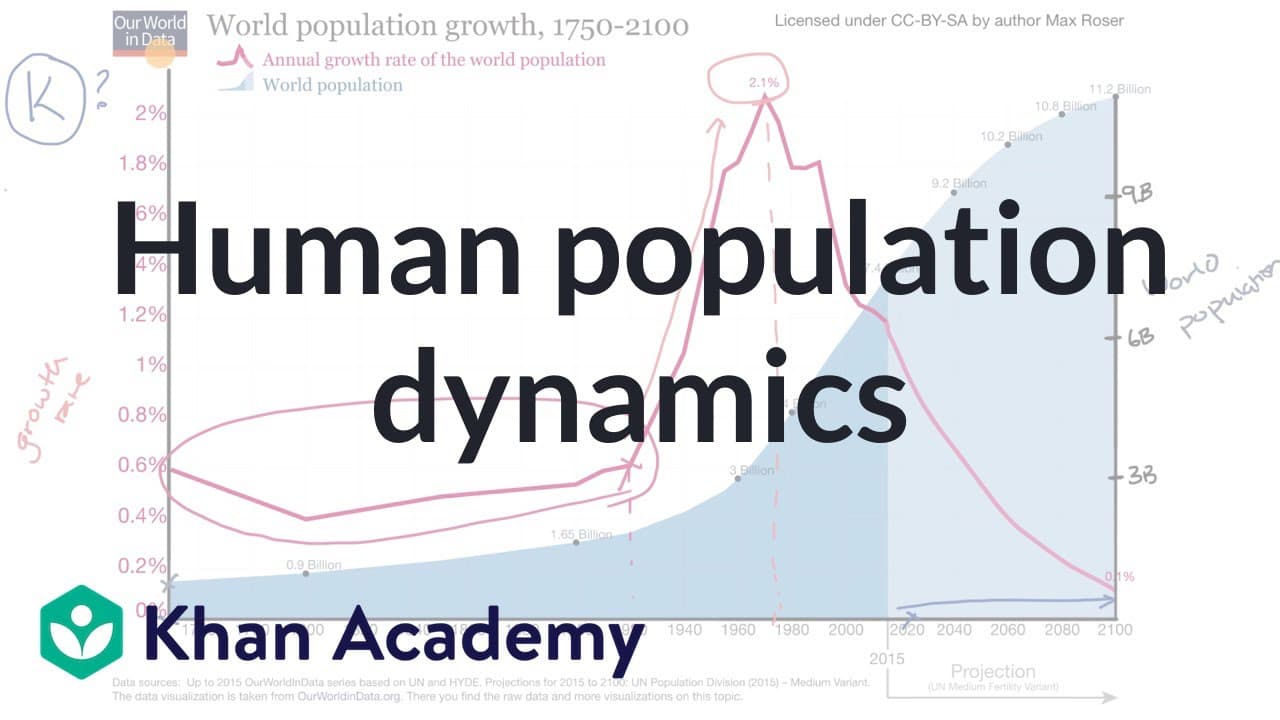
A visual representation shows the growth and projections of the world population, indicating a significant increase in the early 20th century and a declining growth rate after 1970.
Transcript
- [Instructor] What we have here is a really interesting visual that shows world population growth from 1750 all the way to 2100. And obviously this isn't 2100 yet. So it's doing some projecting for roughly the next 80 years. It also shows the absolute world population over that time period. So just to make sure we're understanding this graphic, ou... Read More
Key Insights
- ☠️ The world population growth rate increased significantly in the early 20th century, driven by improved healthcare and more efficient agriculture.
- ❓ Carrying capacity, the maximum sustainable population for humans, remains uncertain due to constantly evolving technology and resource utilization.
- ☠️ Economic development, women's empowerment, and better access to education and healthcare contribute to declining population growth rates.
- 💗 The world population has grown by a factor of 10 in the last 270 years and is projected to stabilize around 11 to 12 billion people.
- 👨🔬 Sustainable population growth and its environmental impact are subjects of ongoing debates and research.
- 😘 Industrial and post-industrial countries tend to have lower growth rates compared to developing nations.
- ☠️ The decline in population growth rates is correlated with increased wealth, healthcare, and women's rights.
Install to Summarize YouTube Videos and Get Transcripts
Explore YouTube Video Summarizer or Get YouTube Transcript Extractor
Questions & Answers
Q: What was the world population around 1750?
The estimated world population around 1750 was around seven or 800 million people. However, this is just an estimation due to the lack of a global census during that period.
Q: Why did the rate of growth increase in the early 20th century?
The main cause of the increased growth rate was the improvement in healthcare and more efficient agricultural practices. Reduced child mortality and increased food availability led to higher birth rates.
Q: What is carrying capacity, and how does it relate to human population growth?
Carrying capacity refers to the maximum number of individuals an ecosystem can sustain. While it has been theorized that there must be a limit to human population growth based on resources, technology advancements make determining the carrying capacity for humans an open question.
Q: Why has the growth rate of the world population declined after 1970?
The decline in growth rate can be attributed to factors such as economic development, better healthcare, women's empowerment, and increased access to education. These factors lead to lower fertility rates as individuals have fewer children.
Summary & Key Takeaways
-
The visual represents world population growth from 1750 to 2100, projecting an increase in population for the next 80 years.
-
The growth rate of the world population significantly increased in the early 20th century, attributed to improved healthcare and more efficient agriculture.
-
The growth rate started declining after 1970 due to factors such as increased education, better healthcare, family planning, and women's rights.
Read in Other Languages (beta)
Share This Summary 📚
Summarize YouTube Videos and Get Video Transcripts with 1-Click
Try YouTube Summary with ChatGPT & Claude or YouTube Transcript Generator
Explore More Summaries from Khan Academy 📚



Summarize YouTube Videos and Get Video Transcripts with 1-Click
Try YouTube Summary with ChatGPT & Claude or YouTube Transcript Generator