How Comparative Advantage Shapes Trade Decisions
TL;DR
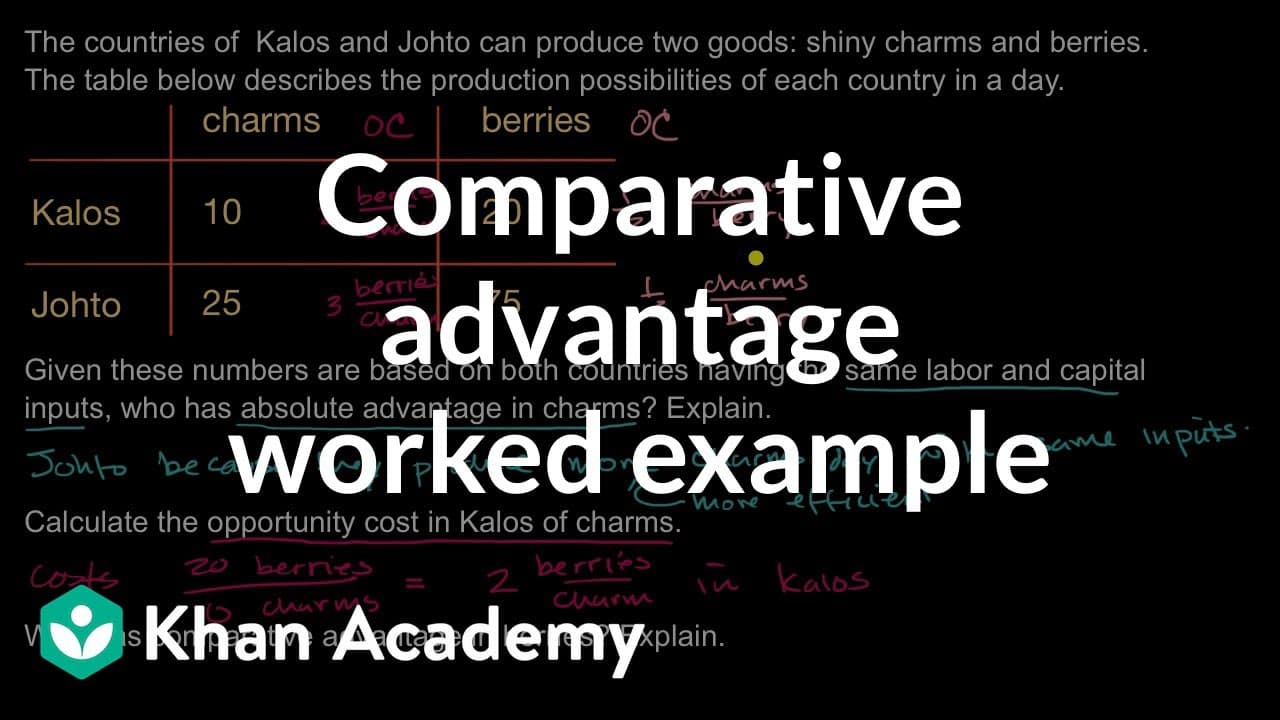
Johto holds the absolute advantage in producing charms due to higher output. However, Kalos has a comparative advantage in charms with a lower opportunity cost of two berries per charm, while Johto's cost is three berries. For optimal trade benefits, Kalos should focus on charms and Johto on berries.
Transcript
- [Instructor] The countries of Kalos and Johto can produce two goods. Shiny charms and berries. Yep, you got to love these worlds created in these economics questions. The table below describe the production possibilities of each country in a day. So here it tells us that Kalos, if it puts all of its energy behind charms, it can produce 10 charms ... Read More
Key Insights
- 👋 Absolute advantage is determined by which country can produce more units of a good with the same inputs.
- 🇨🇷 Comparative advantage considers the opportunity cost of producing goods and focuses on the country with the lowest opportunity cost.
- 😘 The country with the comparative advantage should specialize in producing the good with the lowest opportunity cost.
- ™️ Trade based on comparative advantage allows both countries to benefit and achieve gains from trade.
Install to Summarize YouTube Videos and Get Transcripts
Explore YouTube Video Summarizer or Get YouTube Transcript Extractor
Questions & Answers
Q: Who has the absolute advantage in charms?
Johto has the absolute advantage in charms because it can produce more charms per day compared to Kalos. Johto can produce 25 charms while Kalos can only produce 10.
Q: What is the opportunity cost of charms in Kalos?
The opportunity cost of charms in Kalos is 20 berries. This means that to produce 10 charms, Kalos must give up the production of 20 berries.
Q: Who has the comparative advantage in berries?
Johto has the comparative advantage in berries because it has a lower opportunity cost of producing berries compared to Kalos. Johto's opportunity cost is three berries per charm, while Kalos' opportunity cost is two berries per charm.
Q: If they specialize in trade, who would produce which good?
Kalos should specialize in producing charms, while Johto should specialize in producing berries. This is because Kalos has the comparative advantage in producing charms, and Johto has the comparative advantage in producing berries.
Summary & Key Takeaways
-
Johto can produce more charms per day than Kalos, giving it the absolute advantage in charms.
-
The opportunity cost of producing charms in Kalos is two berries per charm, while in Johto, it is three berries per charm.
-
Johto has the comparative advantage in producing berries based on a lower opportunity cost of one third charm per berry, compared to Kalos' one half charm per berry.
-
According to comparative advantage principles, Kalos should specialize in producing charms, while Johto should specialize in producing berries.
Read in Other Languages (beta)
Share This Summary 📚
Summarize YouTube Videos and Get Video Transcripts with 1-Click
Try YouTube Summary with ChatGPT & Claude or YouTube Transcript Generator
Explore More Summaries from Khan Academy 📚



Summarize YouTube Videos and Get Video Transcripts with 1-Click
Try YouTube Summary with ChatGPT & Claude or YouTube Transcript Generator