The water cycle | Ecology | Khan Academy
TL;DR
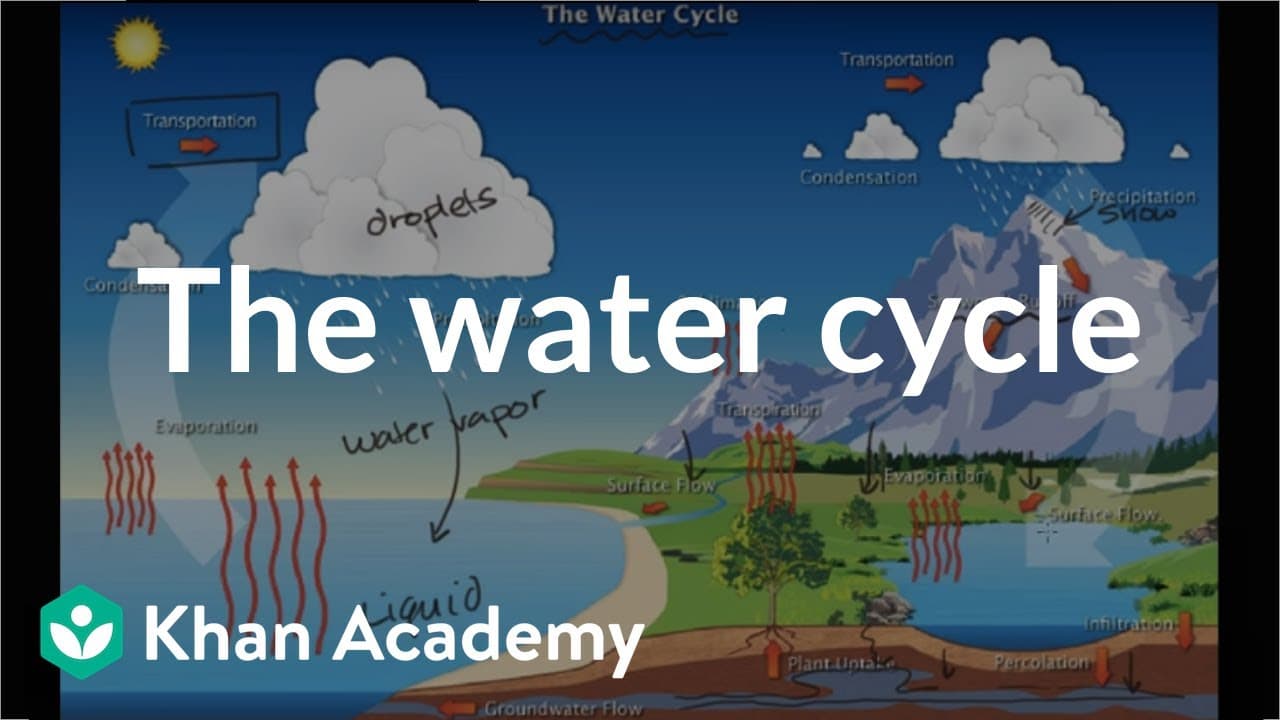
This video provides a detailed explanation of the water cycle, including evaporation, condensation, precipitation, and the role of water in biological processes.
Transcript
- [Voiceover] Let's talk a little bit about the water cycle, which we're all familiar with. In fact, we're all part of the water cycle, every moment of our lives. We might not fully appreciate it. So let's just jump in the cycle. I'll start with evaporation. So we could start with the surface of the ocean here, or this river, or this lake. And at a... Read More
Key Insights
- 💦 The water cycle involves processes like evaporation, condensation, and precipitation, which continuously circulate water on Earth.
- 😶🌫️ Clouds are formed when water vapor condenses around dust particles in the air.
- ❄️ Precipitation can be in the form of rain, snow, sleet, or hail, and it replenishes water sources like rivers, lakes, and groundwater.
- 🤽 Plants play a crucial role in the water cycle by absorbing water from the soil and releasing it through transpiration.
Install to Summarize YouTube Videos and Get Transcripts
Explore YouTube Video Summarizer or Get YouTube Transcript Extractor
Questions & Answers
Q: What causes water to evaporate and become water vapor?
Water evaporates when it gains enough energy to transition from a liquid to a gaseous state. This is typically due to heating from the sun or other heat sources.
Q: How are clouds formed from water droplets or ice crystals?
Clouds form when water vapor in the air condenses around tiny dust particles, creating droplets. In colder conditions, these droplets can also freeze and form ice crystals.
Q: How does precipitation occur?
Precipitation happens when water droplets or ice crystals in clouds become heavy enough to fall back to the Earth's surface. This can result in rain, snow, sleet, or hail, depending on temperature conditions.
Q: What is the role of plants in the water cycle?
Plants take up water from the soil through their roots and use it for various processes like nutrient transport and photosynthesis. They also release water vapor through transpiration, contributing to the water cycle.
Summary & Key Takeaways
-
The water cycle begins with evaporation, where water molecules in liquid state gain enough energy to become water vapor.
-
Water vapor then rises with the air, condenses into droplets or ice crystals to form clouds, and is transported by wind.
-
Precipitation occurs when droplets become heavy enough to fall as rain or snow, which can then percolate into the soil or flow into rivers and lakes.
Read in Other Languages (beta)
Share This Summary 📚
Summarize YouTube Videos and Get Video Transcripts with 1-Click
Try YouTube Summary with ChatGPT & Claude or YouTube Transcript Generator
Explore More Summaries from Khan Academy 📚



Summarize YouTube Videos and Get Video Transcripts with 1-Click
Try YouTube Summary with ChatGPT & Claude or YouTube Transcript Generator