What Is the Distance to the Nearest Star?
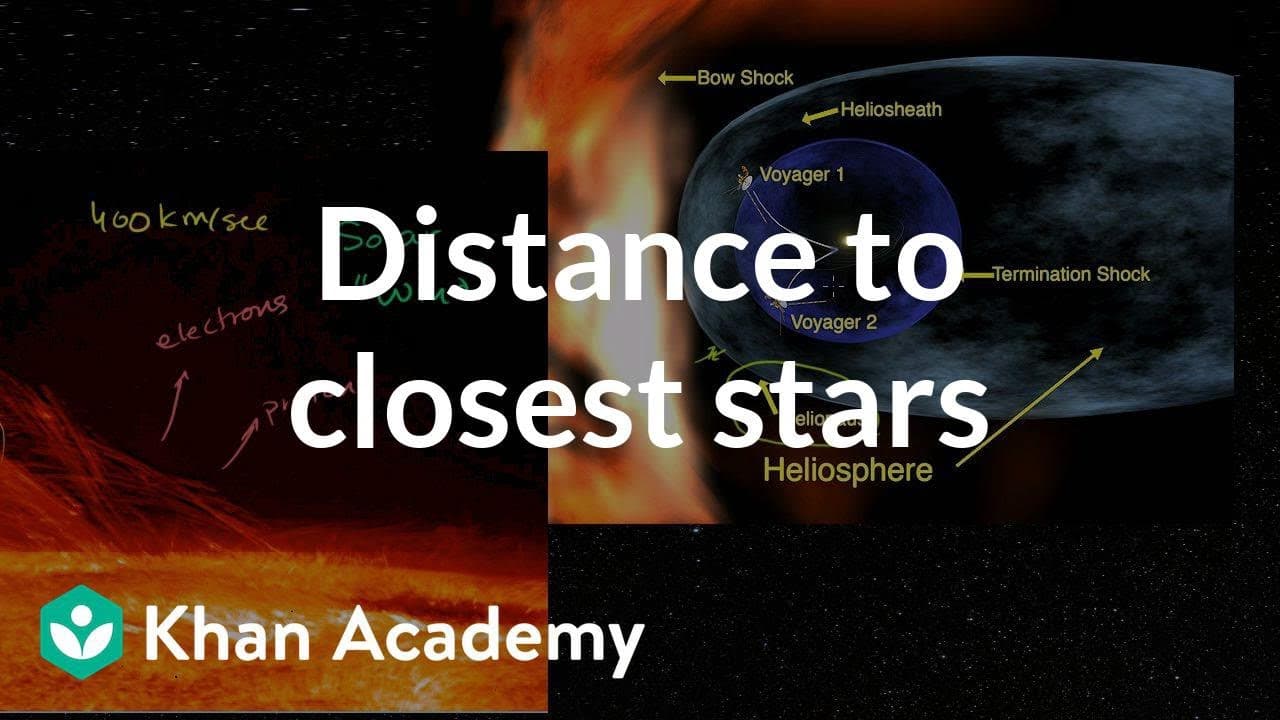
TL;DR
The nearest star system, Alpha Centauri, is 4.2 light years away from Earth, illustrating the vastness of space. Even at Voyager 1's speed, it would take approximately 80,000 years to reach it. The solar wind and the Oort Cloud define the boundaries of our solar system, adding to the enormity of interstellar distances.
Transcript
Before we start going off into things outside of our solar system, I want to take a few steps back because I found this neat picture of the Sun over here. And the reason why, at least in my mind, it's kind of mind blowing is because at this scale, the Sun is obviously still a huge object at this scale. The Earth would be roughly-- and this is an ap... Read More
Key Insights
- ❓ The Sun's size is astonishing, with the Earth being minuscule in comparison.
- 💨 The solar wind is made up of charged particles that extend to the edges of the solar system.
- ⛔ The Oort Cloud and the heliopause are additional markers of the solar system's limits.
- 🙂 Alpha Centauri, the nearest star system, is 4.2 light years away, emphasizing the vast distances involved in space travel.
- 👾 Voyager 1 and Voyager 2 have reached the heliopause, demonstrating the potential of space exploration.
- 🗺️ Traveling at the same velocity as Voyager 1, it would still take 80,000 years to reach Alpha Centauri.
Install to Summarize YouTube Videos and Get Transcripts
Explore YouTube Video Summarizer or Get YouTube Transcript Extractor
Questions & Answers
Q: What is the solar wind?
The solar wind is a stream of charged particles, such as electrons and protons, ejected from the Sun at high speeds. It extends to the edge of the solar system and is considered a defining feature of its boundaries.
Q: How do we know the extent of the solar system?
The boundaries of the solar system are defined by various factors. These include the extent of the solar wind, the presence of the Oort Cloud, and the heliopause. All of these elements contribute to our understanding of the limits of our solar system.
Q: What is the Oort Cloud?
The Oort Cloud is a theoretical region in the outermost reaches of the solar system. It is believed to contain a vast number of icy objects and comets. Although we haven't directly observed objects in the Oort Cloud, its existence is inferred from the behavior of comets.
Q: How far is the nearest star from our solar system?
The nearest star system, Alpha Centauri, is approximately 4.2 light years away. This means that if someone were to shine a light on one of its planets, it would take 4.2 years for that light to reach us. It's a massive distance in astronomical terms.
Summary & Key Takeaways
-
The Sun is mind-blowingly large, and Earth is a tiny speck compared to it.
-
The solar wind, made up of charged particles, extends to the edge of the solar system and defines its boundaries.
-
The Oort Cloud, a distant region of objects, and the heliopause, where the solar wind meets interstellar medium, further mark the limits of our solar system.
Read in Other Languages (beta)
Share This Summary 📚
Summarize YouTube Videos and Get Video Transcripts with 1-Click
Try YouTube Summary with ChatGPT & Claude or YouTube Transcript Generator
Explore More Summaries from Khan Academy 📚



Summarize YouTube Videos and Get Video Transcripts with 1-Click
Try YouTube Summary with ChatGPT & Claude or YouTube Transcript Generator