Bailout 6: Getting an equity infusion
TL;DR
The video discusses the balance sheet of a bank, including its assets, liabilities, and equity, as well as the options for paying off loans and raising capital.
Transcript
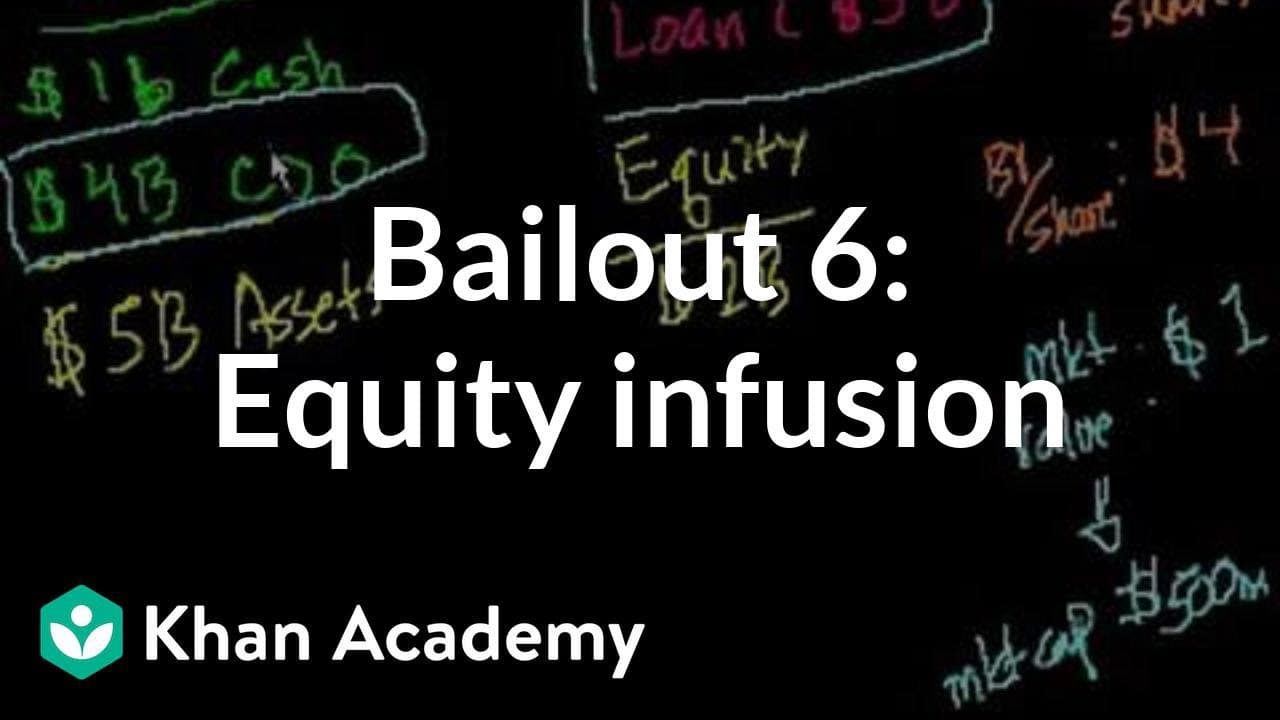
Welcome back. And I've made this balance sheet so messy I think it would make sense to redraw it cleaned up a little bit. So what's our new balance sheet, after we've unloaded a lot of those assets? All I have now, I have a little bit of cash, let me write that down, I had $1 billion of cash. I'll write the 'b' there so you know. And just so you kn... Read More
Key Insights
- 🏦 A bank's balance sheet consists of assets, liabilities, and equity.
- 🏦 The market value of a bank's equity may differ from its book value.
- 😘 If a bank cannot renew loans, it may need to sell assets, potentially at a lower market price.
Install to Summarize YouTube Videos and Get Transcripts
Explore YouTube Video Summarizer or Get YouTube Transcript Extractor
Questions & Answers
Q: Why does a bank need cash to operate?
A bank needs cash to conduct day-to-day transactions, pay rent, and fulfill customer needs. It cannot use all its cash to pay off debts.
Q: Why did the market value of the bank's equity differ from its book value?
The market value is based on the perceived worth of the bank's assets, and the market may have a lower valuation due to concerns about the toxic CDOs.
Q: What happens if the bank cannot renew its loans or get new loans?
The bank must sell its assets, specifically the CDOs, at the market price. However, if the market price is too low, it may not be enough to pay off the loans.
Q: What are the options for the bank to address its loan payment situation?
The bank can try to obtain a loan from the Fed by using the toxic assets as collateral. Alternatively, it can seek investment from external sources to raise cash.
Summary & Key Takeaways
-
The balance sheet of the bank includes $1 billion in cash and $4 billion worth of toxic residential CDOs.
-
The bank has $3 billion in liabilities in the form of loans.
-
The book value per share is $4, but the market value is only $1, indicating market skepticism about the bank's assets.
Read in Other Languages (beta)
Share This Summary 📚
Summarize YouTube Videos and Get Video Transcripts with 1-Click
Try YouTube Summary with ChatGPT & Claude or YouTube Transcript Generator
Explore More Summaries from Khan Academy 📚



Summarize YouTube Videos and Get Video Transcripts with 1-Click
Try YouTube Summary with ChatGPT & Claude or YouTube Transcript Generator