The Doomsday Clock, explained
TL;DR
The Doomsday Clock symbolizes humanity's proximity to global catastrophe.
Transcript
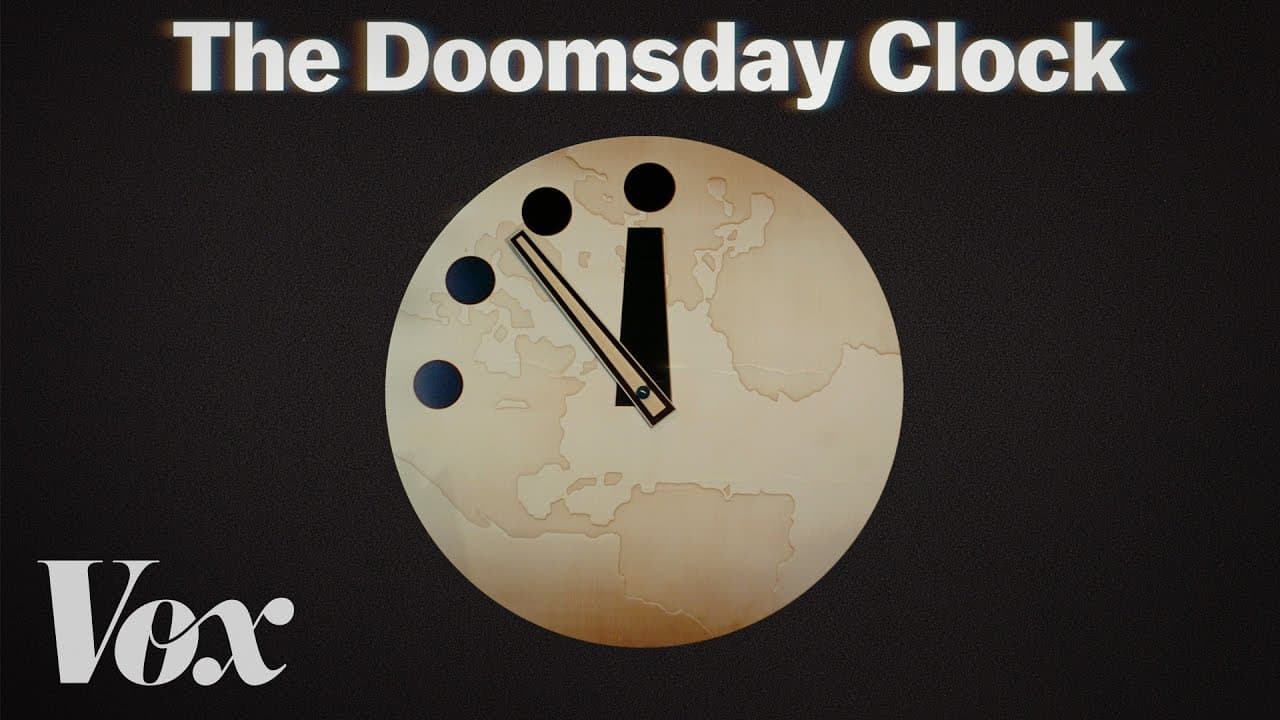
This is the Doomsday clock. It was designed back in 1947 by artist Martyl Langsdorf. And the Bulletin of the Atomic Scientists sets the clock to show how much time we have left until midnight. Midnight in this case meaning nuclear armageddon and the end of humanity. In January 2017, the Bulletin of the Atomic Scientists revealed that the clock tick... Read More
Key Insights
- The Doomsday Clock was created in 1947 by artist Martyl Langsdorf, symbolizing the threat of nuclear annihilation.
- Originally set at seven minutes to midnight, the clock's time is adjusted based on global threats and political tensions.
- The Bulletin of the Atomic Scientists manages the clock, considering factors like climate change, cyber threats, and political rhetoric.
- In 2017, the clock moved closer to midnight due to concerns about climate change, cyber security, and political discourse.
- The clock is not a precise measure of time but a symbolic representation of existential threats facing humanity.
- Throughout history, events such as nuclear tests, arms treaties, and geopolitical tensions have influenced the clock's setting.
- The clock's adjustments reflect both nuclear and non-nuclear threats, expanding its scope over time.
- Despite its ominous symbolism, the clock serves as a reminder that humanity can take action to avert disaster.
Install to Summarize YouTube Videos and Get Transcripts
Explore YouTube Video Summarizer or Get YouTube Transcript Extractor
Questions & Answers
Q: What was the original purpose of the Doomsday Clock?
The Doomsday Clock was originally created in 1947 to symbolize the threat of nuclear annihilation, serving as a visual representation of how close humanity was to global catastrophe. It aimed to raise public awareness and encourage action to prevent nuclear war, reflecting the concerns of scientists involved in the Manhattan Project.
Q: How is the time on the Doomsday Clock determined?
The time on the Doomsday Clock is determined by the Bulletin of the Atomic Scientists, who assess global threats such as nuclear weapons, climate change, cyber security, and political rhetoric. The clock's time is not a precise measure but a symbolic representation, adjusted based on perceived increases or decreases in threat levels.
Q: What factors influenced the clock's adjustment in 2017?
In 2017, the Doomsday Clock was adjusted closer to midnight due to concerns about climate change, cyber security, and the political rhetoric surrounding the U.S. presidential election. For the first time, a disregard for scientific expertise by global leaders, including the American president, was cited as a contributing factor.
Q: How has the scope of the Doomsday Clock expanded over time?
Initially focused solely on nuclear threats, the scope of the Doomsday Clock has expanded to include non-nuclear factors such as climate change, bio weapons, cyber threats, and political rhetoric. This reflects the evolving nature of global threats and the Bulletin of the Atomic Scientists' broader interpretation of existential risks to humanity.
Q: What historical events have influenced the clock's time?
The Doomsday Clock's time has been influenced by various historical events, including nuclear tests by the Soviet Union, the development of the hydrogen bomb, the end of atmospheric nuclear testing, the signing of arms treaties, and geopolitical tensions during the Cold War. These events have caused the clock's time to fluctuate over the years.
Q: Why is the Doomsday Clock considered a symbolic representation?
The Doomsday Clock is considered a symbolic representation because it does not measure actual time but rather serves as a metaphor for humanity's proximity to global catastrophe. It is adjusted based on perceived threat levels, aiming to raise awareness and encourage action to address existential risks facing the world.
Q: What role does scientific expertise play in setting the clock?
Scientific expertise plays a crucial role in setting the Doomsday Clock, as the Bulletin of the Atomic Scientists relies on the input of scientists and experts to assess global threats. In 2017, a disregard for scientific expertise was cited as a doomsday factor, highlighting the importance of informed decision-making in addressing existential risks.
Q: How can humanity respond to the threats represented by the clock?
Humanity can respond to the threats represented by the Doomsday Clock through collective action, international cooperation, and informed decision-making. By addressing issues such as nuclear disarmament, climate change mitigation, and cyber security, humanity can work to reverse the clock's time, emphasizing the potential for positive change and the prevention of global catastrophe.
Summary & Key Takeaways
-
The Doomsday Clock, created in 1947, symbolizes the threat of global catastrophe, initially focusing on nuclear danger but now including climate change and cyber threats. Its time is adjusted by the Bulletin of the Atomic Scientists based on perceived threat levels, serving as a metaphorical warning rather than a literal countdown.
-
In 2017, the clock moved closer to midnight due to concerns over climate change, cyber security, and political rhetoric, marking the first time a disregard for scientific expertise was cited as a doomsday factor. The clock's time is not linear but reflects fluctuating global threats.
-
The clock's history shows fluctuations influenced by nuclear tests, arms treaties, and geopolitical tensions. Despite its grim symbolism, the clock emphasizes that humanity can reverse course through action and cooperation, highlighting the importance of vigilance and scientific understanding in addressing existential threats.
Read in Other Languages (beta)
Share This Summary 📚
Summarize YouTube Videos and Get Video Transcripts with 1-Click
Try YouTube Summary with ChatGPT & Claude or YouTube Transcript Generator
Explore More Summaries from Vox 📚

Summarize YouTube Videos and Get Video Transcripts with 1-Click
Try YouTube Summary with ChatGPT & Claude or YouTube Transcript Generator