Multiplying and dividing by powers of 10
TL;DR
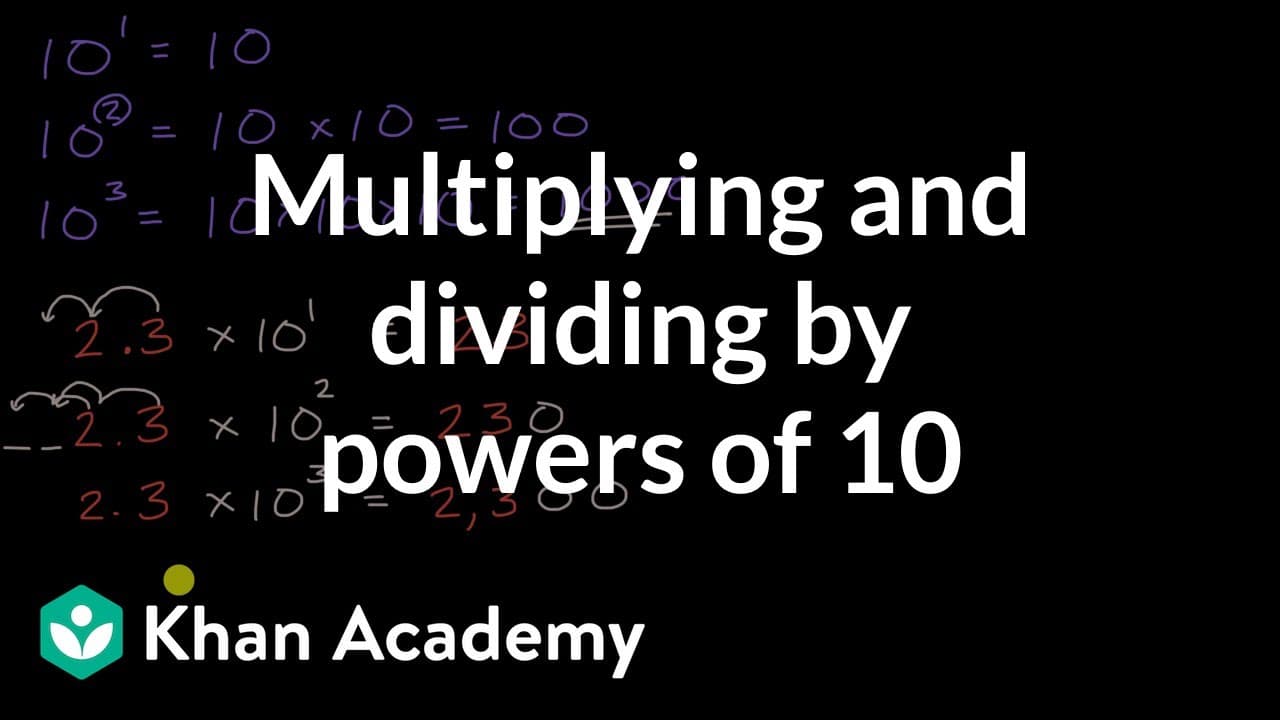
This video explains how to multiply and divide numbers by powers of 10, by shifting digits to the left or right based on the exponent.
Transcript
- [Instructor] In another video, we introduce ourselves to the idea of powers of 10. We saw that if I were to say 10 to the first power, that means that we are just really going to take one 10. If we have 10 to the second power, that means that we're gonna take two 10s, so a 10 and a 10, and we're gonna multiply them and so that's going to be 100. ... Read More
Key Insights
- ↔️ Powers of 10 involve multiplying or dividing numbers by shifting digits to the left or right based on the exponent.
- 🗨️ The pattern of shifting digits to the left applies when multiplying by powers of 10, resulting in larger numbers.
- 🥺 When dividing by powers of 10, the pattern of shifting digits to the right leads to smaller decimal numbers.
- ✊ The exponent in the power of 10 determines the number of places the digits are shifted.
- ✊ Multiplying by 10 to the first power means shifting one place, second power means shifting two places, and so on.
- 🗯️ Dividing by 10 to the first power means shifting one place to the right, second power means shifting two places to the right, and so on.
- ⚾ The shifting of digits based on the exponent is consistent for both multiplication and division.
Install to Summarize YouTube Videos and Get Transcripts
Explore YouTube Video Summarizer or Get YouTube Transcript Extractor
Questions & Answers
Q: How does multiplying by 10 to the first power affect the digits of a number?
Multiplying by 10 to the first power shifts all the digits one place to the left. For example, 2.3 multiplied by 10 becomes 23.
Q: What happens when a number is multiplied by 10 to the second power?
Multiplying by 10 to the second power shifts all the digits two places to the left. For 2.3, it becomes 230 (2 hundreds and 3 tens).
Q: How does multiplying by 10 to the third power affect the digits of a number?
Multiplying by 10 to the third power shifts all the digits three places to the left. For 2.3, it becomes 2300 (2 thousands, 3 hundreds, and 0 tens).
Q: How does dividing by 10 to the first power affect the digits of a number?
Dividing by 10 to the first power shifts all the digits one place to the right. For example, dividing 2.3 by 10 gives 0.23 (2 tenths and 3 hundredths).
Summary & Key Takeaways
-
The video introduces the concept of powers of 10 and explains how multiplying by 10 to the first, second, or third power shifts the digits to the left and creates larger numbers.
-
Division by powers of 10 is also discussed, where shifting the digits to the right based on the exponent results in smaller decimal numbers.
-
The pattern of shifting digits based on the exponent is highlighted, emphasizing that it applies to both multiplication and division.
Read in Other Languages (beta)
Share This Summary 📚
Summarize YouTube Videos and Get Video Transcripts with 1-Click
Try YouTube Summary with ChatGPT & Claude or YouTube Transcript Generator
Explore More Summaries from Khan Academy 📚






Summarize YouTube Videos and Get Video Transcripts with 1-Click
Try YouTube Summary with ChatGPT & Claude or YouTube Transcript Generator