Automatic stabilizers | National income and price determination | AP Macroeconomics | Khan Academy
TL;DR
Automatic stabilizers are economic tools, such as taxes and welfare payments, that help smooth out fluctuations in the business cycle without the need for specific government intervention.
Transcript
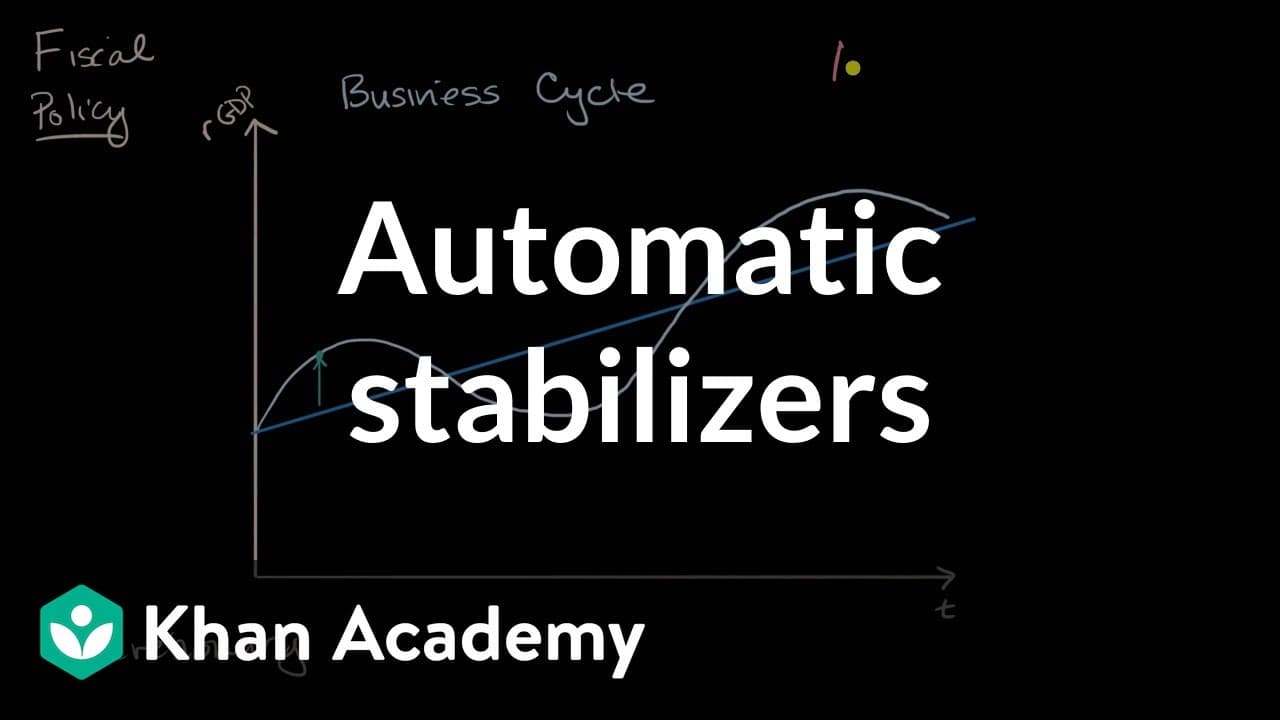
- [Instructor] So what we have depicted in this diagram is the business cycle that we have looked at in other videos. This horizontal axis is time. The vertical axis is real GDP. What we see in this dark blue color, you can view that as full employment output at different points in time, and you can see that it is growing. So this economy is experi... Read More
Key Insights
- 👨💼 The business cycle consists of periods of economic growth and recession, and real economies tend to fluctuate around their full employment output.
- 😚 Governments can use fiscal policy, such as changes in taxes and government spending, to close output gaps and stabilize the business cycle.
- 😑 Automatic stabilizers, such as taxes and welfare payments, are pre-existing tools that naturally adjust based on the state of the economy, helping to smooth out fluctuations.
- 😮 During economic expansions, taxes tend to increase as incomes and profits rise, while welfare payments decrease as fewer people require assistance.
- 👯 During recessions, taxes decrease as incomes and profits decline, while welfare payments increase as more people require assistance.
- 🧑🏭 Automatic stabilizers act as built-in mechanisms that can dampen economic oscillations and reduce the need for discretionary fiscal policy.
- 🚕 Unlike discretionary fiscal policy, automatic stabilizers do not require specific government intervention and are already embedded in tax policies and welfare systems.
Install to Summarize YouTube Videos and Get Transcripts
Explore YouTube Video Summarizer or Get YouTube Transcript Extractor
Questions & Answers
Q: What are automatic stabilizers in economics?
Automatic stabilizers are economic tools, such as taxes and welfare payments, that help stabilize the business cycle by automatically adjusting based on the state of the economy. They do not require specific government intervention.
Q: How do taxes act as automatic stabilizers?
Taxes can help smooth out fluctuations in the economy by adjusting based on the output gap. During periods of economic expansion, taxes tend to increase as incomes and corporate profits rise. Conversely, during a recession, taxes decrease as incomes and profits decline.
Q: What role do welfare payments play as automatic stabilizers?
Welfare payments, including unemployment benefits, act as automatic stabilizers because they increase during recessions when more people require assistance. During economic expansions, fewer people need welfare, leading to a decrease in government spending.
Q: How do automatic stabilizers differ from discretionary fiscal policy?
Automatic stabilizers are pre-existing mechanisms in the economy that respond automatically to changes in the business cycle. Discretionary fiscal policy, on the other hand, involves deliberate government actions to actively address output gaps in the economy.
Summary & Key Takeaways
-
The business cycle shows how real GDP fluctuates over time, with periods of economic growth and recession.
-
Governments use fiscal policy, such as changes in taxes and government spending, to close output gaps during different phases of the business cycle.
-
Automatic stabilizers, like taxes and welfare payments, act as built-in mechanisms that automatically adjust in response to changes in the economy, helping to stabilize the business cycle.
Read in Other Languages (beta)
Share This Summary 📚
Summarize YouTube Videos and Get Video Transcripts with 1-Click
Try YouTube Summary with ChatGPT & Claude or YouTube Transcript Generator
Explore More Summaries from Khan Academy 📚



Summarize YouTube Videos and Get Video Transcripts with 1-Click
Try YouTube Summary with ChatGPT & Claude or YouTube Transcript Generator