S I Engine Emission - Engine Testing and Performance Engine - Internal Combustion Engines
TL;DR
Discusses exhaust and non-exhaust emissions from SI and CI engines, with a focus on hydrocarbons, CO, NOx, SOx, PM, and smoke.
Transcript
dear friend in this video we are going to discuss about the different emissions from the esi engine in the last video as we have already discussed about the indian emission and its harmful effect on the environment as well as on the human body so in this video we are going to discuss about the different emissions from the esi engine so si and ci en... Read More
Key Insights
- 🚒 SI and CI engines produce exhaust and non-exhaust emissions.
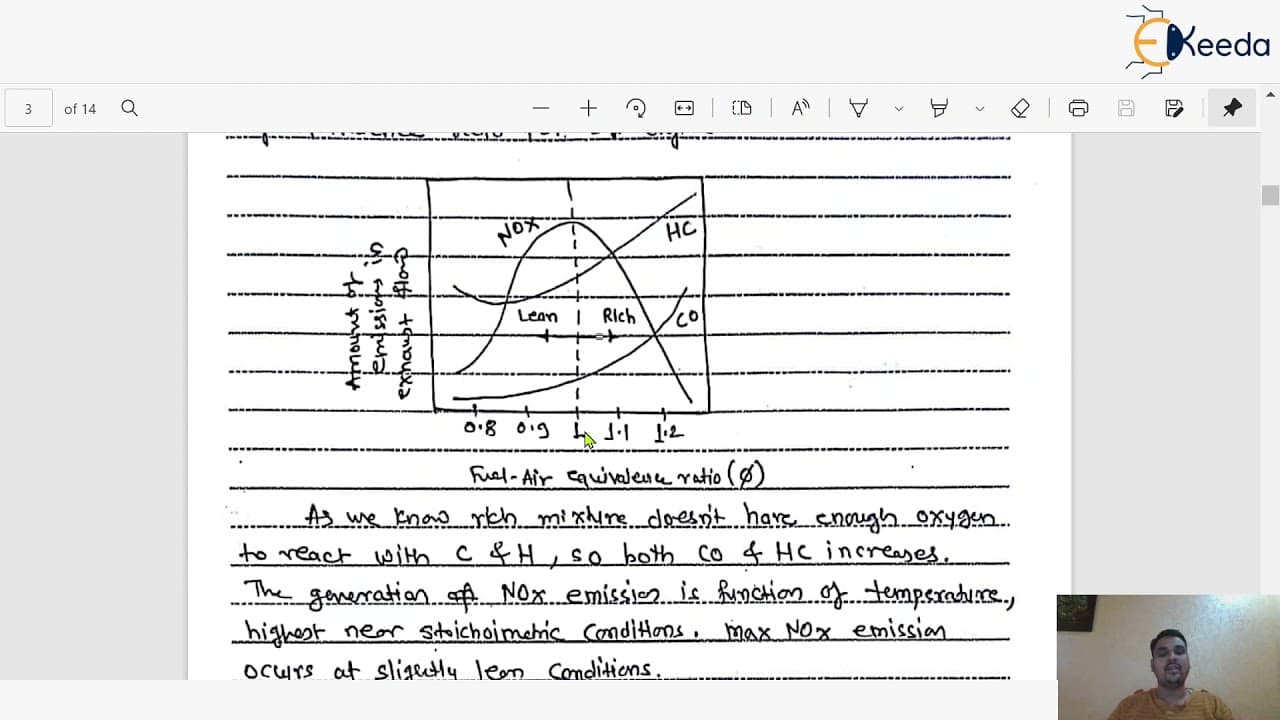
- ♿ SI engine emissions increase with richer air-fuel mixtures.
- 🤨 CI engine emissions peak at stoichiometric conditions.
- 🚒 NOx emissions from SI engines are temperature-dependent.
- 🐿️ HC, CO, NOx, SOx, PM, and smoke are common engine emissions.
- 🥳 Understanding air-fuel ratio is crucial in managing emissions.
- 🎚️ Mixture richness influences pollutant levels in combustion.
Install to Summarize YouTube Videos and Get Transcripts
Explore YouTube Video Summarizer or Get YouTube Transcript Extractor
Questions & Answers
Q: What are the two main categories of emissions from SI and CI engines?
The emissions from SI and CI engines are classified as exhaust and non-exhaust emissions, encompassing various pollutants like HC, CO, NOx, SOx, PM, and smoke.
Q: How do emissions from SI engines change with the air-fuel ratio?
Emissions from SI engines such as HC, CO, and NOx vary with the air-fuel ratio, increasing with richer mixtures due to inadequate oxygen for complete combustion.
Q: What is the significance of the stoichiometric equivalence ratio in CI engine emissions?
CI engine emissions peak at stoichiometric conditions, with NOx emissions highest slightly lean, showcasing the importance of mixture richness in controlling pollutant levels.
Q: How does temperature affect NOx emissions from SI engines?
NOx emissions from SI engines are a function of temperature, peaking near stoichiometric conditions and reducing with richer mixtures due to decreased temperatures.
Summary & Key Takeaways
-
Emissions from SI and CI engines classified into exhaust and non-exhaust categories.
-
SI engine emissions include HC, CO, NOx, SOx, PM, and smoke, varying with air-fuel ratio.
-
CI engine emissions peak at stoichiometric conditions, decreasing with richer mixtures.
Read in Other Languages (beta)
Share This Summary 📚
Summarize YouTube Videos and Get Video Transcripts with 1-Click
Try YouTube Summary with ChatGPT & Claude or YouTube Transcript Generator
Explore More Summaries from Ekeeda 📚






Summarize YouTube Videos and Get Video Transcripts with 1-Click
Try YouTube Summary with ChatGPT & Claude or YouTube Transcript Generator