How to Use Chi-Square for Hypothesis Testing
TL;DR
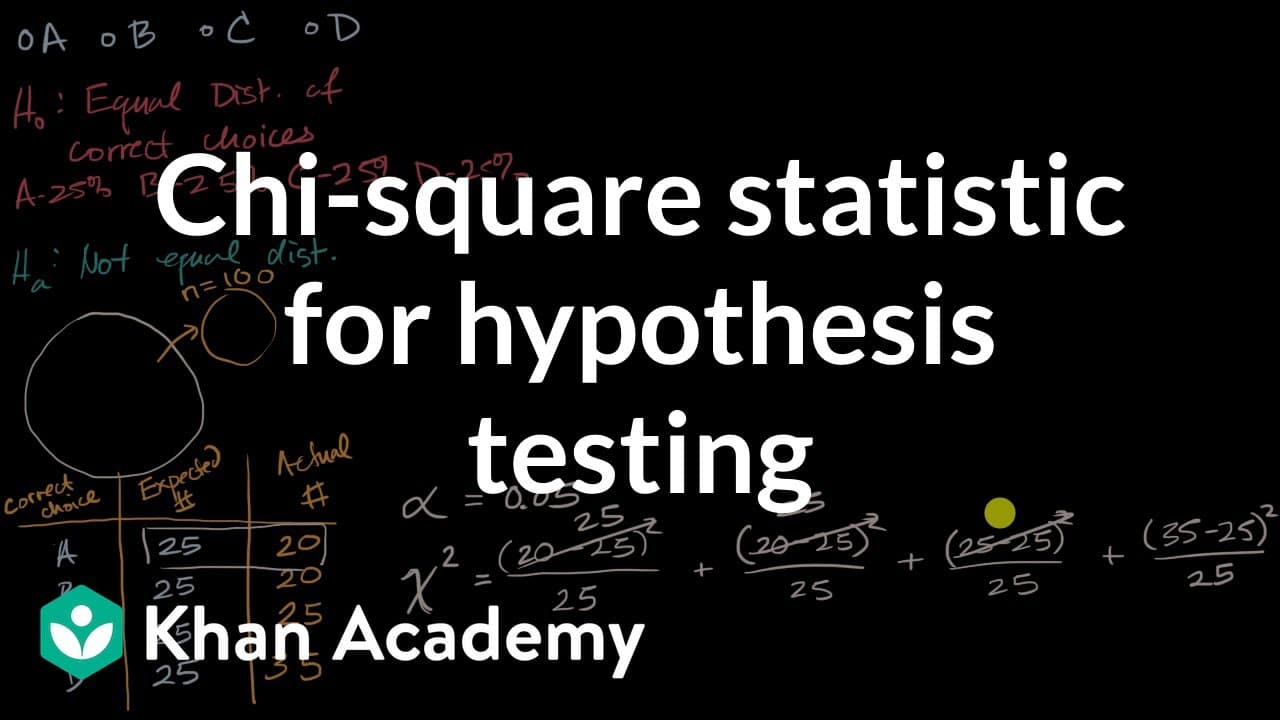
The chi-squared statistic is a critical tool for testing hypotheses about expected distributions in data. This video explains how to apply it by comparing observed outcomes of a standardized exam with the expected equal distribution of correct answers. By analyzing the results, we can determine if there's a significant deviation from what was anticipated.
Transcript
- [Instructor] Let's say there's some type of standardized exam where every question on the test has four choices, choice A, choice B, choice C, and choice D. And the test makers assure folks that, over many years, there's an equal probability that the correct answer for any one of the items is A, B, C, or D. It essentially is a 25% chance of any o... Read More
Key Insights
- 👻 Hypothesis testing allows us to evaluate whether observed data significantly deviates from the expected distribution.
- 🤏 The chi-squared statistic measures the difference between observed and expected values, while the chi-squared distribution helps calculate the probability of obtaining extreme results by chance.
- 🤏 Degrees of freedom in the chi-squared distribution are determined by the number of categories minus one.
- 🤏 The p-value obtained from the chi-squared distribution helps make decisions on accepting or rejecting the null hypothesis.
Install to Summarize YouTube Videos and Get Transcripts
Explore YouTube Video Summarizer or Get YouTube Transcript Extractor
Questions & Answers
Q: What is the purpose of conducting a hypothesis test in this scenario?
The purpose of the hypothesis test is to determine whether the observed distribution of correct answers on the standardized exam is significantly different from the expected equal distribution. It helps to test whether the exam is biased towards a particular choice.
Q: How is the chi-squared statistic calculated in this context?
The chi-squared statistic is calculated by taking the squared difference between the observed and expected values for each choice, dividing it by the expected value, and summing those values across all choices. It provides a measure of how much the observed distribution deviates from the expected distribution.
Q: What role does the chi-squared distribution play in hypothesis testing?
The chi-squared distribution is used to determine the probability of obtaining a chi-squared statistic as extreme or more extreme than the observed one, assuming the null hypothesis is true. This probability, known as the p-value, helps to evaluate whether the observed deviation from the expected distribution is statistically significant.
Q: How does the degrees of freedom relate to the chi-squared distribution in this analysis?
The degrees of freedom for the chi-squared distribution in this analysis are calculated as the number of categories minus one. In this case, with four choices, the degrees of freedom are three. The appropriate chi-squared distribution curve is selected based on the degrees of freedom to determine the p-value.
Summary & Key Takeaways
-
The video discusses the process of hypothesis testing and introduces the null and alternative hypotheses in the context of examining the distribution of correct answers on a standardized exam.
-
By taking a sample of exam items, the video demonstrates how to compare the expected distribution of correct choices with the actual distribution.
-
The chi-squared statistic is introduced as a measure to quantify the difference between the expected and actual distributions, and the chi-squared distribution is used to determine the probability of obtaining a result as extreme or more extreme as observed.
Read in Other Languages (beta)
Share This Summary 📚
Summarize YouTube Videos and Get Video Transcripts with 1-Click
Try YouTube Summary with ChatGPT & Claude or YouTube Transcript Generator
Explore More Summaries from Khan Academy 📚



Summarize YouTube Videos and Get Video Transcripts with 1-Click
Try YouTube Summary with ChatGPT & Claude or YouTube Transcript Generator