Scarcity | Basic economics concepts | Economics | Khan Academy
TL;DR
Scarcity is the foundation of economics, as it refers to the limited availability of goods, services, and resources that leads to the need for allocation.
Transcript
- [Instructor] The entire field of economics is based on the idea of scarcity. And, arguably, we wouldn't even need a field of economics, if there wasn't the notion of scarcity in the world. So what does scarcity mean? Well, think about what does it mean in everyday life? It means that there's not enough of something to go around. If we're talking ... Read More
Key Insights
- 🪡 Economics is centered around the concept of scarcity and the need to allocate limited resources.
- 🧑💼 Scarce resources require individuals and societies to make trade-offs and choices about their distribution.
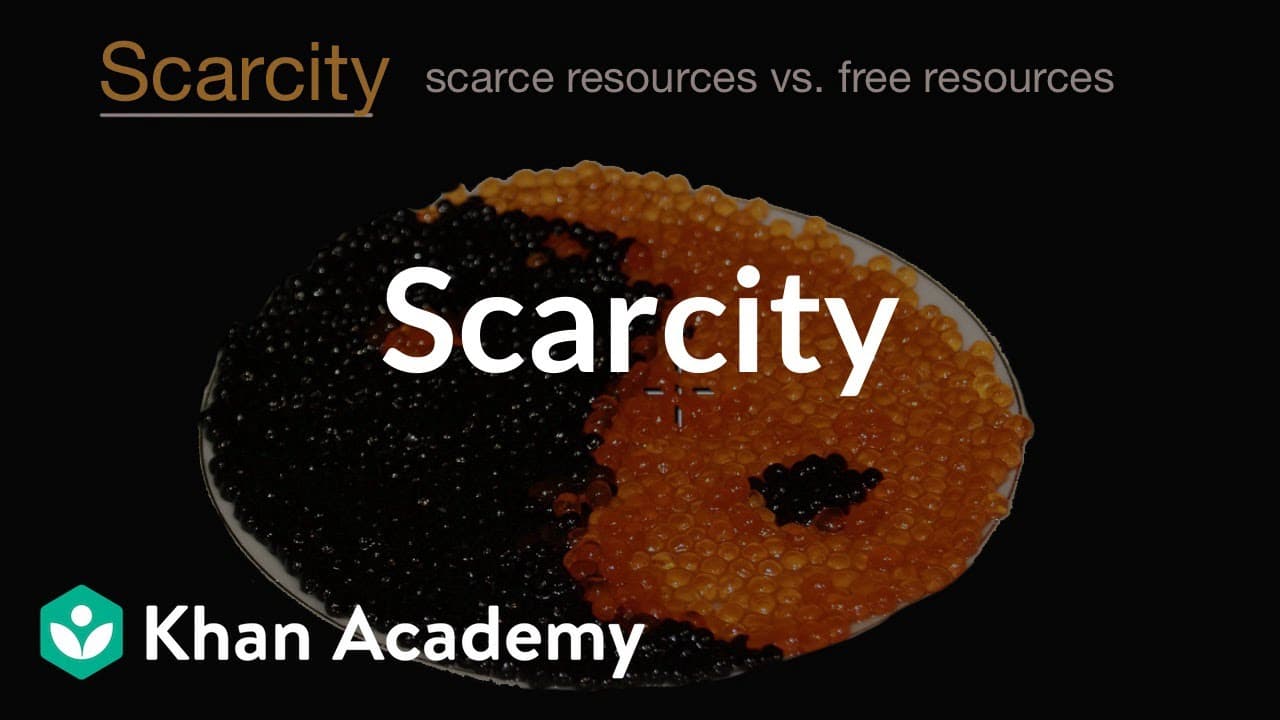
- 👾 Certain resources, such as caviar or desirable living spaces, are inherently scarce due to their limited availability.
- 💦 Labor is also considered a scarce resource as individuals expect some form of compensation for their work.
- 🥶 Resources like water and oxygen can be considered free resources in certain contexts but may become scarce based on demand, accessibility, and external factors.
- 🇨🇫 The allocation of scarce resources is a central concern in economics, and various models and methods are used to analyze and understand resource allocation.
- ❓ Economics explores the implications of different allocation methods on individuals, societies, and economies.
Install to Summarize YouTube Videos and Get Transcripts
Explore YouTube Video Summarizer or Get YouTube Transcript Extractor
Questions & Answers
Q: What is the definition of scarcity in economics?
Scarcity in economics refers to the limited availability of goods, services, and resources, where demand exceeds supply, necessitating choices and trade-offs.
Q: Why is scarcity important to the field of economics?
Scarcity is the foundation of economics, as it requires the study of how to allocate limited resources efficiently to satisfy unlimited wants and needs.
Q: How do scarce resources impact the allocation process?
Scarce resources require individuals and societies to make choices and trade-offs to obtain them, as there is not enough to satisfy everyone's desires fully.
Q: Can resources that are scarce in some contexts be abundant in others?
Yes, the abundance or scarcity of resources can vary depending on the context, demand, and availability. For example, oxygen may be abundant on Earth but can become scarce in certain confined environments.
Q: What factors contribute to the scarcity of a resource?
Factors such as limited availability, high demand, difficulty of production, natural limitations, and exclusivity can contribute to the scarcity of a resource.
Summary & Key Takeaways
-
Economics is based on scarcity, where there is not enough of something to go around, leading to the need to allocate resources.
-
Scarcity is essential to economics as it necessitates the study of how to allocate limited resources based on demand and trade-offs.
-
Examples of scarce resources include caviar, labor, desirable living spaces, and potentially even oxygen in certain contexts.
Read in Other Languages (beta)
Share This Summary 📚
Summarize YouTube Videos and Get Video Transcripts with 1-Click
Try YouTube Summary with ChatGPT & Claude or YouTube Transcript Generator
Explore More Summaries from Khan Academy 📚



Summarize YouTube Videos and Get Video Transcripts with 1-Click
Try YouTube Summary with ChatGPT & Claude or YouTube Transcript Generator